Author Anosh Irani. Photo Steve Carty.
Anosh Irani wrote his first story in 1998 on a flight from Mumbai to Hong Kong, en route to Vancouver. He had just left his friends, family, home and advertising job to become a writer in Canada. It was as good a time as any to see if he could actually write.
Fast forward eight years. Irani, now 32, has had two plays (The Matka King and Bombay Black) successfully produced, won acclaim for his first book The Cripple and His Talismans (2004) and has just released his second novel The Song of Kahunsha. From his home in North Vancouver, he conjures up a Bombay (he prefers this to the city’s new name of Mumbai) that is as menacing as it is magical: an amputee goes in search of his missing arm, a mother forces her daughter to dance for strange men for money, a woman sells rainbows, a small-time gangster shakes down local beggars for their hard-won coins, and bougainvillea stubbornly blooms in forgotten courtyards. A mordant strain of humour runs throughout his work, which might be best described as a combination of Charles Bukowski, Morris Panych, Rohinton Mistry and Morrissey (four writers Irani admires), with a little Charles Dickens and Samuel Beckett thrown in for good measure.
The Song of Kahunsha is an Oliver Twist-like tale of a 10-year-old boy named Chamdi who flees the shelter of his orphanage to search for his father. Imagining Bombay to be a paradise he calls “Kahunsha” (a city of no sadness), Chamdi instead finds himself hungry and filthy and caught in the middle of the violent, religious riots that rocked the city in 1992 and 1993.
While in Toronto for a reading recently, Irani talked about the city that serves as his muse.
A: If I still lived in Bombay, I think that I’d feel obligated to write more factually. So the distance, both in terms of time and geography, has helped me in two ways. It’s given me a clearer perspective on Bombay and, secondly, being away has given me room to invent. There’s more room for the imagination. That’s what I love about writing novels. You start out with something that’s real and put something that’s imagined right next to it.
A: I think so. There’s a lot of darkness in Bombay, but people have learned to ignore even the most difficult things, or they just accept them as part of the city. But, still, they want fantasy and escapism. So, in the book, Chamdi has to produce real tears on demand and a really sad story when he’s begging in order to get money. It’s a reflection of the melodrama of Bollywood movies. There is this very dramatic quality to Bombay. Everyone is larger than life. There’s so much happening in that city, it just seeps into you. That’s what’s interesting to me as a writer. On one hand there’s so much money and so much power and fame and at the same time there’s abject poverty. You become very casual about the darkest of things. You learn how to handle pain with a sense of humour. But then you’ll turn around and get very dramatic about a bad cup of coffee.
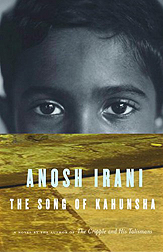
Courtesy Doubleday Canada.
A: If you grow up in a city like Bombay it’s very hard to escape the street life, unless you live in a very privileged area. I didn’t. I grew up in Byculla which is one of the neighbourhoods hardest hit by the riots [of 1992-93]. Before that I lived very close to the red light district. One of the things I remember about being a child was walking through it with my mother because it was a short cut to my grandmother’s house. My mom didn’t think I would recognize what was going on. I didn’t, of course, but the place stayed with me. It had a very depressing aura, but at the same time, I was fascinated by the characters. The prostitutes would always chew paan and they’d have red lips. And in the mornings they’d sit on their haunches and use black toothpaste and it would drip down their faces. It was very strange. It was almost like watching theatre. I had no idea what this was. In [The Song of Kahunsha], the character of Dabba [a limbless beggar] is literally a human box. He’s actually based on a man I saw when I was in university. I remember being at VT Station, which is the main hub, it’s like Grand Central Station. I remember on the platform seeing this man who had no arms and no legs, lying on his back, staring up and there was a metal bowl with coins in it by his head. Even though I was used to seeing people in terrible conditions, this in particular stayed with me.
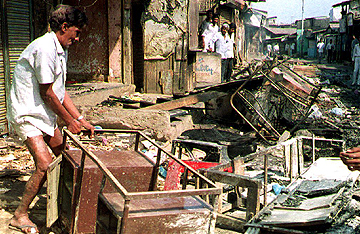
A shopkeeper clears debris after a Bombay riot in January, 1993. Photo Douglas E. Curran/AFP/Getty Images.
Q: You were in Bombay during the riots. What was that like?
A: It was a period in Bombay that surprised a lot of people. Up until then, Bombay was a tolerant city in terms of having people of different religions co-exist. One of my strongest memories is not one of violence, but of silence. The curfew was on in my neighbourhood. It was about nine at night. I lived in an enclosed compound, surrounded by a fence, so we were fairly protected. There were military tanks patrolling the city. I remember sitting alone outside and watching the tanks and feeling an unease that I’d never felt before in Bombay. The moment the riots happened things changed for everyone. People who were friends and neighbours were suddenly attacking each other.
A: I’m Zoroastrian, Parsi, as we’re called. My grandfather is from Iran. I felt I was watching something unfold that I had no control over. Lucky for us, we’re a religious minority that people ignored.
A: I can’t really say I long for the smell of Bombay! It’s not humanly possible to long for that smell. Certainly there are things I’m glad to have escaped from.
Vancouver is not just a different city. It’s a different planet. The mistake I made for the longest time was comparing them. I was miserable. I’d chosen to come to Vancouver to become a writer. I didn’t realize how different it would be. Vancouver is home now. I don’t think I’d go back to Bombay. I do miss the coconut trees, the landscape, the red earth and the heat. Those kinds of things.
What I love about Vancouver is simple. You can actually breathe in Vancouver. When I first arrived I couldn’t believe how clean the air was. I’d never smelled air like that. In Vancouver the pace is slow. It enables me to write. And breathe.
The Song of Kahunsha is published by Doubleday Canada.
Rachel Giese writes about the arts for CBC.ca.
 CBC
does not endorse and is not responsible
for the content of external sites
- links will open in new window.
CBC
does not endorse and is not responsible
for the content of external sites
- links will open in new window.
Copyright © 2005 Canadian Broadcasting Corporation - All Rights Reserved
More from this Author
Rachel Giese
- Ladies Man
- Volver's feminine touch
- Fit to Print?
- A conversation with the Canadian distributor of O.J. Simpson's new memoir
- Yep, I'm Gay
- Hollywood's incredible shrinking closet
- Eyes on the Prize
- Breaking down this year's Giller Prize nominees
- A Passage from India
- An interview with Booker winner Kiran Desai


