A hair-raising conspiracy: Tom Hanks and Audrey Tautou in The Da Vinci Code. (Columbia Pictures)
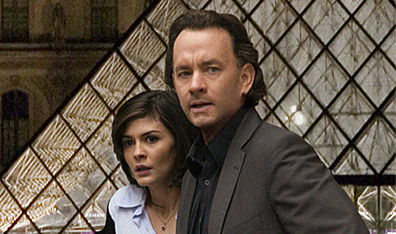
Born from an unholy union of popularity and controversy, the screen version of The Da Vinci Code opens this weekend. Industry analysts are predicting a new box-office messiah, even as Vatican official Archbishop Angelo Amato calls on Catholics to boycott the film.
At the eye of this media storm, we have the reassuring, regular-guy presence of Tom Hanks. So far, the 49-year-old star has managed to limit the controversy swirling around his character, Harvard “symbologist” Robert Langdon, to the man’s inexplicable hairstyle, which could best be described as an academic mullet. Indulging in the kind of conspiratorial thinking that has made Da Vinci Code author Dan Brown a rich man, Peter Hartlaub of the San Francisco Chronicle says Hollywood hair doesn’t get this awful by accident. Maybe director Ron Howard has decided that if Langdon is an Ivy League intellectual who’s going to blow the lid off Christianity, he’d better look approachable and audience-friendly.
In other words, he’d better have bad hair.
That, after all, is the secret of Tom Hanks’s universal appeal. Some celebrities succeed because they seem better than us; Hanks succeeds because he seems the same as us.
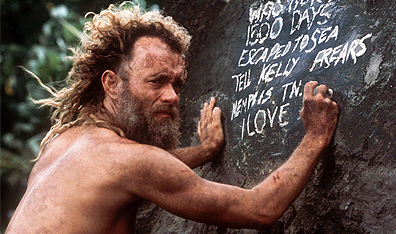
He’s a superstar who looks like a character actor, with a face like a friendly bowl of mashed potatoes and a body that seems more comfortable with a little middle-age ballast. His bulked-up turn as the coach in A League of Their Own (1992) was perfectly natural, while his transformation, midway through Cast Away (2000), from a doughy mail courier into a sinewy, Palaeolithic hunter-gatherer was genuinely jaw-dropping.
The sense that Hanks shares the common human experience is best illustrated by the fact that he is seen peeing — discreetly, of course — in no less than seven films. As sympathetic prison guard Paul Edgecomb in The Green Mile (1999), Hanks groans his way through a painful urinary-tract infection; as astronaut Jim Lovell in Apollo 13 (1995), he negotiates zero-gravity body functions.
What I would give for a razor: A hirsute Hanks in Cast Away. (Zade Rosenthal/Dreamworks/20th Century Fox/CP Photo)
To measure Hanks’s popularity, just look at his stats. His lifetime box-office take is estimated at $3.1 billion US. He has won back-to-back Oscars (for Philadelphia in '94 and for Forrest Gump in '95), and in 2002, received the American Film Institute lifetime achievement award, making him the youngest recipient at that time. He’s rich, powerful, famous — and still, somehow, likeable.
The nicest guy in Hollywood is a hybrid-car-driving Democrat who quietly raises money for veterans’ causes and the environment. While he has racked up one divorce (from an '80s starter marriage to Samantha Lewes), he has been married to Rita Wilson for 18 incident-free years. When Hanks makes the news, it’s not for sexual scandal or couch-jumping craziness, but because he has chivalrously come to the aid of a heat-exhausted jogger (in 2001) or a swimmer caught in a riptide (in 2002).
Hanks is often compared to Jimmy Stewart, with whom he shares an unassuming, aw-shucks charm. Hanks can draw audience empathy without pleading for it in the way Jim Carrey does when he plays straight or demanding it in the way the increasingly passive-aggressive Kevin Costner does. Hanks radiates basic decency, neatly dodging any suggestion of saintliness with his self-deprecating humour.
Like Stewart, Hanks is known for iconic, often heroic American roles, though he tends to humanize them with modesty and minor idiosyncrasies. (By urinating, for one.) In Apollo 13, Lovell and his men aren’t “Right Stuff” hotshots but a lunch-bucket crew who save a doomed mission with can-do, duct-taping ingenuity and high-speed trigonometry. In Steven Spielberg’s Saving Private Ryan, Hanks’s army captain embodies the almost mythic qualities of “the greatest generation,” but he does so with trembling hands and a nagging doubt that his wife will recognize him if he ever manages to get home.
Like Stewart in his collaborations with Frank Capra, Hanks is associated with goodness, kindness and optimism. Stewart could also go dark, though, channelling sexual unease in Hitchcock thrillers and unleashing unexpected violence in Anthony Mann westerns. Hanks has never been able to match this moral complexity. His turn as master-of-the-universe bond trader Sherman McCoy in The Bonfire of the Vanities (1990) is a notorious example of the way miscasting could ruin a book adaptation. Hanks portrayed Sherman as a sympathetic sap, effectively deflating Tom Wolfe’s social satire.
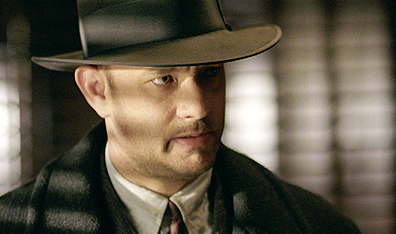
In 2002’s Road to Perdition, Hanks again played against type as a contract killer for the Irish mob in Chicago. Michael Sullivan may have several notches on his gun, but he is also a solid, polite, plainspoken family man, a very Midwestern sort of assassin. Hanks’s attempts to explore this conflicted antihero were worthy but forgettable, rather like the film itself.
The ethical gangster: Hanks as an assassin in Road To Perdition (Francois Duhamel/Twentieth Century Fox/CP Photo)
In fact, the only movie in which Hanks comes off as genuinely creepy is the family holiday adventure The Polar Express (2004), and that’s mostly due to director Robert Zemeckis’s unfortunate use of motion-capture technology. This computer hybrid of live action and animation replicates Hanks, who handles multiple roles, with spooky exactitude but no sense of warm, breathing life. For goodness sakes, even his Santa Claus is unsettling.
Audiences are happiest when Hanks plays sensitive guys (as in his rom-coms with Meg Ryan), naifs or man-boys. He was literally a man-boy in Big (1988), playing Josh, a 12-year-old who is magically transported into a grown-up’s body. It’s a tricky technical performance. Josh’s responses to the world are outsized and immediate and bouncy, whether he’s conveying astonishment at his very first paycheque (which comes to a whopping $187!) or navigating his first “sleepover” with a girl. But Hanks also imbued Josh with a poignant sense of loss. He is, after all, stranded in the alien world of adults.
The delicate sweetness of Big turned saccharine in Forrest Gump, another Zemeckis project, in which the filmmaker’s use of Forrest’s distressingly blank slate to illustrate key moments in modern American history felt wrongheaded. (Continuing the urination motif, Forrest’s blurted response upon meeting John F. Kennedy is, “I need to pee!”) Hanks embraced Forrest’s flood pants, buttoned-up shirt and goony-bird face, but his conviction was misapplied.
Philadelphia again seized on the “non-threatening boy” aspect of Hanks’s persona, this time to help straight people feel comfy with homosexuality. Hanks was brave for helping introduce the topic of AIDS into mainstream movies; he wasn’t so brave for playing Andrew Beckett as sexless, even with the red-hot Antonio Banderas standing nearby. Andrew was so mild, so cuddly, so neutered, that one couldn’t help wondering how it was possible that he contracted a sexually transmitted disease in the first place.
Hanks has an unusual ability to reassure and comfort audiences, even when he’s in controversial territory. That’s why he’s the perfect star for The Da Vinci Code. That’s also why his real greatness often gets diffused into fuzzy, feel-good projects and well-intentioned failures. This weekend, he’ll be taking fans on a search for Dan Brown’s hopelessly middlebrow version of the Holy Grail. If only he were willing to take them someplace more risky.
Alison Gillmor is a writer based in Winnipeg. CBC
does not endorse and is not responsible
for the content of external sites
- links will open in new window.
CBC
does not endorse and is not responsible
for the content of external sites
- links will open in new window.
Copyright © 2005 Canadian Broadcasting Corporation - All Rights Reserved
More from this Author
Alison Gillmor
- Where Is the Love?
- The decline of the romantic comedy
- Good Fella
- The average-Joe appeal of Tom Hanks
- A Recipe for Living
- Caitlin Flanagan and her inner housewife
- Channelling Mayhem
- Winnipeg cable TV's golden age
- Trunk Show
- Tree Planting made photographer Sarah Anne Johnson an art star


