Byron Hurt, director of the documentary Beyond Beats and Rhymes: A Hip-Hop Head Weighs in on Manhood in Hip-Hop Culture . Photo courtesy Hot Docs.
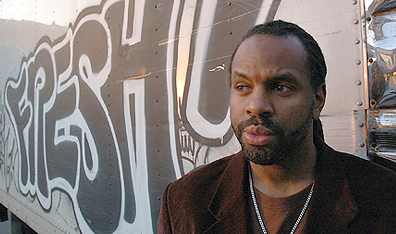
When Byron Hurt was a teen, hip hop was his light. Coming of age in the late ’80s, the Central Islip, N.Y., native listened to rap lords like Big Daddy Kane, the Jungle Brothers and A Tribe Called Quest. He spun De La Soul’s 3 Feet High and Rising while partying with his frat brothers, and LL Cool J’s Mama Said Knock You Out to get hyped for football (Hurt quarterbacked Boston’s Northeastern University Huskies from 1988 to 1991).
After completing his journalism degree, Hurt, who is now 35, took a job with Northeastern lecturing young men about violence against women. The deeper he dug into sexism, domestic battery and other gender issues, the more he questioned his own ideas about manhood, and what influence hip hop had made on his character.
From 1994-98, Hurt crafted his first documentary, I Am a Man: Black Masculinity in America. When it was done, he toured the film to more than 80 college and university campuses. Also in the mid-’90s, Hurt joined Mentors in Violence Prevention-Marine Corps, described on his website as “the first system-wide gender violence prevention program in the history of the United States military.” He remains the group’s associate director.
By 2000, Hurt was living in New York City and eager to make another doc. While watching rap videos one Saturday morning, he was bothered by a nonstop spew of misogyny and materialism. He knew right then what his next topic would be.
The result, completed this January, is Beyond Beats and Rhymes: A Hip-Hop Head Weighs in on Manhood in Hip-Hop Culture. The hour-long documentary is driven by Hurt’s intelligent, deliberate interviews with aspiring and star MCs, industry executives and insiders, fans, academics and even a “hip-hop minister.” It debuted at this February’s Sundance Film Festival, and is now screening at Toronto’s Hot Docs Canadian International Documentary Film Festival.A: LL Cool J had a song [Rock the Bells] that started out “LL Cool J is hard as hell,” and that was in 1985. There has always been a preoccupation with hardness within the hip-hop community, but it became more important to one’s street credibility as gangsta rap became more prevalent and commercially viable [near the turn of the ’90s]. LL said “I’ll crush you like a jelly bean” in 1987. It sounded hard at the time, but it doesn’t sound too hard now. There’s been a pressure on artists to push and push and push that masculine edge.
Q: Violence is a staple of North American movies, television, videogames and sports. It’s included in almost all the things that men are supposed to enjoy. Is hip hop any worse than the rest of those influences?
Striking a masculine pose for Beyond Beats. Photo courtesy Hot Docs.
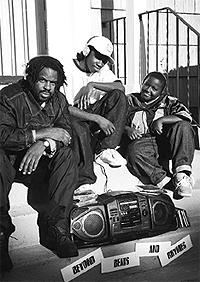
A: It’s a little bit more crass, a little bit more in your face. The fact that it’s performed by black and Latino males makes it a little bit more threatening and scary – and makes it easier to scapegoat. Black and Latino males are easy targets to focus on for [problems with] violence and sexism and homophobia. Hip hop fits very neatly into the white racist imagination about black masculinity.
A: I think it’s horrible.... I interviewed Proof. If you pay close attention, he’s standing right behind me in the tease of my film, when Bizarre from D12 says, “D12 ain’t all about smacking bitches and smacking hos, but we will smack a bitch and smack a ho.” My questions for them were mainly geared towards misogyny, but Proof had a real “I don’t give a f---” attitude about anything. Do I think rap will learn something from his death? I hope so. But the type of bravado that’s in hip hop is part of a male reality where violence is normal.... I think people expect stuff like this to happen in hip hop every once in a while. I really do.
A: I don’t like to get into that argument. It’s a good question, but my contention is that the kind of hypermasculinity that leads to violence – whether it’s on the streets or in music – is way too normalized to be accepted.
A: It’s ridiculous, but it’s understandable. All of us as men and women are socialized with an intense level of misogyny and sexism. It doesn’t strike us as being a big problem. It’s hard for some people to make the connection that they are not separate from the language that is being used to demean black people or to demean women.
A: I don’t want to misquote him, but I remember reading a statement where Chuck said that hip hop used to be like the black CNN, but has now become the black Cartoon Network. I’ve shown this film and had people – I mean mainly black audiences – give his statement [about BET] a standing ovation.
A: That was some crazy s---. All I did was ask one question. I didn’t realize it was that touchy. For some people, homophobia and homosexuality are still too taboo. The black community, like some other communities, is very conservative about homosexuality. I don’t think Busta wanted to be seen talking about it in any particular way. He wanted to avoid the issue altogether.
A: We’re all complicit. Corporations bought the railroad system, and we all got on the train. We’re all participating in these expected gender roles. But ultimately, the people who are in leadership positions know that they reinforce certain stereotypes and things of that nature – and don’t necessarily do anything to change the situation.
A: I want to say no, it’s not fair to ask the rappers to carry that weight. But what makes it easier for me to question all of this is that I’ve been educated about gender issues – I know and understand that the vast majority of boys and men don’t receive the training about manhood and masculine identity that I have received. So it is asking a lot for the rappers to change, and it’s asking a lot for the executives to change as well – they also buy into expected norms about masculinity. It’s difficult to ask that of men in general who’ve never studied feminist theory or any of those things that are considered academic. But that’s how I see my role as a documentary filmmaker who wants to push people’s consciousness about these issues.
A: As much as I wanted to examine only hip hop when I first started, I realized that it is even more important to examine masculinity in general. I also learned that making a film about any societal problem or social issue within the black community is very tricky and complicated. You run the risk of reinforcing certain stereotypes about black people that can be dangerous. You have to think really carefully about how you approach those topics.
A: I still listen to hip hop, but I hear it with a very informed ear.
Beyond Beats and Rhymes: A Hip-Hop Head Weighs in on Manhood in Hip-Hop Culture is screening at Hot Docs on May 7.
Matthew McKinnon writes about the arts for CBC.ca. CBC
does not endorse and is not responsible
for the content of external sites
- links will open in new window.
CBC
does not endorse and is not responsible
for the content of external sites
- links will open in new window.
Copyright © 2005 Canadian Broadcasting Corporation - All Rights Reserved
More from this Author
Matthew McKinnon
- The Smackdown
- This week: Is U2 over?
- Can't Stop, Won't Stop
- The unretirement of Jay-Z
- Twos of a Kind
- François Brunelle’s look-alike portraits
- Behind the Music, Y'all
- Kevin Federline's Playing with Fire: the liner notes
- See No Ego
- A doc reveals the amazing story of the blind mountaineers of Tibet


