Still from the title film in Trains of Winnipeg - 14 Film Poems. Courtesy Clive Holden.
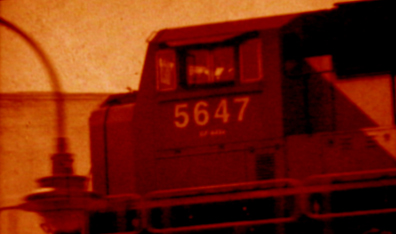
Clive Holden knew he’d figured out how to shoot his short film Trains of Winnipeg when a conductor climbed off a train and shooed him from the tracks.
“I lived in Winnipeg for the last eight years,” says the 45-year-old filmmaker, who recently moved to Toronto. “But that doesn’t mean I know trains. Everyone [in Winnipeg] said, ‘Oh, I had an uncle who worked on CP or CN.’ Winnipeg is a train city. But when I walked onto the yards, I realized trains are a wide-angle subject. I didn’t have the right camera.
“I had to find the sweet spots to capture what I wanted. I walked tracks. I wandered inside trains. I learned where to shoot. One time, I got too close and the driver got down and asked what I was doing. We had a good conversation. He understood. I knew I was finally close enough to make my film.”
The 17-minute short ended up taking two years to make, and illustrates Holden’s commitment to art. Last year, Holden released Trains of Winnipeg — 14 Film Poems, a collection of shorts that reflect various facets and stages of his own life. The 89-minute compilation enjoyed a lavishly praised run in art-house theatres internationally and has just been released on DVD.
All told, the 14 short films go back 40 years. The three-minute short Nanaimo Station is a looping collage of 8-mm footage from 1960 of Holden’s first steps as a child; the images are accompanied by a stately reminiscence of his Irish family’s idyllic early days in Nanaimo, B.C. Holden shot 18,000 Dead in Gordon Head (13 minutes), the story of a girl killed in a small B.C. town, on Super-8 film in 1982; it wasn’t until two decades later that he re-examined the footage to find the story. The 13-minute Hitler! (revisited) is Holden’s third attempt to tell the story of his brother Niall, a long-time mental patient.
Like Jonathan Caouette, the director of Tarnation, Holden returns to archival family footage to solve old mysteries and find the “sweet spots” in a story. Holden explains his appreciation of good storytelling by elaborating on his enthusiasm for American writer Raymond Carver. “I love it when he gets that sub-atomic flow of language pitched right,” Holden says. “When you encounter it on the page, your eyes just flow through it. But it takes years to develop what some call the gift of the gab.” In the following interview, Holden describes how he developed his own gift for what he calls “film poetry.”
A: I grew up a few blocks from [the University of Victoria]. As a teenager, I hung out at the UVic library, where I discovered [Montreal poet] Louis Dudek. They had a cassette of him that made a big impression on me — a poet’s voice! Eventually, I took writing at UVic and discovered John Berger and Raymond Carver. I loved their language and the ideas below the surface of their work. I remember reading some paragraphs of Berger and being too excited to continue. I’d stop and let the words sink in.
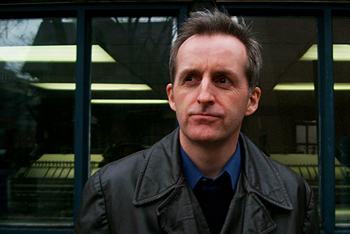
Filmmaker Clive Holden. Photo Sol Nagler. Courtesy Clive Holden.
Q: Were you interested in film?
A: I wanted to be a screenwriter. I moved to Montreal and studied at Concordia, where I was influenced by Bruce Bailey and [Toronto filmmaker] Phil Hoffman. But the big thing that happened to me at Concordia was picking up a camera. Something happened when I pulled the trigger of a camera. I wanted to be a filmmaker. But first I wrote. I spent the ’80s in small rooms, writing. I wrote pilots for a Montreal man who had ideas for films. I turned them into scripts. He gave me money. I don’t know what happened to the pilots. I moved from room to room, writing for 18 hours a day sometimes.
A: Montreal, at first, but then I moved to Whitehorse for a year, and to Watson Lake, a town of 800 people 500 miles south of Whitehorse.
A: I drove a Greyhound bus.
A: I think a pre-existing Western Canadian trait of craving wide open spaces — and definitely a fascination with visual movement — has led me to driving, quite a bit of roaming, and to filmmaking as well.
A: At the time, I was living in Winnipeg and visiting my parents on the [west] coast every few months. When I flew through the mountains, I shot film. When I watched the footage, I found the poem. When I write and it’s going well, I hit a phrase or idea and relax, because I know I have a poem — it’s there somewhere. Sometimes, I see film and feel the same thing. What excites me about working in different disciplines is that you pick up energy and ideas crossing from one to the other.
A: Most of Hitler! I shot visiting my brother at the Riverview Mental Hospital in Victoria. I’ve never seen anyone stare so openly into a camera as Niall did that day.
A: Niall is a schizophrenic who suffered a stroke that restricts him to nine words, one of which is “Hitler.” He can also sing Beatles songs. Once, he heard a German-speaking person and asked, “Are you a Nazi?” Then he and this woman had a conversation for 20 minutes about the war — out of nowhere! Then he closed down again. It was astonishing. Actually, the Hitler! in Trains of Winnipeg is a remix of a film I made in 1996. Later, I deconstructed the film with another filmmaker, Sol Nagler.
A: We rethought it, remade it, stripped it to individual shots. I literally stepped on footage. We played and handled it. Sol’s family is Jewish, from the Warsaw ghetto. He had questions. As we worked, we talked about Niall, Hitler, Germany, mental illness. I’m big on process and hands-on filmmaking. I believe that the physical labour of working on material brings the subconscious to play.
A: Trains of Winnipeg cost $60,000, and almost all the money went into film stock. Soon, we’ll be in the era of high-definition DVD. Everything will be digital — cheap! Kids in schools now learn to edit digitally, learn to make film like we learned to write stories. It’s thrilling to consider what they might do.
Stephen Cole writes about the arts for CBC.ca.
 CBC
does not endorse and is not responsible
for the content of external sites
- links will open in new window.
CBC
does not endorse and is not responsible
for the content of external sites
- links will open in new window.
Copyright © 2005 Canadian Broadcasting Corporation - All Rights Reserved
More from this Author
Stephen Cole
- Guy Talk
- The hit comedy Entourage shows Hollywood some love
- Tuned Out
- Panic in American TV land
- End of Term
- The series finale of The West Wing
- Heeeeeeelp!
- The disaster picture, then and now
- Canadian Idols
- Randy Bachman and Burton Cummings take care of business


