Illustration by Jillian Tamaki
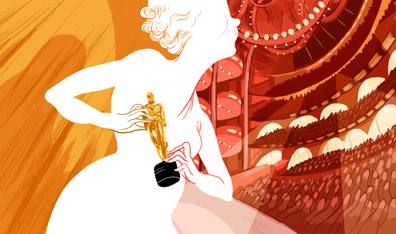
This year’s Oscar race reveals that it’s been a very busy year for men in Hollywood — playing cowboys in love, assassins with a conscience, famous writers, anti-McCarthy crusaders and enterprising pimps. And just what were the women up to? Not much, it seems. Here, a pair of CBC Arts Online writers discuss the faded fortunes of women in Hollywood.

Alison Gillmor is a writer based in Winnipeg.
Rachel Giese writes about the arts for CBC.ca.
March 1, 2006
To: Alison Gillmor
Subject: Women and the Academy Awards
For me, the Oscars are just a sore reminder that this past year was a dismal one for women in film. Nicole Kidman (Bewitched) and Cameron Diaz (In Her Shoes), usually box-office sure-things, watched their films tank. Meanwhile, the small, smart films that triumphed with the critics and awards shows (if not at the box office) scuttled women to the sidelines. I’ve never heard of something being called a husband/boyfriend role, but this year wife/girlfriend roles abounded: they were let down in Brokeback Mountain, nurturing in Munich, dead in The Constant Gardener, grating and slutty in Match Point, saintly in Walk the Line. And, oh right, they got to be hookers in Hustle & Flow.
Not one of the best picture nominees — Capote, Brokeback Mountain, Good Night, and Good Luck, Munich and Crash — features a woman in a leading role. And compare the roles that were nominated in the best actress and best supporting actress categories. As a whole, the supporting roles are more compelling, more textured and more surprising than the leading ones.
It’s nothing new. Looking back at the five previous years, of the 25 films that were nominated for best picture, only 10 had women as main characters or as co-leads (among those: Erin Brockovich, The Hours, Million Dollar Baby, Lost in Translation, Chicago).
What’s going on, Alison? What happened to all the women?
To: Rachel Giese
Subject: Women and the Academy Awards
You’re right, Rachel.
You know that the set design for this year’s ceremony goes back to the Art Deco glamour of Hollywood’s “golden age.” If only the nominations were doing the same thing. The ’30s through the ’50s was great times for actresses. Bette Davis and Joan Crawford were box-office queens, feuding sisters Joan Fontaine and Olivia de Havilland could both be nominated for best actress honours in the same year (1941), and “women’s pictures” had presence and power.
These days, grown-up women are an overlooked audience. It’s not that we don’t like movies, but we’re less likely to get out on those all-important opening weekends. (Hey, we have babysitting problems.) And films featuring female stars are less likely to go boffo at the box office. (Studios conveniently forget the corresponding part about these films being so much cheaper to make — fewer exploding helicopters, those 70-cents-on-the-dollar salaries.)
But we can’t just blame reduced audiences. A lot of today’s women-centred films are wish-fulfillment fantasies and Oprah’s Book Club mush. “The women’s picture” has become “the chick flick,” and instead of indomitable dames like Kate Hepburn and Barbara Stanwyck standing up for themselves (and looking swell doing it), we’re more likely to see Renee Zellweger and Cameron Diaz dithering over self-esteem issues.
It’s not that I want to go back to the old studio system. (Well, actually, maybe I do.) But the studios tended to invest in their female stars and hold onto them — often for decades! These days, actresses struggle to prolong their careers past the young ingenue, Maxim-covergirl stage — and that’s a real problem when it comes to Academy Award-worthy performances.
Actors and actresses, and the characters they play, often get more interesting after age 40, which is just about the point when most female players are put on the Hollywood equivalent of an ice floe. (Just look at Virginia Madsen. Last year she’s a nominee for her work in Sideways and everybody’s quoting her “wine is like a living thing” speech whenever they open a $12 Shiraz. This year she’s reduced to playing Harrison Ford’s trophy wife in Firewall.)
There is a loophole for Brits, since they’re not expected to be sexy (putting aside It Girl Keira Knightley just for a moment). They’re expected to be classy, which is why 71-year-old Judi Dench — pardon me, Dame Judi Dench — is being nominated for what is essentially a pleasant piece of piffle.
Not that I would hold that against Dame Judi. Let’s say we take the position that these women are basically making the best of a bad job. Rachel, what did you think about the nominees this year?
To: Alison Gillmor
Subject: Women and the Academy Awards
Judi Dench is like the female Sean Connery coasting by on Hollywood’s awe of accents. At least she infuses her eccentric, salty older lady roles with a knowing twinkle, unlike, say, Shirley MacLaine, who’s been on autopilot since the 1980s playing wacky cranks. (Why do screenwriters seem to think that menopause makes all women full of tartness and whimsy?)
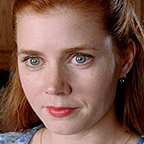
Amy Adams in Junebug. Courtesy Sony Pictures Classics. I lurve Catherine Keener. In fact, most of Hollywood’s wrongs would be righted if she got more work. Both Michelle Williams as a wronged wife in Brokeback Mountain and Rachel Weisz as a brainy crusader in The Constant Gardener more than proved their chops and made me eager to see what they’ll do next. North Country’s Frances McDormand was reliably good in an ill-defined role. But my heart belongs to Amy Adams, who was both thrilling and wrenching as a good-hearted, pregnant naïf in Junebug. Watching that performance was my “wow, who is that?” movie moment of the year.
Despite the slimmer-than-Kate-Moss pickings this year, there was a deep well of female talent working in 2005 — to the women we’ve already mentioned I’d add Laura Linney (The Squid and the Whale), Maria Bello (A History of Violence) and Rachel McAdams (Red Eye, The Family Stone). So what’s it going to take to get these women into some meaty roles the equivalent of Philip Seymour Hoffman’s Truman Capote, or Heath Ledger’s Ennis Del Mar? Even romantic comedies, the erstwhile domain of female talent, have become a boy’s club, with Vince Vaughn and Owen Wilson’s Wedding Crashers and Steve Carell’s The 40-Year-Old Virgin.
You raised some really great points about the demise of the studio system and the assumptions about female audiences. I think another problem is the lack of women behind the scenes. We need female Bennett Millers and Dan Futtermans incubating smart indie films with female protagonists. And we need a female George Clooney — an insider with enough charm and popcorn-movie clout to helm worthy non-studio projects. And at this point, I don’t even care if the films are women-centred. I’d just like to see some more films that have women characters, period.
The last word is yours, Alison. Who stood out for you in the supporting actress category? Any roles overlooked by Oscar this year? And most important, how can Hollywood fix its female troubles?
To: Rachel Giese
Subject: Women and the Academy Awards
First of all, I have to confess that Junebug has not yet made it to Winnipeg. (Sigh.) I’ll defer to your big-city smarts on that one, my cosmopolitan friend.
I was drawn to Williams’s sad, peaky little face in Brokeback (and am quite confident that her real-life relationship with Heath is off to a better start than the screen version). And I liked that McDormand remained staunchly tough and unsentimental, even as her subplot descended into movie-of-the-week territory. When it comes to vivid, immediate emotional presence and sheer luminosity, nobody could touch Weisz this year.
In the “she wuz robbed” category, I would put forward one of my perennial fortysomething female faves — Joan Allen. The Upside of Anger was an uneven pic, but Allen somehow retained her characteristic steely control while spending an entire movie being irrationally, cathartically, magnificently furious. (If looks could maim, that 45-year-old loser lech who’s dating her character’s college-aged daughter would have to be carried off in a basket.)
This is the kind of do-not-mess-with-me female anger that — as you point out, Rachel — needs to be channelled into behind-the-camera action. Premiere magazine’s so-called “Power Issue” is always a depressing confirmation that a few glamorous female stars like Julia Roberts or Sandra Bullock have some limited — and usually short-lived — pull, while the real clout is wielded by mostly old, white, male studio executives. (And we wonder why Harrison Ford gets the green light for another Indy Jones movie.)
It’s not that we demand the feminine equivalent of Die Hard 4. We don’t need more “you go, girl” comedies or suffering sisterhood weepies; we just need all-round better movies. Original conceptions, sharp writing, grown-up material — this is bound to lead to more satisfying female roles. (And male roles, too, come to think of it.)
That’s a long-term plan. As a quick fix, we could always take the regressive step of demanding more hooker-with-a-heart-of-gold roles — those are sure-fire best actress bait.
Right, Rachel?
 CBC
does not endorse and is not responsible
for the content of external sites
- links will open in new window.
CBC
does not endorse and is not responsible
for the content of external sites
- links will open in new window.
Related
Complete Oscar Coverage
- Crash scores surprise best picture Oscar
- The top 10 moments in the Oscar telecast
- Oscar Blog
- Oscars Nominee List (pdf)
- CBC Arts Online Alternative Oscar Pool (pdf)
- Who should win at the Oscars
- Quiz: Test your knowledge of politicking at the Oscars
- Gowned and Out: A Look at Oscar Fashion
- Stage Antics: Memorable Moments at the Academy Awards
- The Lady Vanishes: Hollywood's dismal year for actresses
- Canada Goes to the Oscars
- CBC Arts Online Reviews of Oscar Nominees
- Weighing in on Oscar's short lists
- 'Brokeback' leads indie wave on Oscar nominee list
- 'Daily Show' host picked for Oscar gig
- Producers clash over 'Crash'


