From left: NDP Leader Jack Layton, Conservative Leader Stephen Harper, Liberal Leader Paul Martin and BQ Leader Gilles Duceppe before the French language leaders’ debate last week in Montreal. (CP Photo/Paul Chiasson)
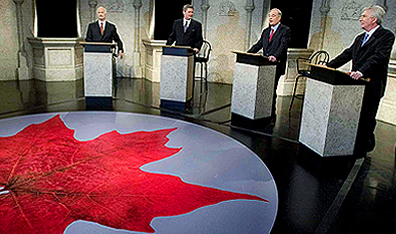
Those searching for mention of arts and culture issues in this election have had to dig deep. References to the sector are either buried in parties’ election platforms, or, in the case of the Tories, were not released until the end of last week. In the recent leaders’ debates in Montreal, the candidates were silent on the subject.
“Are we disappointed?” asks Alain Pineau, national director of the Ottawa-based advocacy group Canadian Conference of the Arts. “Yes. Surprised? No. Discouraged? No, not yet. I joke that it’s just like what Kim Campbell said during the 1993 election, ‘Election time is not the time to talk about serious issues.’”
And serious is exactly how various artists and arts groups perceive cultural issues in this election. After more than a decade of inadequate, and in some cases declining, federal support, major arts organizations across the country are struggling to stay alive. The Liberal government’s pre-election announcement that it will increase annual funding to the Canada Council of the Arts to $306 million over the next three years was hailed as a lifeline for the under-funded sector. Arts sector lobbyists hope that the commitment to the Canada Council will be preserved whatever the outcome of the election.
Heather Redfern, executive director of the Vancouver-based umbrella group Alliance for Arts and Culture says that compared to other countries, Canada has failed miserably at supporting its artists. “England’s national arts council funds in the amount of $24.36 per capita. Ireland is at $17.91 and Norway is at $10.97.” Currently, the Canada Council receives $4.73 per Canadian. The promised increase would double that amount.
Redfern points out that Canada’s cultural sector generates more than $39 billion annually in economic activity and 600,000 jobs, but adds that its value is not just in financial terms. “The arts have not been on the political agenda, yet they are at the core of our sovereignty. That’s what defines us and gives us our identity and differentiates us from the rest of the world, particularly our huge neighbour to the south.”
In the last days of the election, arts groups have stepped up their lobbying efforts to put cultural issues on the agenda. Both the Canadian Conference of the Arts and the Alliance for Arts and Culture have detailed information on their websites related to key arts issues, as does the Canadian Arts Coalition’s Vote Arts 2006 campaign. ACTRA, the Canadian actors union, held an election press conference last week at the CBC’s broadcast centre in Toronto, featuring a lineup of celebrities including Colin Mochrie, Wendy Crewson and R.H. Thompson.
In addition to retaining the plan to increase Canada Council funding, issues raised by these groups include:
- Providing stable funding for CBC/Radio-Canada, the Canadian Television Fund and Telefilm.
- Protecting Canadian media and cultural industries from foreign ownership.
- Imposing content and spending requirements on Canadian broadcasters to support Canadian productions.
- A fair tax treatment policy for artists in Canada.
- Revisions to the Copyright Act to protect the economic and moral rights of creators and copyright holders.

Here’s a summary of where the parties stand on arts and culture issues:
Liberal Party
- Will double annual funding to the Canada Council for the Arts over the next three years.
- Will reintroduce legislation to amend the Copyright Act to protect arts creators (this bill died when the government was dissolved).
- Supports current limits on foreign ownership of Canadian media and cultural industries.
- Having approved the UNESCO Convention on the Protection and Promotion of the Diversity of Cultural Expression, will work to sign on other countries.
- Will continue to support the Tomorrow Starts Today initiative, which provides funding for arts and culture.
- Is committed to stable funding for CBC/Radio-Canada.
Conservative Party
- Supports the Liberals’ increase in funding to the Canada Council for the Arts.
- Believes that government support should be linked to accountability, transparency and sustainability.
- Will work to strengthen opportunities and accessibility in both the domestic and international markets for creative works.
- Will, through the tax system and other means, support charitable giving by individuals and corporations to the arts and cultural community.
- Will focus CBC/Radio-Canada on its mandate as a public broadcasting service.
- Will preserve the role of the National Film Board, the Canada Council and other federal arts and culture agencies.
- Will review and update the Broadcasting Act and will establish national policy directions that will maximize freedom of choice and freedom of expression.
- Will give Canadians increased access to international and foreign language programming.
- Will reduce the CRTC’s role in content regulation to eliminate duplication where other legislation exists.
New Democratic Party
- Supports the Liberals’ increase in funding to the Canada Council for the Arts.
- Will introduce a system of tax averaging to provide fair and equitable tax treatment for Canadian artists.
- Will protect children in the arts with minimum standards and trust fund rules for income earned as performers.
- Supports current limits on foreign ownership of Canadian media and cultural industries.
- Will direct the CRTC to require performance standards for broadcasters to promote and protect Canadian cultural industries.
- Will increase and stabilize funding for CBC/Radio-Canada.
- Will provide sustained funding for Canadian Television Fund and Telefilm Canada.
- Will enhance federal film incentives to encourage film and television production.
- Will establish a forum with film distributors to set targets and a strategy to screen and distribute domestic films in Canada.
Bloc Québécois
- Supports the Liberals’ increase in funding to the Canada Council for the Arts.
- Supports current limits on foreign ownership of Canadian media and cultural industries.
- Will maintain pressure on the federal government to push other countries to ratify the UNESCO Convention on the Protection and Promotion of the Diversity of Cultural Expressions.
- Proposes a comprehensive review of the Copyright Act to protect creators’ rights and to bring Canada into compliance with international intellectual property treaties it has already signed.
- Supports stable funding for CBC/Radio-Canada and greater governmental input into the representation of regions.
- Proposes to revisit the CRTC decision allowing satellite radio in Canada, objecting particularly to the minimal French content and the high percentage of American programs.
- Supports a fairer tax system for Canadian artists.
Rachel Giese writes about the arts for CBC.ca.
 CBC
does not endorse and is not responsible
for the content of external sites
- links will open in new window.
CBC
does not endorse and is not responsible
for the content of external sites
- links will open in new window.
Related
Internal Links
More from this Author
Rachel Giese
- Ladies Man
- Volver's feminine touch
- Fit to Print?
- A conversation with the Canadian distributor of O.J. Simpson's new memoir
- Yep, I'm Gay
- Hollywood's incredible shrinking closet
- Eyes on the Prize
- Breaking down this year's Giller Prize nominees
- A Passage from India
- An interview with Booker winner Kiran Desai


