We didn't start the fire: Kristine Bendul and David Gomez in Movin' Out. Photo Joan Marcus. Courtesy Mirvish Productions.
Once, musicals gave birth to popular songs; lately, pop songs have been coupling with each other to spawn theatricals. It seems every pop singer with a few platinum albums is in talks to turn their greatest-hits package into a money-spinning musical.
After stitching together a plot to connect ABBA’s songs in Mamma Mia! (over 20 million served), playwright Catherine Johnson says she received offers to give the same treatment to Cat Stevens’ and The Carpenters’ back catalogues. "I like the Carpenters," she recently observed, "but I wouldn’t know how to steer the dialogue towards Calling Occupants of Interplanetary Craft."
Some rock-meets-theatre amalgams, like Mamma Mia!, the Billy Joel-inspired Movin’ Out and the Queen tribute We Will Rock You, have made it big on Broadway or the West End. The ABBA musical played in Toronto between 2000 and 2005 (grossing over $200 million), and had a sold-out run in Vancouver in the 2003. A touring version of the Broadway hit Movin’ Out — wherein dancers enact a story to Joel’s music, played and sung by a band perched above the stage — opens shortly in Toronto. (Although Canadian mega-musical producer David Mirvish has flirted with staging the Queen show, he hasn’t yet committed to it.)
Critics have often savaged “jukebox musicals” — as New York Times critic Ben Brantley sneeringly dubbed the genre — but that hardly matters. Fans of Joel, ABBA and Queen keep turning out in droves because the staged products captured something of their beloved music’s spirit.
Connecting a medley of super-trooper hits to a plot doesn’t always succeed. While Freddie Mercury’s legend (and songbook) can still put bums in seats in far-flung locales like Australia, England, Germany, Russia, Spain and the U.S. (Vegas, naturally), other artists have proved less attractive to the masses. Neither Closer to Heaven (music by the Pet Shop Boys) nor Our House (Madness) filled theatres for very long, even in the bands’ native London.
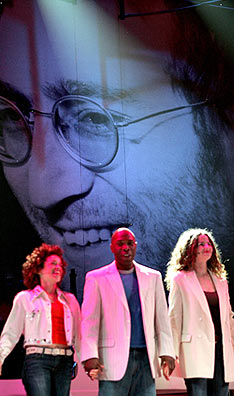 Imagine being cut after six weeks: Members of the cast of Lennon. Photo by Paul Hawthorne/ Getty Images. |
Despite the expensive failures, the trend shows no signs of abating. Last summer, the central event in Melbourne’s gay pride week was a musical stringing-together of Kylie Minogue’s club anthems: I Should be So Lucky recounted a toothsome gay guy’s dating adventures to the soundtrack of Miss Kylie. Nasty stage and screenwriter Neil Labute (In the Company of Men, The Shape of Things) is reportedly now collaborating on a project with Elvis Costello, exploiting a recent album. Even lesser acts like UB-40 and Frankie Valli and the Four Seasons are said to be seeking competent, underemployed playwrights to transform their oeuvres into musicals.
It’s easy — and quite enjoyable — to deride the jukebox musical trend. What next — Life is a Highway: The Musical? Bollocks: The Sex Pistols Remembered? Britney (Lies Down) on Broadway? Backstreet’s Back (Again)?
Sometimes, the shows mark the last step on a long journey towards completely selling out. The authorized merchandise offered in connection with Lennon included expensive silver jewellery emblazoned with quotes from his songs ("Give peace a chance"). Sick of the commercialization of his hero, a long-time Lennon fan recently told the Sacramento Bee, “Nowadays when I hear the name John Lennon, the first thing that comes to mind is ‘limited edition.’”
The shows can also deform a musician’s legacy in less trivial ways. Lennon focused primarily on the work he did after meeting Yoko. The Beatles exited the stage mid-way through the first act and only one Fab Four song, The Ballad of John and Yoko (inevitably), made the cut. The musical also represented yet another attempt to canonize, and thereby simplify, a complicated man.
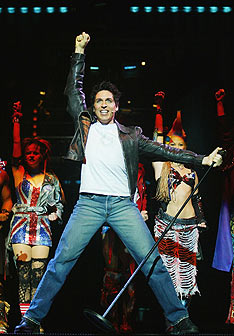 Mercury rising: Cast of the musical We Will Rock You perform at the Regent Theatre in Melbourne, Australia. Photo Mark Dadswell/Getty Images. |
But really, this gives the staged versions too much credit. They’re responding to the aging of the music’s fan-base (for whom theatres have become more congenial venues than stadiums), reflecting, rather than precipitating, the cleaning up of a formerly raunchy genre. The music became safe long before theatrical producers got their hands on it.
The best of these shows pump new blood into sclerotic veins. Michael Cavanaugh, the young piano man in the Broadway production of Movin’ Out was, by all accounts, a more vital interpreter of the tunes than Joel himself, who has grown blowsy and maudlin. (Sadly, Cavanaugh is not appearing in the touring version.)
The three most successful jukebox musicals — Mamma, Movin’ and Rock You — share certain common traits. They don’t use the songs to tell the rockers’ own staged (and sanitized) biographies. They also don’t delve too deeply into the back catalogues, using only the most famous songs. These jukeboxers pander to our love of the familiar. This is neither our lowest artistic impulse — sometimes you do want to go where everybody knows your name — nor our highest.
The shows continue to narrow what has become a miniscule gap between high and low culture. If the rock purists are offended by jukebox musicals, just imagine how put out the theatre aficionados are. But musicals have always been about pleasing as many as possible for as long as possible. I can see the writing on the wall: “Opening tonight at the Royal Theatre, Drury Lane, a new musical by the Kinks. It’s called Give the People What They Want.”
Movin’ Out opens at the Canon Theatre in Toronto on Nov. 23.
Alec Scott is a Toronto playwright and theatre critic.
 CBC
does not endorse and is not responsible
for the content of external sites
- links will open in new window.
CBC
does not endorse and is not responsible
for the content of external sites
- links will open in new window.
Copyright © 2005 Canadian Broadcasting Corporation - All Rights Reserved
More from this Author
Alec Scott
- Crowd Pleaser
- Sizing up Toronto's new opera house
- Write of Passage
- Madeleine Thien's quest for Certainty
- Happy Birthday, Bob
- Sixty-five quotes about Dylan
- Unscripted
- Tara Rosling follows her instincts
- Small World
- Books offer history in a nutshell


