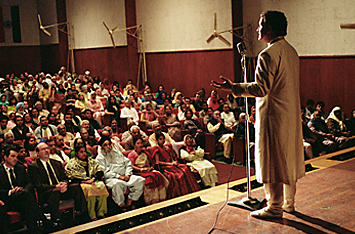
Comedian Azhar Usman. Courtesy Word of Mouth Publicity.
On Jan. 20, American comedian and actor Albert Brooks will release a film about his quest to find out what makes followers of Islam laugh. In the mockumentary Looking for Comedy in the Muslim World (which opens across Canada), Brooks (playing himself) is asked by the American State Department to prepare a report on Islamic comedy as part of the U.S. government’s post-9/11 strategy to understand the Middle East. Brooks travels to India and Pakistan to see whether his own Borscht Belt-bred shtick will amuse local Muslims (it doesn’t).
Sadly, the film spends more time satirizing American ignorance of Islam than it does figuring out Muslim humour. If Brooks really wanted to come to terms with the state of Muslim comedy, he would have done well to interview Azhar Usman, a young, increasingly celebrated headliner with the Allah Made Me Funny comedy show, which is currently touring the world. The show premiered last May in Toronto, and has since played to English-speaking audiences in places ranging from Scotland to Malaysia, Turkey to Denmark to Australia.
A practising Muslim brought up in Chicago by East Indian immigrants, Usman favours what he and his fellow Muslim comics call “halal humour”: jokes that don’t rely on four-letter words and sexual innuendo. Even so, his material is far from tame. The 29-year-old ex-lawyer, who sports a skullcap and a long beard, notes that fellow passengers on Western flights sometimes make a point of being nice to him — “after we land,” he adds dryly. He also numbers jokes on September 11 and the status of the Guantanamo Bay prisoners in his repertoire: “The black man is always complaining that he can't get a fair trial in America,” the comedian quips. “The Muslim says, ‘Man, we can’t even get a trial.’” He also talks about his sense of being an outsider in America after the destruction of the twin towers: “Everywhere I go, people look at me as if I am responsible for 9/11. I had nothing to do with 9/11. 7-11, maybe…”
Reached on the road between gigs in Montreal and Ottawa, Usman comes off more like a sage than a funnyman, as much an activist as a gagster.
A: Jerry Seinfeld likens using cusswords and blue material to racing in the Indy 500 and cutting across the middle of the field. You're going to get to the finish line a lot faster, but it defeats the purpose. Playing to a drunk audience at midnight in a small club, it’s a lot easier to make them laugh by telling dirty jokes and swearing a lot. It takes a far greater comedian to make the same crowd laugh without using any of that lowest-common-denominator material.
Not a chuckle to be had: Albert Brooks on stage in the film Comedy in the Muslim World. Courtesy Warner Bros Entertainment.
Q: You recently
attended the premiere of the Albert Brooks film
in Los Angeles. What did you think?
A: It was funny,
but I don't think there was much
thought given to the Muslim perspective,
to actually looking for comedy in
the Muslim world, like the title
says. People were talking about the
scene where Brooks puts on a big
show in New Delhi and none of the
Indian people laugh at his jokes.
The scene is ambiguous. It begs the
question: are they not laughing because
they don't enjoy his humour, or because
they just don’t get comedy shows
generally? The notion that a Muslim
audience wouldn’t have the vaguest
notion of what stand-up is is utterly
false. The American stand-up comedy
routine has made its way around
the world, and wherever we play,
be it Turkey or Malaysia, people
are familiar with the format.
For many years, there has been a great tradition of humour in the Indian subcontinent. I grew up listening to comedy albums recorded in the ’60s and ’70s by Indian and Pakistani comedians, among them Moin Akhtar, Umar Sharif and a guy who went by the name Johnny Lever. Their style of comedy would not be unfamiliar to the viewers of Seinfeld, with bits about the differences between men and women, jabs at politicians, lots of material about daily life, situational stuff.
Brooks does have a point, though, that it can be hard to find humour in Islamic locales now. Artistic and comedic expression is now becoming more and more repressed in the region. It’s so sad, when you look at the Muslim contributions to the world. These are the people who have given the world the Taj Majal, the Blue Mosque in Istanbul and Jalalud'din Rumi, the [13th-century] mystic Muslim poet whose work is now selling phenomenally well in the West right now. And yet today, we find that Muslims are not associated with art and artistic expression. Instead, we’re associated with violence, barbarism and terrorism.A: I’ve delved pretty deeply into the history of ethnic comedy in America. I'm a fan of Dick Gregory, the great black American comedian and civil-rights activist. Stand-up is an art of protest, fundamentally. When you study the history of stand-up, you see how often it gets used as a tool, an art form for the underdog. Black American comedians, Jewish-American comedians, Latino comedians, women comedians, gay comedians, blue-collar Americans, Jeff Foxworthy and that whole hillbilly comedy tour… time and time again, you find that groups that are written off by mainstream America use comedy as a weapon. This is a way for them to speak truth to power — that quintessentially American thing to do. And that’s what we’re doing as well.
A: Not many. We’ve gone to great lengths to ensure that the tour is growing within this community and out of our community. Our website includes testimonials from Muslim community leaders, including intellectuals, imams and Muslim community leaders. This is progress. Traditionally, within the community, there wasn't much support for comedy. In the past, you might go to a mosque and people would ask what you did for a living. You’d say, ‘I’m a comedian,’ and they’d tell you, ‘You’re a sinner; you’re going to hell.’ And now those very same people are some of our biggest fans, and we’ll have imams giving sermons saying what we’re doing is important cultural work.
A: They say comedy is tragedy plus time. The two are linked, those ancient Greek symbols for comedy and tragedy; the two masks aren’t that different. One of my favourite quotes is from Kahlil Gibran's The Prophet. He says your joy is your sorrow unmasked. The answer to your question is probably no. I don’t think I’ve ever come across anything you can’t joke about — if you do it in a tasteful way and bide your time until the right moment.
A: A lot of my stuff plays on the stereotypes in the West regarding Arabs and Muslims, and well, those stereotypes have been around for a long time. A documentary film now in production, Valentino's Ghost, directed by Michael Singh, is documenting Hollywood's stereotyping of Arabs and Muslims as bad guys, terrorists and uncivilized barbarians over the last 100 years. He’s picking up on the work of Edward Said, the Columbia academic who recently passed away, and particularly his [book] Covering Islam. A lot of what I talk about in my act, in terms of critiquing the media for its stereotyping and dealing with the dirty words that people like me get just walking down the street, well, that’s all been around since pre-9/11. The other thing that happened after 9/11 was that the American public suddenly wanted to know more, and that’s probably why our Muslim comedy tour has been so popular.
Alec Scott writes about the arts for CBC.ca.
 CBC
does not endorse and is not responsible
for the content of external sites
- links will open in new window.
CBC
does not endorse and is not responsible
for the content of external sites
- links will open in new window.
Copyright © 2005 Canadian Broadcasting Corporation - All Rights Reserved
More from this Author
Alec Scott
- Crowd Pleaser
- Sizing up Toronto's new opera house
- Write of Passage
- Madeleine Thien's quest for Certainty
- Happy Birthday, Bob
- Sixty-five quotes about Dylan
- Unscripted
- Tara Rosling follows her instincts
- Small World
- Books offer history in a nutshell


