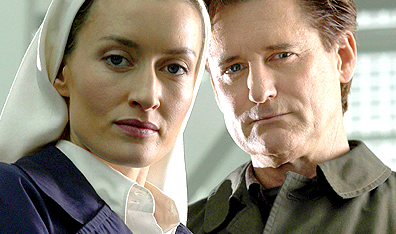
Natascha McElhone is Sister Josepha Montafiore and Bill Pullman plays Harvard professor Dr. Richard Massey in the television mini-series Revelations. Courtesy Global TV.
According to Revelations, NBC’s new, six-hour miniseries, Satan is real and lives among us taking the form of sexual predators that devour children.
Other revelations in the prime-time religious drama, which is very loosely based on the Bible’s Book of Revelation: God is for capital punishment yet against euthanasia. And a Pope is shown to conspire against Christ by ignoring evidence He’d returned to Earth.
The bad news about Satan is offset by advances in devil detection. As seen in Revelations’ premiere episode on April 13, Satan has no blood. Cut off a finger – not a drop. Which makes Revelations-style fingerprinting a grisly task, for sure, but then you get to execute devils with untroubled vengeance, as God intended. Or as a preacher says to a devil here, “If this plane goes down, it’s because you’re on it and God doesn’t want to take any chances.”
Behold the legacy of the social climate that brought us such productions as Mel Gibson’s The Passion of the Christ, a small budget film that grossed more than $370 million US, selling nine million DVDs its first week on the market. Throw in the publishing success of the religious thriller The Da Vinci Code, and faith-based subject matter is suddenly hot in Hollywood. In addition to Revelations, NBC is developing The Book of Daniel, the story of a minister (Aidan Quinn) who succumbs to prescription drugs before being rescued by a “cool, contemporary Jesus.” Fox, meanwhile, has Briar + Graves in the works, a series about a priest who befriends a neurologist in an effort to solve religious mysteries. It will be interesting to see how these last two shows fare. And no one should begrudge the recent spate of more honourable dramas created to serve the growing interest in religion in North America – Joan of Arcadia, Seventh Heaven or, going back a few years, Nothing Sacred and Touched by an Angel.
But Revelations is not merely a religious drama, not simply about God. No, it presumes to know God’s plan. More disturbing, it presumes God’s will in deciding right and wrong with regard to justice, medicine, even fashion.
The six-part NBC miniseries (airing on Global in Canada) begins with a montage that embraces the creationist theory while proposing Armageddon is upon us. We see time-lapse photography of plants springing to life and decaying, then images of floods, war and catastrophe. “From snowflakes to dandelions, grasshoppers to giraffes, it’s as probable for a tornado traveling through a junkyard to produce Buckingham Palace than for life to emerge from the Big Bang,” a college professor advises a crowded lecture hall.
A scene from Revelations. AP Photo/NBC Universal/Larry Horricks.
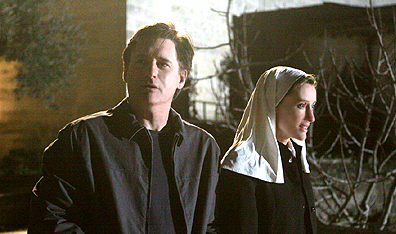
From there we meet a devastated Harvard astrophysicist, Dr. Richard Massey (Bill Pullman), flying back home with the killer of his only child. Along with police and religious officials, the group is returning from South America where the devil has been arrested for the little girl’s Satanic ritual murder.
Cut to Sister Josepha (Natascha McElhone), a beautiful rebel nun who travels the globe in search of growing proof Jesus has returned. We first encounter her filming a miracle on a mountain in Mexico – the silhouette of a crucifix moving across a rock. “It looks like a shadow,” the Sister exclaims. “But there’s nothing to create a shadow. The sky is perfectly clear. The head of Christ turns! His head is turning toward us!”
A few scenes later, a rebellious 11-year-old girl fights with her dad over a skimpy outfit she’s wearing, then runs from the house in a rainstorm and is struck dead by well-aimed lightning. Sister Josepha arrives at the hospital and places her hand on the child’s marble-cool forehead.
“Dead technically,” a priest advises her. “That’s how they’re justifying unplugging her – to harvest her organs.... Her father has been offered money for a kidney transplant.”
Sister Josepha soon discovers the child is speaking scripture. The end is near, the little girl whispers in Latin. Later, with a storm raging outside, she scrawls a donkey on paper. Seeking validation for the miracle, Sister Josepha calls upon Dr. Massey. The astrophysicist refutes the nun’s evidence. Then he sees the drawing of the donkey and experiences a shiver of dread. His murdered daughter drew the same image before being taken away.
And so Dr. Massey joins with the rebel Sister. In another thunderstorm they seize the brain-dead girl and spirit her away to a Florida nunnery. There, Dr. Massey suggests that it will be helpful to have Vatican support in the legal struggle to keep the child on life support.
“We wouldn’t know [about support from Rome],” Mother Superior Francine sighs. “The Vatican rejects our activities because it’s threatened by them....What validity would the Pope have, for instance, as a conduit to Jesus, if Jesus was no longer in heaven, listening to our prayers?”
Revelations writer David Seltzer has been spinning religious thrillers since The Omen (1976). In interviews he suggests everything in the NBC series has been vetted by experts, including a faculty member of Harvard’s divinity school. Presumably, he’s referring to the series’ biblical references as well as the incidents of warfare and strife that herald the Second Coming.
But it’s not the NBC miniseries’ take on biblical prophecies that is so alarming. Rather it is the schoolyard bully manner in which it expresses reactionary conservative values. These views won’t bother agnostics, who will disregard Revelations just as people who do not care about hockey won’t watch the Stanley Cup. But religious people should be offended by the depiction of God as an angry disciplinarian who would electrocute an 11-year-old girl for wearing low-riding pants.
Hollywood has been fairly criticized for ignoring the feelings and needs of faith-based viewers in America. But there is a difference between entertaining and pandering to an audience. At times you can almost feel Revelations ticking off Bush’s red-state shopping list of desired moral stands on issues like evolution, capital punishment and euthanasia.
The leads are characteristically good. Nobody does wounded calm better than Pullman, as he proved playing the mentally ill dad in Igby Goes Down. And McElhone (Laurel Canyon) is an actress of great energy and conviction – talents that make her unnerving to watch here as she angrily brushes aside so many institutions in her rush to do God’s bidding: the Catholic Church has lost its way; hospital organ donations are mercenary harvests that ignore the sanctity of life.
All Sister Theresa’s prejudices are permitted, vindicated even. She hears voices – sees visions. She is always right; the scriptwriter, if not God, is on her side. Still, it is unlikely that viewers of every faith will endorse the rebel Sister’s revelations in NBC’s ongoing, crudely simplistic religious drama.
Stephen Cole writes about television for CBC.ca.
Copyright © 2005 Canadian Broadcasting Corporation - All Rights Reserved
More from this Author
Stephen Cole
- Guy Talk
- The hit comedy Entourage shows Hollywood some love
- Tuned Out
- Panic in American TV land
- End of Term
- The series finale of The West Wing
- Heeeeeeelp!
- The disaster picture, then and now
- Canadian Idols
- Randy Bachman and Burton Cummings take care of business


