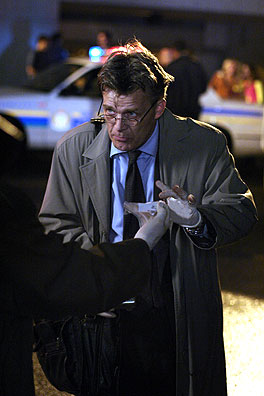
I see dead people: Nicholas Campbell stars as a Vancouver coroner on Da Vinci's Inquest.
One of the best things about popular arts is that they are just that – popular. A hit TV show lubricates social discourse and so is good for the whole neighbourhood. Since TV arrived in Canada, in 1952, no show has done more to provide conversational ballast for this nation than Hockey Night in Canada. For decades, the phrase “How about those Leafs?” was all you needed to get a cab driver or uncle started.
Not anymore. NHL teams are currently in limbo. There are no Leafs. Worse yet – no Calgary Flames! By my reckoning the Flames were the Canadian TV show of the year in 2004. Five million of us hung around to the bitter end last June, watching Calgary lose to the Tampa Bay Lightning in the Stanley Cup finals.
Before falling in Florida, however, the underdog Flames scorched Vancouver, Detroit and San Jose in a playoff run so giddy and tense you could have harvested goose bumps with carrot graters. The games changed not only what we think of Calgary, but also how the city defined itself.
During playoff games, HNIC placed cameras along the 17th Avenue restaurant strip called the Red Mile to witness an ongoing ’60s-style be-in, as tens of thousands of exuberant, orange-dressed (and undressed!) Flames fans went completely Mardi Gras. Calgary, which played Joe Frazier to the more colourful, Muhammad Ali-like Edmonton Oilers during Alberta’s pro hockey renaissance in the ’80s, was for once the sports capital of Canada. Now the NHL and its players are locked in a tedious labour dispute, and the question can rightly be asked: will playoff fever make another Canadian city grow attractively young and foolish anytime soon?
Afraid not. Lawyers tell us that the NHL will be closed down for the remainder of this season. The owners will declare an impasse this fall or next, then impose a salary cap and invite the prodigals to cross a picket line to join career minor leaguers in what will be a decidedly inferior confederation.
In other words, HNIC might not be back until 2007, with who knows what kind of mongrel line-ups on display. Not to mention Don Cherry, steamed at all the scabs in uniform, singing from the Joe Hill songbook. Canadians won’t buy it. Montreal and Toronto both turned away from Major League Baseball in 1995 when that sport returned from a labour dispute after a comparatively brief walkout.
The reason? Canadian fans, unlike their American counterparts, never pardoned the “millionaire ball players.” All polling evidence suggests we won’t forgive NHLers their mercenary ways either, even good lads from Prince Albert and the Soo. Nor will we cotton to multimillionaire owners locking out players. That might fly in the U.S. of A., where the athletes are mostly foreign-born workers. Here, however, hockey players are kids from the neighbourhood. The NHL labour dispute won’t kill our national sport, but it will critically injure the familiar relationship we enjoy with pro hockey, turning the game into something resembling the evidently compromised CFL of the ’90s. (Anyone remember the Baltimore Stallions winning the Grey Cup?)
Now onto better news! Finally, in its seventh season, Da Vinci’s Inquest (CBC) fulfilled its rookie promise, when it gave evidence of being the great Canadian TV drama. All of the show’s attributes came into focus in 2004. Creator Chris Haddock’s signature flourishes – the serpentine tracking shots through junky hallways and tuxedoed civic functions – were rendered with rare acrobatic finesse. And the carefully layered plots were a marvel of planning and execution. A dozen things, most of them bad, appeared to be happening at the same time – a murder involving the mayor; Da Vinci’s careful politicking to get a sanctioned red light district; and the deceptively casual takeover of the Vancouver police department by a bushel of bad apples.
The brilliance of this season rested in the tantalizing manner in which the whirring segments brushed against each other. Finally we came to understand that Da Vinci was not so much investigating the death of any one individual, but rather the attempted murder of city government. Despite the boldness of its design, the most obvious virtue of this uniformly well-acted series remains the work of star Nicolas Campbell, who has perfected an artless manner of playing that is a continuous pleasure to behold.
Campbell-DaVinci is at his best, I think, persuading strangers, usually city workers stuck in some unpleasant murder scene, to do his bidding. Lightly cajoling, pickpocket fast, he expertly pushes around cops and sanitation workers, escaping seconds later with his work done and a new friend. Campbell and Da Vinci’s Inquest were in championship form in ’04. All we can ask for is more of the same. And, please-please, a DVD release of the seventh season in time for next Christmas.
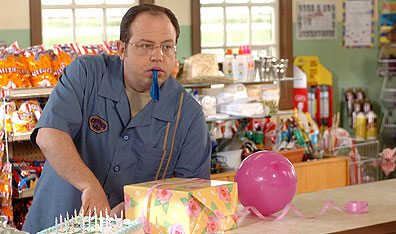
Party animal: Brent Butt in his hit sitcom, Corner Gas. Courtesy CTV
More glad tidings – until recently, it was thought that making a proper Canadian sitcom was harder than lying to your mother. What a surprise then to flip around the TV and find two perfectly good, popular Canadian sitcoms, the most notorious of which is Trailer Park Boys (Showcase) – a Halifax-made, six-paper joint of stupidity and fun for the whole Manson Family. Actually, once you get to know it, the four-year-old Maritime series is really quite sweet, in a sloppy-woozy, rum-drunk kind of way, as anyone who saw the recent reeling and rocking Christmas special would attest. Full credit to Showcase, the smartest of all Canadian specialty channels, for recognizing not everyone loves Raymond.
Even more significant, I think, is CTV’s comedy hit, Corner Gas, which drew more than a million and a half viewers to its second season debut last October. The Saskatchewan series is a classically constructed sitcom, with a wryly skeptical straight man (Brent Butt as gas station owner, Brent LeRoy) surrounded by a small town full of eccentrics. The obvious reference point is the old Andy Griffith Show. The show comes with the obligatory goofball best friend, played here by Hank Yarbo, an energetic cross between Mike Myers and Larry Storch on F-Troop. Plus, lots of unlikely guest stars pop by (Darryl Sittler, Pamela Wallin), a shtick that goes back to Here’s Lucy.
But while Corner Gas is Hollywood in form, the show itself is as Canadian as complaining. I love the way characters spit out the name of Dog River’s rival town – “Woolverton, pthhh!” – and how everybody’s car windshield is cracked from driving too fast on gravel roads. Even the chip tray in the gas station is authentically small town, right down to the orange bags of Hawkins Cheezies. Corner Gas also manages the trick of every mainstream comedy hit – the players are all instantly familiar, yet just cracked enough to be interesting. In just its second season, the show is a landmark in Canadian television history.
Hey, turns out Canadians can make sitcoms – Canadians outside Ontario anyway.
Stephen Cole writes about television for CBC.ca.
More from this Author
Stephen Cole
- Guy Talk
- The hit comedy Entourage shows Hollywood some love
- Tuned Out
- Panic in American TV land
- End of Term
- The series finale of The West Wing
- Heeeeeeelp!
- The disaster picture, then and now
- Canadian Idols
- Randy Bachman and Burton Cummings take care of business


