When two tribes go to war: Phil Esposito (David Berni) is penalized yet again.
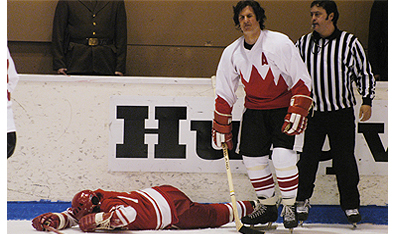
The CBC-TV miniseries Canada Russia ’72 is a cold blast of skate spray to the face of anyone who believes that The Hockey Fight of Our Lives, the historic first meeting of Canada’s National Hockey League pros and Russia’s fabled national team, was a simple story of grit and glory. The two-part, four-hour drama (airing at 8 p.m. on Sunday, April 9 and Monday, April 10) depicts our now-canonized hockey standard-bearers — Paul Henderson, Phil Esposito, Ken Dryden et al — not as hockey heroes, but as frightened POWs who in slaying the Russian bear killed part of themselves.
Even the miniseries’ obligatory climax — Henderson’s last-minute, series-winning goal — becomes part of a sombre, unsettling tableau. Canadian players celebrate the clinching tally on ice and in the dressing room, as you might expect, but soon return in a trance to the dark cavern that is the now empty Moscow arena. There, a familiar mosquito-hum guitar stirs alive, followed by the voice of gloom, Leonard Cohen, murmuring, “I stepped into an avalanche; it covered up my soul…”
As imagined by Trailer Park Boys writer-producer Barrie Dunn and co-scenarist Malcolm MacRury, Canada Russia ’72 goes so far as to suggest that the wounded soul of Canada was wretchedly exposed in the eight-game hockey tournament. The miniseries begins with Canada’s NHL heroes playfully exerting themselves in training camp, building an appetite to feast upon the amateur Russians — a spectacle eagerly anticipated by patriotic Canadian fans. Then came Team Canada’s (and this country’s) ugly humiliation. The first match, played in Montreal, saw the Soviets brush aside Canada’s best, 7-3.
The TV drama takes us into the losing team’s dressing room the following morning, where goalie Ken Dryden, a Cornell University graduate, reflects upon the tidal wave of public venom that has engulfed his team: “All this public flogging,” the goalie ponders, “It’s like a spasm of self-loathing. It’s as if the fragile Canadian ego can’t accept the fact that we might not be the only people in the world who are good at hockey.”
Part one of the compelling, filmed-in-New Brunswick series follows the tournament through Canadian cities: after Montreal, Toronto, then Winnipeg and Vancouver. Team Canada wins but a single game, while losing thousands of fans, who take to ridiculing their former heroes in an effort to mask their shame. When, in part two, several Canadian players desert the panicking club in Moscow, we understand that Canada Russia ’72 is a war movie as much as a sports story, and one that is not afraid to tell unflattering truths about soldiers, generals and cheering crowds.
Going ballistic: Team Canada coaches (left to right) John Ferguson (Mark Owen) and Harry Sinden (Booth Savage) vent their true feelings.
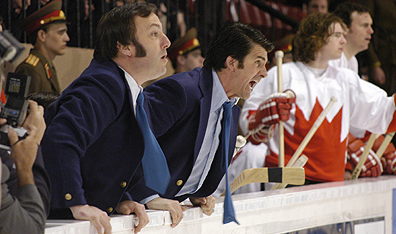
The most involving moments take place in dressing-room trenches, before battle, where we see players and management wrestle with the disgrace of probable defeat. Deranged with anger at being benched game after game, Vic Hadfield quits the team and heads back to Canada. Coach Harry Sinden is seen gargling scotch before one contest. Tournament organizer Alan Eagleson, a bull who travels with his own china shop, flails at Russian counterparts, angling for concessions for his side.
Allied in hatred and suspicion of a Russian opponent who comes to represent the sum of all their fears, the remaining players band together, evolving into the murderously efficient crew that was Team Canada. The miniseries, which is directed by TW Peacocke (The Eleventh Hour), is very good at capturing the psychological foreplay that leads to mortal combat. In one segment, coach Sinden patiently reassures skittish goaltender Dryden, even while his hatchet-faced assistant, John Ferguson, whispers a silent, purposeful command into the ear of the team’s most willing soldier, Bobby Clarke.
Later, Clarke finds Russia’s greatest player, pinball blur Valeri Kharlamov, and takes him out with a two-handed slash to the ankle that would bring down a tree. With Kharlamov neutralized, Team Canada becomes the first foreign army to conquer Moscow, beating Russia three straight games.
Canada Russia ’72’s greatest achievement is that it somehow manages to create a gripping drama out of a story most Canadian boomers thought they knew by heart. The accomplishments here are rich and various. Dunn and MacRury manage a provocative screenplay while remaining true to the pungent banter and war-whoop camaraderie of the hockey dressing room. Filmmaker Peacocke, meanwhile, has found a mode of expression — a fluid, cinéma vérité shooting style — that lends a bracing immediacy to action on and off the ice.
Peacocke has also done an impressive casting job. The miniseries presents Team Canada as a collective protagonist. What characters the filmmakers do flesh out, they mostly get right. Booth Savage expertly captures the beleaguered calm of coach Sinden, while David Berni personifies the airy superiority and grit of superstar-turned-commando Phil Esposito. And Gabriel Hogan is perfect as erudite, dithering netminder Ken Dryden.
The TV drama does get one Team Canada member wrong. With his wild flounce of curls and unconcerned manner, John Bregar’s Bobby Clarke seems a comic hybrid of Harpo Marx and the loopiest Hanson brother from Slap Shot. Whereas the real Clarke, who went on to captain the Philadelphia Flyers to Stanley Cups in 1974 and 1975, is as serious as a heart attack. There are other minor flaws: Peacocke switches to a distracting black and white film stock when venturing into the Russian dressing room. And the decision to replicate so many key on-ice sequences is arguably a mistake, given the actors are travelling with half the speed and artistry of their real-life counterparts.
Still, in a brawling, ambitious work distinguished by compulsive risk taking, these are almost unnoticeable transgressions. Canada Russia ’72 captures this country’s dangerously consuming passion for hockey with probing intelligence and wit. Another plus: it gets the ’70s show that was Canada right, from Pete Mahovlich’s Parker Brothers game board suits, to the series’ soundtrack, which makes a dozen cheeky Canadian pop-cult references. Team Canada’s opening game disaster is set to the Guess Who song No Sugar Tonight, while the club’s arrival in Moscow is marked by the Poppy Family’s moody trifle Where Evil Grows.
Curiously, the miniseries makes little effort to understand the Russian players. They are seen here to be little more than good hockey players — puzzled hostages to a Canadian psychodrama they could not begin to understand. For as the Dunn-MacRury interpretation of the first great international hockey super-series makes clear, Team Canada won by employing a cruelty of purpose that was as chilling as the ice they fought on. “There is no doubt in my mind that I’d have killed to win that series,” Phil Esposito would later tell a reporter. “It scares me, but it’s true.”
Stephen Cole writes about the arts for CBC.ca.
 CBC
does not endorse and is not responsible
for the content of external sites
- links will open in new window.
CBC
does not endorse and is not responsible
for the content of external sites
- links will open in new window.
Copyright © 2005 Canadian Broadcasting Corporation - All Rights Reserved
Related
Internal Links
More from this Author
Stephen Cole
- Guy Talk
- The hit comedy Entourage shows Hollywood some love
- Tuned Out
- Panic in American TV land
- End of Term
- The series finale of The West Wing
- Heeeeeeelp!
- The disaster picture, then and now
- Canadian Idols
- Randy Bachman and Burton Cummings take care of business


