Illustration by Jillian Tamaki
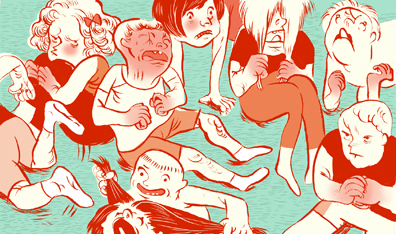
In her classic how-to book Kids Are Worth It!: Giving Your Child the Gift of Inner Discipline (1994), child-rearing guru Barbara Coloroso divides parenting styles into three types: the controlling, punishment-minded brick wall; the wishy-washy, inconsistent jellyfish; and the firm but compassionate backbone.
Oh, to be a backbone parent! Coloroso’s ideal is patient, resolute, affectionate and full of wise, empowering ideas about handling a toddler’s tantrums and a teenager’s delinquency. The sad reality is that a lot of parents flounder between the other two approaches, with this generation of parents, the pampered, self-absorbed baby boomers and Generation Xers, tending towards the jellyfish.
For proof in the extreme, one needn’t look any further than television’s Supernanny and Nanny 911, two reality shows that dispatch childrearing experts to homes, where, as the announcer of Nanny 911 intones, “kids [are] completely out of control and taking over the household.” Are they ever! In quick montages that set up each show, siblings are throttled, toys are kicked, smashed and thrown, food is spat out, bedtimes are ignored, parents are slugged and homes are laid to waste by children on Godzilla-like rampages. Meanwhile, cowering on the leather sectionals in their suburban McMansions, bewildered parents plead to the camera for a nanny intervention: “Our family needs help!”
The first nanny to the rescue was Supernanny, aka Jo Frost, a zaftig, Mary Poppins type full of cute Britishisms (“What a cheeky madam!”), who was a celebrity in England before ABC imported her show to the U.S. After driving up in her black London cab, she observes the family, makes recommendations — including sending bratty kids to the famous Naughty Corner for a time out — and then cuts the parents loose to see how they do on their own (invariably poorly), before stepping in for a final tutorial.
Caped crusaders: From left, Nanny Yvonne, Nanny Deb, Head Nanny Lilian, Frasier the butler and Nanny Stella of Nanny 911. Courtesy Fox/Life Network.
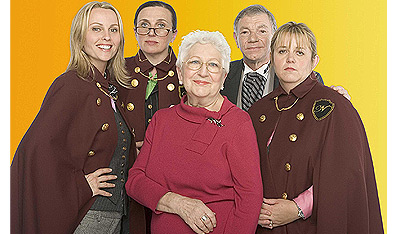
Fox’s Nanny 911, a lower-budget rip-off, varies only in its set-up. Like frumpy Charlie’s Angels, a crack team of caregivers convenes at Nanny Central for assignments from Head Nanny Lillian (identified as “Nanny for the Royals”), before being sent out in matching burgundy capes and hats to offer assistance.
On both shows, the suggestions are simple, sound and, after two or three episodes, dully repetitive: set limits and stick to them; be consistent; praise good behaviour; don’t stray from the daily routine; and provide kids with lots of opportunities to play. But this practical advice isn’t the appeal of the shows. It’s the monstrous kids. There’s also the Schadenfreude and comfort viewers get in knowing that no matter how many fits their own kid has thrown at the grocery store, he’s still not as bad as four-year-old Dylan, who punches his mother and screams, “I’m the boss!”; or six-going-on-sixteen Jadyn, who back-talks, slams doors and refuses to stay in her own bed; or eight-year-old Olivia, the eldest of seven, who, when asked to help with dinner, hides under the table and refuses to come out.
But the sly trick of the shows is how much they reveal about the adults. As Nanny Deb puts it on Nanny 911, “the issues tend to be with the parents, not with the kids.” And the parents are a mess — bickering with each other, uncomfortable with setting limits and as addicted as their kids to their large-screen TVs and junk food.
Most of the couples barely like each other, let alone their children. The adults gaze helplessly at high chairs and minivans and at the spaghetti drying on the kitchen floor, as if to say, how did I get here? One couple on Nanny 911 hasn’t slept together in years because the mother refuses to stop sharing a bed with their five-year-old son. A dad on Supernanny puts his two-year-old twins in front of the television for three hours at a stretch so that he can surf the internet. It’s no wonder that the first thing Supernanny does is put the parents on a schedule. Despite exploring the experience of parenthood to the navel-gazing extreme in parenting memoirs (sometimes called momoirs), blogs, vlogs and hipster television shows like Erica Ehm’s new series Yummy Mummy, today’s parents seem reluctant to embrace the biggest prerequisite of all: being an adult. Maybe it’s just the editing, but when I’m-the-boss Dylan finally does learn that there are consequences to his actions, he is visibly relieved. Turns out the four-year-old had been running the household because no one else was doing the job.
Red is the colour of rehabilitation: the Brat Camp posse. Courtesy ABC/CTV.
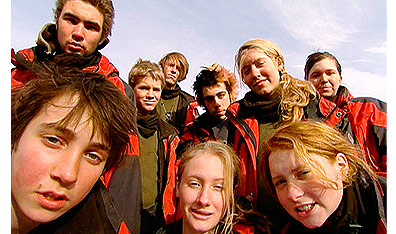
ABC’s new reality show Brat Camp stars what could be the older siblings of the kids from Supernanny. Another Brit-inspired concept, Brat Camp sends nine troubled teenagers to a SageWalk, a “last resort” wilderness therapy camp in the Oregon desert, where they have 40 days to sort themselves out through exhausting hikes, wholesome food and intensive therapy sessions. Think of it as a granola version of the boot camps that Maury Povich and Sally Jesse Raphael used to send kids to.
Adolescence is excruciating, period, but never before have teenagers occupied such an awkward place in our culture. They’re coveted by clothing manufacturers, music labels, film distributors, soft-drink companies, and, yes, reality-show producers, but written off in sensationalistic media reports as out-of-control “teens gone wild” — despite consistently dropping rates of youth violence and crime. To make matters worse, there are fewer ways for teenagers to benignly rebel. Teens in the 1950s could reject their parents’ Lawrence Welk recordings for Elvis. Today, most adults remain in arrested adolescence, sharing their children’s clothes, musical tastes and pop-culture references.
Brat Camp executive producer Arnold Shapiro has the perfect credentials to exploit these ironies. He produced the 1978 documentary Scared Straight!, which won an Oscar for its look at a group of convicted criminals who persuade bad kids to stay out of trouble; he’s also the mastermind behind reality schlock like Big Brother, Minding the Store and Blow Out. Not surprisingly, Brat Camp melds high-minded intentions with reality-show sensationalism.
It starts when the teenagers are dropped off by their parents, all of whom have lied to their children about what’s to come. Needless to say, when the SageWalk counsellors (who go by “earth names” like Glacier Mountain Wolf, Fireshaper and Stalking Cougar) break the news, the kids freak out — with the notable exception of 16-year-old Heather, who arrives covered in hickies and too hungover to react. They’re stripped of their jewellery, clothes, cell phones and piercings, which to most of them is tantamount to being stripped of their identities (which, Glacier explains, is the whole point). Outfitted in new, identical outdoor gear, they are driven to base camp.
Blonde ambition: sixteen-year-old Heather in Brat Camp. Courtesy ABC/CTV.

To assist viewers in distinguishing between the “Hostile Outcast,” the “Self-Destructive Drug User” and the kid who “Tried to Stab Twin,” producers provide helpful captions. Yet, for all the fear mongering, most of the kids don’t seem that different from typically heavy-drinking, drug-using, sexually active middle-class kids who usually straighten out on their own.
What makes for difficult viewing — and what calls into serious question the ethics of the producers, and the parents who consented to their children being filmed — are the kids involved who are truly disturbed. There’s 14-year-old Derek, who refuses to take medication for ADHD and is overcome by twitches and verbal outbursts; 16-year-old Lexi, who was molested by a family friend; and Nick, a 14-year-old with dyslexia who hates himself for being “stupid.” These aren’t brats, but teenagers with profound emotional and developmental issues that require ongoing therapy. They deserve better than the banal ministrations of Mother Raven, SageWalk’s resident therapist, who tells a weeping Lexi that it’s “hard when bad things happen to good people.”
To their immense credit, the kids in the show adapt more quickly than any adult I know would in their situation. There is something to be said for some aspects of SageWalk’s program. The kids seem genuinely to benefit from the time for self-reflection and blossom as they master tasks like rappelling down a cliff and starting a fire with two sticks under the tutelage of the admirably patient counsellors. For all their silly New Ageisms, Boulder, Fireshaper and the gang appear to be the first adults to take the teenagers seriously.
If only the other adults in charge would just turn off the cameras.
Rachel Giese writes about the arts for CBC.ca.Copyright © 2005 Canadian Broadcasting Corporation - All Rights Reserved
More from this Author
Rachel Giese
- Ladies Man
- Volver's feminine touch
- Fit to Print?
- A conversation with the Canadian distributor of O.J. Simpson's new memoir
- Yep, I'm Gay
- Hollywood's incredible shrinking closet
- Eyes on the Prize
- Breaking down this year's Giller Prize nominees
- A Passage from India
- An interview with Booker winner Kiran Desai


