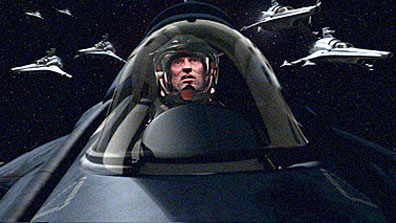
An image from the new Battlestar Galactica series. Courtesy Space: The Imagination Station.
Before Space: The Imagination Station went to air in 1997, friends told program-buyer Ismé Bennie she had to get the cult BBC series, Doctor Who. Used to be their favourite show, they all said.
Used to be, is right. “We put the series on in prime time and it did badly – Doctor Who was for another time,” Bennie says of the 750-year-old doctor who began making TV house calls in 1963. When Space pulled the show, it received one complaint that was nonetheless taken very seriously. The irate viewer threatened to kill Bennie.
Hearing this, I admit succumbing to a lingering suspicion of the science fiction world. Sci-fi was for guys who owned a car before they had their first date, I once figured. Nevertheless, I’d heard intriguing things about Space, currently available to 4.7 million Canadian homes. For instance, two shows, Battlestar Galactica and Enterprise outdraw snob specialty channel comedies like Curb Your Enthusiasm and The Office. Also, while Space demographics tilted young (18-34), the actual viewing audience was – surprise! surprise! – almost evenly split between men and women.
Finally, I recently received a testimonial from a fan reporting that Space scattered originally produced sci-fi and science bits thoughout its schedule. Perhaps it was time to give space travel another chance. To that end, I put Space through the test with which I challenge all specialty channels: what was it like to come home to after work or school? Any can’t-miss shows? How about late night compatibility – anything you might want to share a midnight bowl of Honey Nut Cheerios with?
For the next three days this remote patroller spent his entire TV days and nights lost in space, searching for answers.
Men are from Ullia, Women are from Kobali
Good news. Space passed its first test with flying saucers. The specialty channel’s late afternoon program block is a smartly sequenced package of retro TV. Space devotes some time to horror and paranormal. Buffy the Vampire Slayer (1997-2003) is its top non-sci-fi program. The show’s weekday afternoon, 3-4 p.m. time slot is perfect – because the old WB-UPN series is maybe the best after-school show ever. For the uninitiated, Buffy (Sarah Michelle Gellar) is a teenager whose great talent is slaying vampires – often with withering scorn: “You’re a vampire. I’m sorry, was that an offensive term? Should I say Undead American?”
The show’s conceptual coup was depicting high school as an actual as opposed to figurative horror show. In today’s episode, something beneath the ground reaches up to swallow Xander’s new girlfriend’s dog. With that the gang heads down to the malt shop to confront the dog snatcher – Xander’s old girlfriend. That’s where the following Valley Girl haiku plays out amongst four teenagers, two of them vampires:
“I thought you were Xander’s ex?”“I am.”
“But you and Spike?”
“Had a thing.”
“Didn’t last.”
“But weren’t you and Buffy?”
“Briefly.”
“Never serious.”
“… Anyone you haven’t slept with?”
After Buffy, Space takes to the skies with a Star Trek marathon until dinner. First comes Star Trek (1966-69) then Star Trek: The Next Generation (1987-94) and Star Trek: Voyager (1995-2001). The shows represent 35 years of sci-fi gadgetry. Still, watching them all in a row, I’m startled to discover how obsessed they all are with clumsy, inter-species romance.
The Star Trek episode “Metamorphosis” first aired in 1967. A space shuttle carrying Captain Kirk, Mr. Spock, Bones and an ailing woman arrives on a planet where a lost pilot lives with a glowing cloud-like intelligence. The female patient appears to be dying, while the pilot yearns to return to live with humans. Growing anxious, the alien vapour professes “her” love for the flyer. The Vulcan (Spock) and multi-hued Earthlings, Kirk, Scotty, Lieutenant Uhura and Mr. Sulu observe all this while engaging in a Socratic debate on the challenge of interracial harmony. Finally, the vapour claims the body of the dying woman and the love of the reluctant pilot. In response, Uhura articulates Star Trek’s universal humanism, declaring, “It’s a big galaxy, Mr. Scott.”
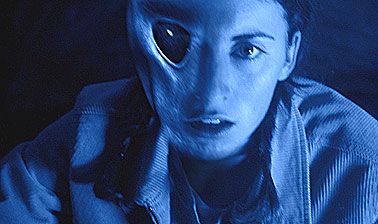
The same scenario plays out later on Star Trek: Voyager. Here, Voyager unexpectedly receives back a presumed dead shipmate, Lyndsay Ballard. The ensign has been revived by the sexless Kobali, it seems. “That’s how they procreate,” a crew member hisses. “They salvage the dead of others.” Now Ensign Ballard is herself Kobali and so possesses a blue cantaloupe head with bathtub-drain ears. Nevertheless, her former shipmate, the painfully non-communicative communication officer, Harry Kim, professes his love. He won’t let Lyndsay get away again. A doctor performs cosmetic surgery. Lyndsay seems human. She and Harry shyly begin dating. But it’s no good. Lyndsay is irretrievably Kobali and so must return home. Harry protests. The Kobali are monsters. Lyndsay can’t go back. Captain Kathryn Janeway (Kate Mulgrew) gently intercedes. Her message: It’s a big galaxy, Harry.
That the middle episode in today’s Star Trek trilogy, a genuinely horrific 1992 episode from the Next Generation, focuses on a troubled sexual encounter between a telepathic Ullian and the Entreprise’s counsellor (Marina Sirtis), leads me to conclude that the Enterprise and Voyager are ideal vessels for transporting TV viewers who are bewildered by the opposite sex. For in Star Trek, men are always from Ullia, while women are from Kobali.
11 Somerset is one of several shot-in-Canada programs on Space. Courtesy Space: The Imagination Station.
Celestial wallpaper
Having been wholly absorbed by the specialty channel’s late-afternoon dating dilemmas, I space out for a while, absently watching shows for scenery as opposed to storylines.
First discovery: most scenery is Canadian. I count at least a dozen shows with Vancouver or Toronto locales, including Stargate SG-1, Andromeda, Mutant X, Dead Zone, Battlestar Gallactica, and the astonishingly bad Relic Hunter (underwear erotica disguised as an Indiana Jones adventure, with History Prof. Tia Carrere stripping at least once between commercial breaks).
Space features 40 or so sci-fi shows, including first-run, re-run and miniseries. Then there are also daily movies, including a Friday horror double bill. Programming breaks are frequent, but I’m guessing fans don’t mind because many ads are for recently released sci-fi DVDs and movies.
As promised, the specialty channel also features lots of one- to five-minute science and sci-fi spots. Surprises here included Canadian poet-natural historian Christopher Dewdney contemplating the light bulb, and an investigation into a gamma ray that hit Earth this past Christmas season. These value-added bits are crucial to consolidating Space’s identity as the electronic home for sci-fi fans. And I can see believers using the specialty channel as celestial wallpaper for their TV screens when not actively watching programs.
The Cylons are coming!
Sci-fi isn’t for everyone of course. Geneviève Bujold was hired to play Captain Janeway on Star Trek: Voyager, but after a few days on set concluded she belonged elsewhere. Three days into my own star trek, I occasionally experience similar misgivings.
Angel (1999-2004), Monday-Thursday at 1 a.m., is an intriguing Buffy spinoff that I would gladly share a bowl of Cheerios with anytime. But the movies that follow are terrible. In fact, all movies on Space are pretty crummy. Not compulsive junk food bad either – just boring, straight-to-home-video bad. Where are all the cold war classics from the ’50s? Where are the Blobs and Bodysnatchers? How come no Godzilla? Come to think of it where is The Twilight Zone and … I almost said Doctor Who.
Well, perhaps the classics of another era are just that – for another era. All the same, having watched Space’s first-run Saturday-Sunday blockbusters I wonder if the future of sci-fi TV will be as rich as its past. The recently cancelled Enterprise (Sunday) isn’t a patch on previous Star Treks. Gone are the inter-personal and philosophical quandaries that made the original production into a multi-series, 10-film franchise. Enterprise is an action series plain and simple – with emphasis on simple.
Much more interesting is Saturday’s Battlestar Galactica, a 2005 sequel to the short-lived 1978-79 TV series. The old ABC show died trying to outperform Star Wars. The pilot cost $3 million (U.S.), at the time the most expensive TV premiere ever mounted. Ironically, I can’t help wonder if the current Galactica will be defeated by its Matrix pretensions.
The new shot-in-Vancouver show looks fantastic. Exploding fireballs and zipping spacecrafts seldom look this good on the big screen. And the series is particularly good at capturing the adrenaline highs of battle. The young pilots of Galactica’s battleship fleet are perpetually zonked on uppers and talk in jangling rushes: “Be careful? Our job isn’t to be careful. It’s to shoot Cylons out of the frackin’ sky!” Galactica’s top gun, Kara “Starbuck” Thrace (Katee Sackoff) shouts at one point.
The Cylons are sentient robots who have turned on their creators – the humans of the 12 Colonies of Kobol. Many Cylons have taken a human form. Some think they actually are human. Is the spy trying to infiltrate Galactica a traitor to himself? Can we even believe what we’re seeing? “You’re not really here and neither am I,” Galactica’s doleful genius, Dr. Gaius Baltar (James Callis) advises spy mistress, Number Six (Tricia Helfer). Dr. Baltar frequently repairs to the back of his mind when things get bleak on board the spaceship, taking Six and us with him.
Every character here has a back-story that ties into the greater drama. The President (Mary McDonnell) battles a second interloper – cancer. And brooding fleet commander, William Adama (James Olmos) has a potential opponent in his impatient second-in-command, a high-functioning alcoholic (Michael Hogan). The drugs, conspiratorial sex, and high-energy battle scenes are fun, but like the willfully obscure later installments of The Matrix, Battlestar Galactica is too much like math homework for anyone other than sci-fi junkies.
“The universe is a vast and complex system. Coincidental, serendipitous events are bound to occur; indeed they’re to be expected, part of the plan, part of the pattern,” Dr. Baltar drones on listlessly at one point.
Right, I got it. “It’s a big galaxy, Mr. Scott.” Me, I think I’ll skip Dr. Baltar and hang around with Buffy and Captain Kirk.
Stephen Cole writes about television for CBC.ca.More from this Author
Stephen Cole
- Guy Talk
- The hit comedy Entourage shows Hollywood some love
- Tuned Out
- Panic in American TV land
- End of Term
- The series finale of The West Wing
- Heeeeeeelp!
- The disaster picture, then and now
- Canadian Idols
- Randy Bachman and Burton Cummings take care of business


