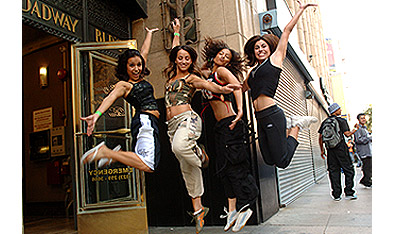
We have lift-off: Dancers outside a casting call for the reality show So You Think You Can Dance. Courtesy Fox/CTV.
Of all the oddball fads spawned during the jazz age — like flagpole sitting and jalopy stuffing — the dance marathon endured the longest, peaking during the Great Depression, when they capitalized on the public’s desperate need for distraction. Organized by sleazy promoters who manipulated the outcome and lured hungry couples out of the breadlines and into the competition with the promise of free meals, the marathons lasted for days, even months. For a quarter, audience members could watch as long as they wanted, witnessing exhausted dancers hallucinate, pass out and be eliminated by the judges until only one couple was left standing. Despite their mass popularity, dance marathons were decried as grotesque, exploitative diversions.
In other words, they were the reality shows of their day.
So it’s surprising it took until this summer for dance to get the reality-show treatment with ABC’s Dancing with the Stars, which coupled B-list celebrities with professionals for a ballroom dance-off, and Fox’s So You Think You Can Dance, an American Idol-style search for the “nation’s best dancer.” With the acclaim received by three recent documentaries — Mad Hot Ballroom, about an elementary school ballroom competition; Breakin’ In: The Making of a Hip Hop Dancer, about aspiring music video dancers; and Rize, David LaChapelle’s celebration of krumping — pop culture is finding itself in the middle of a dance moment.
The last time dance was this hot was the 1980s. Saturday Night Fever (1977) brought disco out of gay and black clubs and into the mainstream, romanticizing dance as Tony Manero’s ticket out of his working-class life in Brooklyn. Two other films, with similar dance-as-escapism themes followed: Fame in 1980 — which had a successful TV spinoff — and 1983’s Flashdance. TV’s cheesy amateur disco competition, Dance Fever, ran from 1979 to 1987, but by the late 1980s, the ascendance of music videos drove most dance shows — including long-running American Bandstand, which was cancelled in 1989 — off the air.
Dance competitions aren’t an obvious draw for TV viewers. While singing competitions like American Idol rely on an audience’s familiarity with pop music talent and the opportunity to see a superstar in the making, most people don’t know enough about dance to distinguish between what’s good and what’s bad. Dance stars like Fred Astaire and Ginger Rogers don’t exist anymore. Today’s dance world doesn’t have any Mariahs, or Celines, or Beyonces. At best, a winner might hope to star in a Christina Aguilera video, or get cast in the chorus of a Broadway show. Still, there’s something undeniably compelling about people working hard at their craft and making it look so effortless. Watching dancers master a tricky turn, or fling themselves through the air with pure exuberance, appeals to one’s own inner ugly duckling: If only I could move like that.
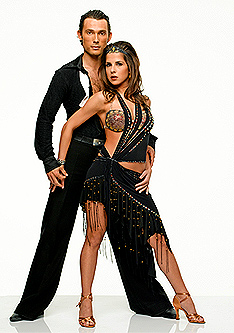
Dancing with the Stars, inspired by the BBC’s Strictly Come Dancing, almost didn’t make it to air. Network executives didn’t think the concept would fly with American audiences. It ended up becoming a surprise hit for ABC, by taking full advantage of an otherwise sluggish summer season with the campy lipgloss-and-hairspray confection of ballroom dance. The small group of good-natured contestants, who genuinely loved to dance, made for a dramatic and tightly focused competition. It didn’t hurt that it ended with a Sale and Pelletier-esque controversy over the judging, when favourite John O’Hurley (Seinfeld’s J. Peterman) lost out to General Hospital’s Kelly Monaco. (The show will return for a second season, with a new voting system.)
Dancing is very serious business: Professional dancer Alec Mazo and his partner, General Hospital's Kelly Monaco, in the series Dancing with the Stars. Courtesy ABC/CTV.
On So You Think You Can Dance (Fox, Wednesdays at 8 p.m.), competitors vie for a grand prize of $100,000 US and a rent-free year in a New York apartment. There’s little dancing on display — and that’s part of the problem. Instead, the show foregoes the big performance payoff for the typical reality-show drama: Should Blake, a professional dancer, be allowed to compete? Was hopeless Jessica faking her injury to get out of learning a complicated routine? Can chubby Allan master the lifts in his demanding salsa class?
At the helm is American Idol producer and one-time choreographer Nigel Lythgoe, an even crankier version of Idol judge Simon Cowell, but without the occasional spark of wit. (Lythgoe shares Cowell’s thinly veiled homophobia, reproaching male dancers who don’t seem masculine enough.) Judging alongside Lythgoe, there’s Mia Michaels, who favours big, pretentious Martha Graham movements; suave and tight-trousered salsa instructor Alex Da Silva; hip-hop choreographers Brian Friedman and Dan Karaty, who, between them, are responsible for the music video moves of Britney Spears, Hilary Duff, Jessica Simpson and ’N SYNC; and Mary Murphy, the bitchy, Southern Belle ballroom instructor, who has come out with the best line of the series. Eyeballing a scantily dressed dancer tripping her way across the floor, Murphy snarks, “The last thing I want to see when someone is doing the foxtrot is crotch!”
As fun as it is to see street dancers struggle through the tango or Irish dancers attempt to lock and pop, there’s no sense of what’s at stake. There are flashes of artistic inspiration and drive in an impromptu hip-hop dance battle and when the exhausted competitors compare post-rehearsal bruises. But, unlike American Idol, where singers are competing for the tangible prizes of a million-dollar recording contract, while spending weeks building up a ready-made fan base, So You Think You Can Dance promises the winner little more than a chance to spend a year in auditions. Which raises the questions: What drives them to do what they do? And, since the producers don’t seem to care, why should we?
While some of the contestants really are just fame whores, So You Think You Can Dance fails because it is nothing but cynically commercial. For all its corniness, Dancing with the Stars genuinely celebrates dance. So You Think You Can Dance celebrates celebrity. And even the most clued-out contestants get the difference. When a mediocre but hard-working woman is kicked out of the competition, one judge advises her to become a Britney Spears impersonator in Las Vegas — “You’d make a lot of money!” she crows. In response, the devastated hopeful tells the camera, “But I don’t want to be Britney. I just want to dance.”
Rachel Giese writes about the arts for CBC.ca.Copyright © 2005 Canadian Broadcasting Corporation - All Rights Reserved
More from this Author
Rachel Giese
- Ladies Man
- Volver's feminine touch
- Fit to Print?
- A conversation with the Canadian distributor of O.J. Simpson's new memoir
- Yep, I'm Gay
- Hollywood's incredible shrinking closet
- Eyes on the Prize
- Breaking down this year's Giller Prize nominees
- A Passage from India
- An interview with Booker winner Kiran Desai


