Repeat offender: Richard Pryor. Photo David McGough. DMI/Time Life Pictures/Getty Images.
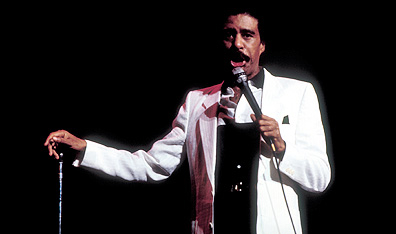
The best comedian of his generation, Richard Pryor had his own TV series in 1977. The first show opened with a shot of the comedian from the waist up, naked, boasting that he’d surrendered nothing to NBC censors. The camera then panned down to reveal the performer was wearing a nude body stocking that made it look as though he had no genitals, the implication being that he felt emasculated by the network censors.
NBC cut the gag. The Richard Pryor Show was cancelled a month later.
The bit was classic Pryor, an artist who always struggled to tell the naked comic truth, no matter how discomforting that might be for himself or anyone else.
Richard Franklin Lennox Thomas Pryor died of a heart attack on Dec. 10, just days after his 65th birthday. He was born on Dec. 1, 1940, in Peoria, Ill. Pryor grew up in his grandmother’s brothel, where the embryonic performer collected material observing hustlers, pimps and prostitutes. “Richie” made his stage debut at seven, sitting in on drums with a whorehouse band. He was a father at 14 and joined the army four years later, making his first stand-up appearance as a serviceman in Germany, participating in amateur nights.
Leaving the service, Pryor gravitated to New York, where he fell under the spell of mainstream humorist Bill Cosby. In 1966, the Peoria native got his big break, appearing as a safe, likeable joke teller on The Ed Sullivan Show. Although Pryor had made it big at age 26, he was miserable. Performing at the Las Vegas Aladdin Hotel in 1967 in front of a packed house of sated, middle-aged gamblers, Pryor mumbled, “What the f--- am I doing here?” then promptly quit the stage.
Calling the experience an “epiphany,” Pryor told the Washington Post, “I found out who I wanted to be. And who I wanted to be was the same guy who used to rap on the street corner back on North Washington Boulevard in Peoria.” He would elaborate on his move to a more candid, personal comedic style in his autobiography Pryor Convictions: “There was a world of junkies and winos, pool hustlers and prostitutes, women and family screaming inside my head, trying to be heard.”
Those voices were made public in the early ’70s, as Pryor geared his performances to an emerging counterculture, even as he continued to work mainstream Hollywood, writing The Flip Wilson Show (1970-74) and the movie Blazing Saddles (1974), while appearing in the Billie Holliday biopic Lady Sings the Blues (1972).
But it was on stage that Pryor was most alive. Albums like Craps (1971), That Nigger’s Crazy (1974) and …Is It Something I Said? (1975) were astonishing comic turns that attracted a cult of young listeners while stretching the boundaries of good taste. Just as Bob Dylan, the Beatles and Marvin Gaye liberated fellow artists from the conventions of popular music, Pryor’s profane, free-ranging comic musings emancipated comedians, allowing for greater personal and social commentary.
When TV, the tidiest of all entertainment media, loosened up in the mid-’70s, Pryor became the hippest, most influential comedian in America. He wrote and performed in an Emmy award-winning special for Lily Tomlin in 1973, hosted Saturday Night Live in its infancy (prompting the five-second delay) and appeared in his own groundbreaking 1977 special, where the dancing Pips, minus lead singer Gladys Knight, soundlessly performed the background choreography for Midnight Train to Georgia.
Pryor seemed like he was everywhere. Although his TV series didn’t last, he picked up seven Emmy and Grammy awards in the ’70s and became a popular film star, appearing in 12 movies from 1976 to ’82, including a series of box-office hits with Gene Wilder. But he remained truest to himself on stage, where, as his entry in the American Museum of Broadcasting attests, “he became the first African-American stand-up comedian to speak candidly… to integrated audiences using the language and jokes blacks previously only shared among themselves when they were most critical of America.”
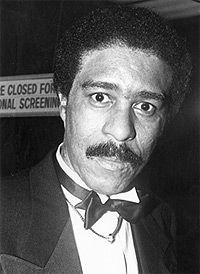
Comic genius: Pryor at the premiere of Stir Crazy, which starred Pryor and Gene Wilder. Photo Lisa Du Bois. Hulton Archive/Getty Images.
Growing up, Pryor felt the sting of racism. In primary school, he had a crush on a white girl in his class and so gave her a present. The next day, the girl’s father barged into class, shouting, “Nigger, never give my daughter anything again!” as the teacher looked away. Years later, he was on The Tonight Show with Johnny Carson, listening as another guest, a sweet old Southern lady, rhapsodized about life in rural white America at the turn of the century.
“Why, there were dances and quilting bees …”
“And lynchings,” Pryor interjected, his eyes wide with panic. Carson and his band were rendered helpless with pained laughter.
Pryor’s effect on audiences is best documented in his concert films, particularly Live in Concert (1979) and Live on the Sunset Strip (1982). There, he talks through childhood whippings, his drug and women problems and the time he set himself on fire free-basing cocaine. But even as he remained himself, Pryor managed to take on the shape and character of all the old voices screaming in his head. “He seemed to go beyond himself,” critic Pauline Kael commented. “He personified objects, animals, people, the warring parts of his own body, even thoughts in the heads of men and women — black, white, Oriental — and he seemed to be possessed by the sprits he pulled out of himself.”
Richard Pryor’s act wasn’t made to last. In the 1980s, he became increasingly dependent on drugs and alcohol. He was diagnosed with multiple sclerosis in 1986 and suffered a heart attack in 1990. Although he retreated from public performance after 1990, his reputation and influence continued to grow. Chris Rock ran an image of one of Pryor’s albums before his 1996 HBO special, Bring the Pain. In 2004, the American network Comedy Central voted Pryor the top stand-up comedian of all time.
That seems about right. For just as jazz saxophonists who came after Charlie Parker inevitably mimicked his sound, so, too, all modern stand-up comedians inescapably imitate Richard Pryor.
Stephen Cole writes about the arts for CBC.ca.Copyright © 2005 Canadian Broadcasting Corporation - All Rights Reserved
More from this Author
Stephen Cole
- Guy Talk
- The hit comedy Entourage shows Hollywood some love
- Tuned Out
- Panic in American TV land
- End of Term
- The series finale of The West Wing
- Heeeeeeelp!
- The disaster picture, then and now
- Canadian Idols
- Randy Bachman and Burton Cummings take care of business


