Illustration by Jillian Tamaki
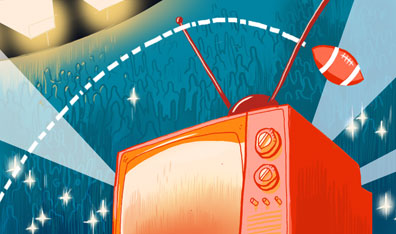
Last year’s Super Bowl was the most popular program in TV history, with 144 million viewers. Incredibly, the top 10 rated American TV shows of all time are Super Bowls.
NFL football is to televised sports what sharks are to underwater life – a miracle of genetic engineering destined to remain forever atop the food chain.
First off, games are on Sunday afternoons, which is sofa time from time immemorial. And playoffs land in North America’s staying-in, broke-after-Christmas season.
There is also dramatic simplicity to a sudden-death championship. Baseball’s World Series clogs up two weeks of prime-time viewing. Children’s Aid might take your kids away if you let them watch hockey playoffs into late-night overtimes. The Super Bowl, by comparison, is extremely consumer friendly: one game only – beginning at six, ending around 10 every year.
The NFL championship is also the biggest game show on TV. It’s expected that $500 million US will be wagered on internet betting sites for Super Bowl 2005. And that doesn’t include Vegas or all the private betting that goes on.
Simply put, the Super Bowl is now so big that even people who don’t like football watch the game, just as many non-Christians enjoy Christmas.
It may surprise you to learn the shark wasn’t always this healthy. Football was once a distant second in popularity to baseball. What happened? Here’s a 50-year chronology that hopes to explain how the Super Bowl became TV’s Superman:
1958 – TV discovers the NFL. Early on, the NFL was considered an industrial league recreation. Team names betrayed working stiff affiliations – Pittsburgh Steelers, Green Bay Packers. The league transcended its Teamster origins with a thrilling 1958 title match between the New York Giants and the Baltimore Colts. The contest went into overtime, with Colts quarterback Johnny Unitas displaying Hemingway cool in engineering two late scores. At once everyone understood how well this violent, dramatic sport suited TV. In 1962 alone, NFL ratings jumped 10 per cent and Green Bay coach Vince Lombardi was grinning through tombstone teeth on the cover of Time. The magazine shout line called football “The Sport of the ’60s.” Three years later, in 1965, the Harris Poll confirmed that pro football had surpassed baseball as America’s favourite pastime.
1967 – Disneyland Armageddon. Genius entrepreneur Pete Rozelle took over as commissioner of the NFL in 1960. For his first miracle, he convinced millionaire owners to join in a grand socialist experiment – all revenues, TV included, would be shared, all expenditures, capped. He then pitched games as “franchise properties” with a stable economic base to competing networks. Rozelle’s crowning glory was the Super Bowl, which he sold as a sort of Disneyland Armageddon – a war between hated rivals (the NFL and the AFL) to be played during the dead of winter in sunny vacation-lands. Ever the showman, the commissioner decreed that games would be marked by Roman numerals. To ensure exposure, he split the first game, in 1967, between two networks (NBC and CBS), who outdid themselves promoting their halves.
1969 – The 19-point spread. Joe Namath guaranteed his New York Jets would upset the Baltimore Colts. And America liked the odds. Super Bowl III generated unprecedented gambling action. Vegas made Baltimore 19-point favourites. Every wise guy in New York put down a bet. And the Jets won, confirming Rozelle’s oft-repeated remark: “On any given Sunday, any team in the NFL can beat any other.” It was a variation on the old gambling hustle – anyone can win! And with that, the Super Bowl quickly replaced the Kentucky Derby as America’s favourite way to lose money.
1970 – Four words – How-ard Co-sell. Rozelle sold night-time football to ABC, expanding the NFL product base while introducing the commentator everyone loved to hate. “Good evening I’m How-ard Co-sell,” the human wind tunnel would begin, “and this is ABC Monday Night Football.” Somehow he always made his name last longer than the show’s title.
1973 – With liberty and football for all. The Apollo 17 crew recited the Pledge of Allegiance prior to Super Bowl VII. Three years later, the half-time theme was “200 Years and Just a Baby: A Tribute to America’s Bicentennial.” Rozelle’s second miracle was at hand: the NFL had recreated the Fourth of July in the middle of January.
1984 – Big Mac attack. The year Blade Runner director Ridley Scott reinvented Super Bowl commercials. His $400,000 US ad began with robots listening to an IBM Big Brother drone on about “information purification directives” on a giant screen. Suddenly a striking blonde emerged, police trailing her. Surging toward the stage, she hurled a slow-mo sledgehammer at the screen, at once shattering Big Brother and Big Blue. Then came the voiceover: “On Jan. 24, Apple Computer will introduce Macintosh. And you’ll see why 1984 won’t be like 1984.” Eight thousand Macs were sold the next day. The following year, ad rates jumped by almost 40 per cent, with a half-minute spot garnering $525,000 US. From here on, many would watch the Super Bowl just for the ads, hurrying to the kitchen for refreshments when the game returned. The result: Ads are now $80,000 US a second, or $2.4 million US a pop.
1987 – Sunday triple-headers. ESPN began airing NFL games. Once the broadcast home of tractor pulls, the cable network gained instant credibility. In return, ESPN gave the NFL a Sunday night game slot to complement two afternoon matches, as well as a venue for 35 years of “Great NFL Moments” sports banquet tapes, to be shown in perpetuity in the early morning. The league also got hourly football newscasts throughout the season – football 24/7.
1989 – The Piano Man's tip jar runneth over. Reigning king of middle-aged pop, Billy Joel sang the national anthem prior to Super Bowl XXIII. His appearance ensured that the game reached the 18 to 45 demographic coveted by advertisers. From this point forward, superstars would entertain at all Super Bowls. In 1993, Michael Jackson appeared alongside 3,500 school children. (Yikes, that’s no good, you’re thinking. Relax-relax, O.J. Simpson, the ceremonial coin flipper, was there to make sure nobody got out of line.)
1995 – The NFL invades Europe. The NFL and Fox Network (how cozy) announced joint partnership in the NFL European League, with teams in London, Frankfurt, Barcelona, Amsterdam, Cologne, and Dusseldorf (the Rhein Fire!). The European clubs served as spring farm teams for NFL clubs – and their telecasts as teasers for the Super Bowl broadcast. By decade’s end the NFL championship was airing in 180 countries.
2004 – Nipplegate. Super Bowl XXXVIII earned every one of its X’s with an infamous half-time show featuring Janet Jackson, Justin Timberlake and a suspicious “wardrobe malfunction.” The NFL and CBS were endlessly apologetic, but you would have to go to the Nile to find more crocodile tears. The allegedly shocking half-time show confirmed an enduring selling point of The Great Event in TV broadcasting: On any given Sunday, anything can happen.
Stephen Cole writes about television for CBC.ca.More from this Author
Stephen Cole
- Guy Talk
- The hit comedy Entourage shows Hollywood some love
- Tuned Out
- Panic in American TV land
- End of Term
- The series finale of The West Wing
- Heeeeeeelp!
- The disaster picture, then and now
- Canadian Idols
- Randy Bachman and Burton Cummings take care of business


