Ken Finkleman as George Findlay in season three of The Newsroom.
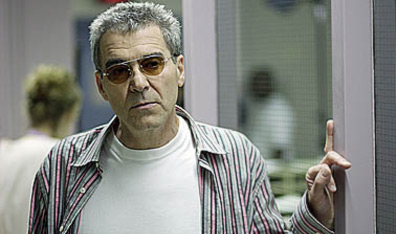
It’s easy to understand why
Ken Finkleman is reluctant to let George Findlay go. It took
him a creative lifetime to find the character who allowed
him to make not only The Newsroom, now in its third
and final CBC season, but also the spin-off dramadies Escape
from the Newsroom, Foreign Objects, More
Tears, and Foolish Hearts.
Long before George, Finkleman was a Winnipeg law student who
bluffed his way (along with Dan Aykroyd) into writing a Toronto
TV talk show for Norm Crosby in the 1970s. After that he dashed
off a few King of Kensington scripts before heading
to Hollywood, where he wrote Grease 2 and wrote and
directed Airplane II.
All profitable work, but the challenge of writing talk-show patter for an admittedly deaf TV host and finding group activities for the retirement-home cast of Airplane 2 (Raymond Burr, Peter Graves, Chuck Connors and Sonny Bono) eventually proved too much. Perhaps in self-defense, Finkleman began satirizing TV and movies.
“At one point I had had it,” he once commented. “I was in Toronto talking to six people in L.A. on speakerphones. They sent me notes on a comedy I’d written. Twenty pages, single-spaced. A perfect document about what’s wrong with American movies — full of stuff about architecture of character and dramatic arcs. And I realized I couldn’t do that anymore.”
So he stayed home, knocked off a funny mockumentary, Married Life (1995), then went to CBC with an idea for a comic investigation into the showbiz frauds who hijacked the evening news. The resulting Newsroom (1996) was a deserving critical hit that served its million-plus audience well. The satire targeted newsrooms, but George Findlay’s preening news director boss and entourage of toady producers (Mark Farrell and Jeremy Hotz) could be appreciated by anyone who had an office job.
And in the character of Audrey the receptionist (Tanya Allen), the series caught Generation X’s “whatever” indifference to boomer careerism. The actress once told me she couldn’t go into a bar after work without some smart ass repeating George’s oft-repeated request to “go get me a muffin.”
Ring dem bells, CBC had a hip comedy that reached a youthful demographic! The big surprise was that the show’s hook turned out to be writer-director Finkleman’s acting – George Findlay was a stirring comic portrait of pampered vanity and unprincipled ambition.
The network wanted more of course. George would appear in all of The Newsroom spin-offs, but you could always feel Finkleman’s resistance. By the end of The Newsroom’s second season (1997), George had a mental breakdown inside a disintegrating power plant – a sure cry for help as Dr. Phil would say.
After that came More Tears, Foolish Heart, and Foreign Objects, George’s art movie sabbaticals from the office. Though the strain of ambition was occasionally evident, the first two series represent Finkleman’s most interesting work. It did the writer-director a world of good to get George outside the newsroom. The final segment of Foolish Heart, a black-and-white Grant Hepburn send-up called “The Critic,” seemed a sensible end to Finkleman’s career as a media satirist.
In that episode Finkleman stood in for Cary Grant (hey, it was his show), while Sarah Strange played a screwball comedienne to wonderful effect. “You don’t do satire any more?” Strange-Hepburn taunts George at one point. He responds by saying that satire no longer performs a useful service; the powers that be might even be drawing undeserved credit for being good sports. After a meaningful pause, George concludes, “Well, there is nothing more pathetic than a naïve satirist.”
An early scene in the season three debut of The Newsroom answers the question, 'What do satirists do when they retire from institution bashing?' Answer: they make fun of themselves.
In the sequence in question, George is screening Iraqi war footage filched off CNN to an interested observer. Probably a concerned network executive who has dropped in to discuss the handling of the story of the decade, right? Wrong. George has freeze-framed a clump of shrubs. “These grasses,” the news director tells his visitor, “I think they would be absolutely perfect in the planters in my back deck.” His gardener responds with a confident nod. “Sure, I can do that.”
Newsroom III is strewn with good bits. And with the possible exception of the inventively staged Arrested Development, nobody shoots a sitcom with more grace and care than Finkleman.
Still, the first three episodes are pretty mild stuff. Newsrooms and anchormen just aren’t the comic punching bags they used to be, it seems. Not after Ted Baxter, Dennis Miller, and Will Ferrell, or for that matter, the soon-to-be-departed Dan Rather, who once trooped off to the Middle East as a foreign correspondent and insisted on wearing a peasant disguise while filing his reports, leading co-workers to dub him, “Gunga Dan.”
George’s co-workers are also a problem. Especially when you compare what is now essentially an office show to, say, The Office. The BBC comedy never ran out of ideas or funny moments because it was stocked with intriguing types. And so when Renaissance boob David Brent wound down, we still had Gareth patrolling his stapler like he was guarding a nuclear facility, or Tim and Dawn moving toward romance in slow fractions.
Peter Keleghan as Jim Walcott in The Newsroom.
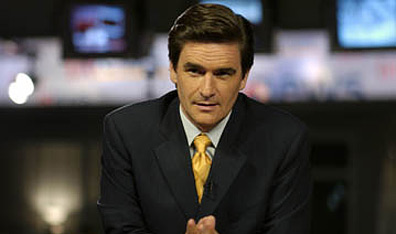
By comparison, The Newsroom seems to have too many temps. Peter Keleghan, as anchorman Jim Walcott, remains an inspired blowhard, but he’s not around much. Doug Bell and Shaughnessy Bishop-Stall are writers, not performers, yet they play segment producers in the series. Unfortunately, there is very little play in their workmanlike performances. We miss Mark Farrell and the continued presence of Jeremy Hotz. We miss Tanya Allen and the muffins.
The fault here though rests with writer-director Finkleman, who just doesn’t seem much interested in even his most promising characters. Given how wonderfully George did and didn’t get along with actress Sarah Strange in Foolish Hearts, it is disappointing to see her show up here as little more than a disapproving scold.
The sad irony in the third and final season of The Newsroom is that while George Findlay has never been more duplicitous or funnier, his creator, Ken Finkleman, no longer seems to have his heart in his job.
That shouldn’t mean the filmmaker is out of TV options. As Finkleman proves in the season’s fourth episode (Monday, March 5), he is still capable of rousing comedy. Tellingly, that episode has almost nothing to do with newsgathering.
The show begins with George obsessing about the O.J. trial (he’s sure that Simpson’s been framed); he's interrupted by a series of scraps with a co-worker in a wheelchair (a nasty Christian) over rights to the handicapped washroom. At the same time, he’s conducting an affair with a college groupie who sideswiped him at a lecture and, beyond that, schmoozing a big shot who might get him a better job.
The problem, alas, is that the wheelchair-worker launches a lawsuit. George fakes a “condition” that requires his going to a doctor.
The medical man orders him to undergo a colonoscopy!
Now that’s funny! I could continue, it gets better, but watch the show. And watch for the great sight gag that has George trying to explain to Matt (Matt Watts – the series’ best straight man) that nothing really happened between him and the college nymphet while, over his shoulder, a Red Lobster commercial on TV shows us buttery fingers lifting a firm pink shrimp from its shell.
That’s funny too! Ken Finkleman is funny. Like many of us, he just needs to get out of the office more.
Stephen Cole writes about television for CBC.ca.More from this Author
Stephen Cole
- Guy Talk
- The hit comedy Entourage shows Hollywood some love
- Tuned Out
- Panic in American TV land
- End of Term
- The series finale of The West Wing
- Heeeeeeelp!
- The disaster picture, then and now
- Canadian Idols
- Randy Bachman and Burton Cummings take care of business


