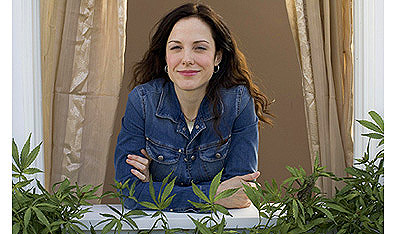
The green grass of home: Mary-Louise Parker as Nancy Botwin in Weeds. Courtesy Showcase Television.
Okay, all right, we get it already. The suburbs are hypocritical, soul-crushing, conformist cul-de-sacs of perversity. Behind those perfect hedges and inside those monster homes, the American Dream has become a nightmare. Those dads dutifully commuting to the city are all closeted homosexuals engaged in insider trading. Those smiling, pilates-toned soccer mommies are, in fact, gossipy, sex-starved depressives. And their softball-playing, Ivy League-bound children? They’re dealing oxycontin in the schoolyard and trading oral sex for Lance Armstrong Live Strong bracelets.
In fact, the only shocking thing left about the suburbs is that after American Beauty, Desperate Housewives, The Man in the Gray Flannel Suit, The Stepford Wives (the original and the remake), Knot’s Landing, The Ice Storm, Far From Heaven and Donnie Darko, filmmakers and television writers can still find material to mine. But mine it they will. Like any good contrast cliché — the hooker with a heart of gold or the foul-mouthed granny — the sin-filled suburb is as addictive as crack.
At first glance, Weeds (Wednesdays, 10 p.m., Showcase) appears to be just another campy suburban send-up. In the opening credits, 1960s folkie Malvina Reynolds warbles her anti-suburban screed Little Boxes, over images of McMansions, identically dressed joggers and an enormous, generic coffee shop franchise. But Weeds creator (and former Sex and the City and Gilmore Girls writer) Jenji Kohan is far too smart to leave it at that. For Kohan, satire is not in the broad strokes of predictable fare like Desperate Housewives, but in the perfect details: the pretentious names of the suburban kids (Quinn, Chelsea, Silas), the thinly veiled contempt the Latina maids have for the white people they clean up after, and the paranoia over sightings of a cougar in the affluent subdivision that has yet to fully beat back the California wilderness.
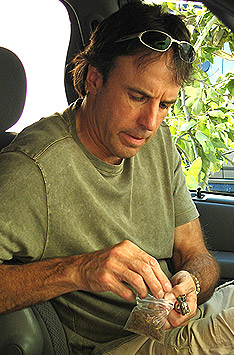
The setting is the aptly hostile sounding community of Agrestic, where newly and suddenly widowed Nancy Botwin (Mary-Louise Parker) has taken up dealing marijuana to support her two sons, perpetually lovesick teenager Silas (Hunter Parrish) and sweet 10-year-old oddball Shane (Alexander Gould). In the first episode, Nancy is still in shell-shocked grief. She attends a PTA meeting, where a Greek chorus of gossips speculates on her financial situation; afterwards, Nancy pays a visit to the cozy but decidedly downmarket home of Heylia (Tonye Patano), the sharp-tongued African-American matriarch of a family of pot suppliers. In the evenings and on weekends, Nancy deals to the locals at soccer games and karate classes. Her best customer is accountant, city councillor and homophobic stoner Doug Wilson (a very funny Kevin Nealon).
One for the road: Doug Wilson (Kevin Nealon) preps a bowl. Courtesy Showcase Television.
As Nancy, Mary-Louise Parker is an inspired choice. Her spacey, adenoidal delivery has always made her seem a little flaky and fragile, but like the feminist lobbyist Parker played on The West Wing, Nancy is no pushover. She stands up to the bitchy PTA moms and even manages to find a tentative rapport with Heylia’s family. When Heylia’s son launches into a diatribe about how blacks are stereotyped as crooks when it was whites behind the huge thefts at Enron and WorldCom, Nancy chimes in, “Maybe black people need to start stealing bigger things.”
Holding her own next to Parker is Elizabeth Perkins, as her sometime friend and nemesis Celia, a cheerleader-blonde scold who carefully maintains appearances while denigrating her chubby youngest daughter (she replaces the girl’s hidden stash of chocolate with laxatives, which produces horrifying and humiliating results). In a fit of pique over an act of rebellion by her eldest daughter, Celia says: “I should have had an abortion.”
Like Nancy, however, Celia isn’t a dismissible suburban stereotype. When she finds out her husband is cheating, she confronts his mistress — the local tennis pro — in a scene that plays against the usual soap opera conventions. In later episodes, when things get even more difficult for Celia, Perkins reveals that there’s more to her than over-achieving brittleness. And, together, Parker and Perkins are perfect foils. In a rare moment of vulnerability, Celia asks Nancy if she likes her. “Mostly,” is Nancy’s honest reply.
Kitchen gathering: Nancy visits her drug suppliers. Courtesy Showcase Television.
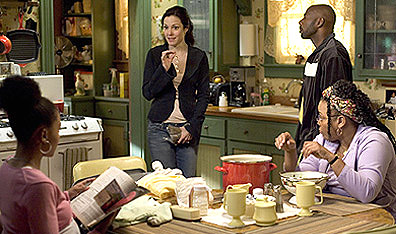
The one sour note in Weeds’ earlier episodes is its portrayal of Nancy’s drug suppliers. At first, they come across as the kind of African-Americans white writers create to show how smart, funny, sassy and soulful black folks are with their corn bread and jive-talk. But a few episodes in, it becomes clear that although Nancy sees them as a kind of surrogate family, particularly the kind and attentive Conrad (Romany Malco), Heylia has no interest in taking “the skinny white girl” under her wing. To her, Nancy is nothing more than access to an untapped market. That Nancy confuses their professional relationship for a personal one at times is its own sly jab at white liberalism.
The show neatly straddles the line between comedy and drama. Parker is as effective in her moments of grief-induced rage and paralysis as she is trading insults with Doug. “You’re an idiot,” she tells him in one scene. “Yes, but I’m an idiot savant,” he beams back. Despite its subject matter, Weeds steers clear of preaching any side in the debate over the legality of smoking or selling pot. Nancy herself is uncomfortably aware of her own hypocrisy. She chastises a rival teenaged dealer for selling to kids, but even as she does it, she knows she doesn’t have any real moral purchase. She could find other work, she could give up her live-in maid, move to a smaller house or trade in her Range Rover, but, as she freely admits, she deals to maintain her lifestyle.
That kind of ambiguity is what makes Weeds so unique compared to other suburban satires. At its heart, the show is less about pot or the suburbs and more about how people face their pain and reconcile their unrealized dreams and expectations. And that resonates no matter where you live. In the ’burbs, like everywhere else, a lot of people cope by self-medicating. In fact, Weeds could turn that into a real estate slogan. “Agrestic: Come for the lawns, stay for the weed.”
Rachel Giese writes about the arts for CBC.ca.Copyright © 2005 Canadian Broadcasting Corporation - All Rights Reserved
More from this Author
Rachel Giese
- Ladies Man
- Volver's feminine touch
- Fit to Print?
- A conversation with the Canadian distributor of O.J. Simpson's new memoir
- Yep, I'm Gay
- Hollywood's incredible shrinking closet
- Eyes on the Prize
- Breaking down this year's Giller Prize nominees
- A Passage from India
- An interview with Booker winner Kiran Desai


