Jack Layton, a different kind of activist
CBC News
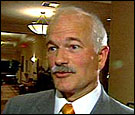
Ask Jack Layton where he gets his activism from and he tells you the story of his great-grandfather, Philip Layton, who came to Canada from Britain as a blind teenager and developed a successful business tuning and selling pianos.
From that base he founded the Montreal Association for the Blind (forerunner of the CNIB) and helped create one of Canada's first social programs. In the 1935 federal election, in the midst of the Depression, Philip Layton secured a pledge from the two main federal parties that whoever won would bring in a $25-a-month pension for the blind, many of whom were destitute and selling pencils on the street. If the new government didn't follow through, the senior Layton said, he was going to show up at Parliament's front door with as many sightless people as he could muster, holding their canes.
Skip ahead a couple of generations and you can see the similar styles. From his father and grandfather, cabinet ministers in Brian Mulroney's Conservative government and Maurice Duplessis's Union Nationale regime respectively, Jack Layton inherited the political gene. From his great-grandfather, he took that feel for the underdog and the dramatic gesture.
It's a technique he has used over and over again in his career as a Toronto municipal councillor. He's alternatively threatened and cajoled his way into getting official sanction for such things as curbside recycling, bike lanes and a downtown windmill.
Since being elected leader of the NDP in January 2003, Layton has been trying this out at the federal level. In spring and fall 2006, he propped up Paul Martin's Liberal minority during a couple of crucial votes. At budget time, he wrangled an additional $4.6 billion in social spending from the government in exchange for his party's support. But it didn't last: the Conservatives cancelled almost all the programs when they took over.
More recently, with Stephen Harper's minority Conservative government on the line, Layton was at it again, negotiating a stronger position on Kyoto and environmental protection from the Conservatives in exchange for NDP support.
Change over power
This approach is not easy for the NDP: For all its help, it is still squeezed at election time by the Liberals in Ontario and the Maritimes, and by the Conservatives in the West. Still, as Layton told a Maclean's interviewer in 2003, as he was seeking to make the jump from municipal to federal politics, "I'm interested in change, not power."
Some of Layton's techniques, mind you, have left him open to the "grandstander" label that was occasionally thrown at him in his past political life. As a Toronto city councillor, he and his wife, fellow councillor, now fellow MP, Olivia Chow, once donned black gags to protest being silenced by other Toronto politicians. At the time, they were objecting to a deal with Shell Oil, which was under fire for its controversial operations in Nigeria.
Many commentators wondered if Layton's penchant for grandstanding, and such accoutrements as his snazzy orange ties, would hurt him in the eyes of the public. But in both the English- and French-language TV debates in 2004 and again in 2006, he came across as a serious and deliberate performer.
Under Layton, the party climbed from 18 to 29 seats and just over 17 per cent of the popular vote in 2006. That was up noticeably from the Alexa McDonough years but still a far cry from the 44 seats the party won with Ed Broadbent at the helm in 1988.
Chow also ran in the 2004 election and lost (both have been running federally since the mid-1990s). But she won in 2006, making them one of only two husband-and-wife teams in the House of Commons and a unique duo in their own right. Their downtown Toronto home has been, over the years, a lively mix of his and her family (grown kids from a previous marriage and an elderly parent) and causes.
Layton gained real-world experience during his time in municipal politics to complement his academic credentials. He remained a university professor with a second job as a Toronto city councillor from 1982 until his election to the NDP's top job in 2003. More importantly, from a networking point of view, he also headed up the Federation of Canadian Municipalities for a time, a group that comprises virtually all the country's mayors and deals with the issues that are of most concern to them.
Anti-poverty
Layton started honing his credentials as an activist at an early age. In his teens in the 1960s, he led a fruitless bid to have a youth centre built in his hometown of Hudson, Que. He would go on to immerse himself in anti-poverty issues, as well as quests for better public transportation and affordable housing. That last area of interest led him to write a book, Homelessness: The Making and Unmaking of a Crisis, which was published in 2000.
A 12-year-old Jack Layton smiles for his school photo in Hudson, Que.
One wonders how heated the political conversations were in the Layton household when he was growing up. Layton was president of his student council in 1967 and announced in his yearbook that he intended to be prime minister some day.
But his father Robert, who served two terms as a Tory MP and junior minister under Mulroney in the 1980s, might have questioned the political path his son chose. Layton was briefly a young Liberal while he studied at McGill University, but turned to the NDP in 1971, impressed by Tommy Douglas's opposition to the War Measures Act.
Winning has not been easy. Running for the Toronto mayor's seat against June Rowlands in 1991, Layton led early only to finish a hard second. He also went down to defeat as a federal NDP candidate in 1993 and 1997. Even as the leader of the NDP in 2004, he garnered just five percentage points more than incumbent Liberal MP Dennis Mills in voting in the Toronto-Danforth riding.
Layton has two children, Sarah and Michael, from his first marriage, to childhood sweetheart Sally Holford. He married Chow in 1988.
My Riding & Riding Talk
Have your say about what's important in your own riding. Read profiles about your candidates, get riding-related information and join the debate.
Vital Signs
- Born:
- July 18, 1950, in Montreal
- First elected to Parliament:
- 2004 to House of Commons
- Profession:
- Political writer, activist, municipal councillor, politics professor; BA from McGill University in 1970, MA and PhD from York University in 1984
- Personal stuff:
- Married to fellow MP and before that fellow councillor Olivia Chow. Likes to ride his bicycle to media events.
Related
External Links
(Note: CBC does not endorse and is not responsible for the content of external sites - links will open in new window)
Related reading
- Speaking Out: Ideas That Work for Canadians
- by Jack Layton, published in 2004 by Key Porter Books.
- Homelessness: The Making and Unmaking of a Crisis
- by Jack Layton, published in 2000 by Penguin.
- Rebuilding Canadian Party Politics
- by R. Kenneth Carty, William Cross and Lisa Young, published in 2000 by the University of British Columbia.
Canada Votes Headlines »
- Joe test CV08 Sept 30
- Joe test CV08 Sept 30 summary
- 0917 testing story Canada Votes jt
- This is a testing story for Canada Votes 2008
- 0916 Nunavut Votes 2008 testing story
- This is a testing story for Nunavut Votes 2008
- Joe Test CV Sept 22 1:48
- Joe Test CV headline summary
- 0916 testing story Canada Votes
- This is a testing story Canada Votes 08
- 0916 testing story North
- This is a testing story North
- 0916 testing story Canada
- This is a testing story for Canada
- sfsd
- sfsfdsf
- testing pluck security


- testing pluck security
- canadavotes 2008
- canadavotes 2008