The Evening Visitor. Oil on canvas, 80.4 × 110 cm. National Gallery of Canada. Courtesy McMichael Gallery.
Nothing embarrassed the late French-Canadian artist Jean Paul Lemieux more than public attention. Before his death in 1990 at age 85, he lived simply with his wife in a farmhouse outside Quebec City, neither needing nor wanting much interaction with the outside world. “He liked to work alone, steeped in silence,” recounts Anne Sophie Lemieux, his only child.
If he’d lived to see 100 this year, he’d probably have spent most of his centenary ducking interview requests, refusing honourary doctorates (already having three, merci beaucoup) and reluctantly (and briefly) attending the openings of his shows.
Still, even this self-contained, shy man might have secretly enjoyed witnessing his work’s continued popularity. Homage to Jean Paul Lemieux, a comprehensive retrospective mounted this fall and winter at the National Gallery of Canada in Ottawa, just moved to the McMichael Canadian Art Collection in Kleinburg, Ont., where it will hang throughout the summer. At a spring auction in Toronto, one of Lemieux’s canvases (Reverberations) sold for $270,000 — improving, by $20,000, his previous personal best and almost putting him in the league of the Group of Seven, price-wise.
Lemieux’s popularity is easy to explain — at least on one level. He painted pretty pictures, ones that aren’t technically difficult to read and feel. He imbues all his pieces, particularly his winterscapes, with a magical luminosity. His subjects are generally accessible: families (remembered from his childhood) wearing their Edwardian Sunday best; unspoiled agricultural landscapes; and nighttime skies hinting (but not too broadly) at the infinite.
Even during the post-Pollock 1960s and ’70s, Lemieux remained resolutely on the figurative side of the great figurative-abstract divide — unlike, say, his great friend Paul Emile Borduas. Formally, Lemieux’s compositions are as well balanced as the shots of a skilled amateur photographer.
Winter at Port-au-Persil. Oil on canvas, 82 x 153.5 cm. Vancouver Art Gallery Purchase Fund. Courtesy McMichael Gallery.
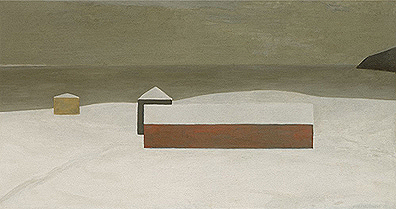
But there’s more to him: if a first glance at his work reveals an orderly prettiness, take two uncovers dark currents swirling under the apparently calm surfaces.
A pure laine Quebecer whose ancestors emigrated from Brittany in the 17th century, Lemieux grew up in a family well enough off to spend winters in a posh enclave of Quebec City and summers at a glamorous, foreigner-frequented hotel outside town. His family sent him to apprentice in Montreal with the leading French-Canadian artist of the preceding generation, Marc-Aurèle de Foy Suzor-Côté. Evidently, the pupil assimilated the master’s knack for portraying natural light.
Shortly after completing his apprenticeship in 1929, Lemieux set up a commercial art studio with his friend Jori Smith (who went on to become a solid, if not stellar painter herself). The studio failed financially, but it became a hub for young artists and their friends, introducing Lemieux to the likes of Borduas and firebrand medic Norman Bethune.
As an artist, Lemieux went through three distinct periods. Through all three, he was preoccupied with the Quebec landscape, but would convey it in different ways. His first (and least distinguished) phase was his most literal and pastoral, and is reflected in Les beaux jours (1937), the leadoff painting in this summer’s exhibition. It depicts Lemieux’s young wife, Madeleine (whom he married earlier that year), looking out over lush, cultivated headlands to a glittering bay; it was the artist’s vision of the Charlevoix region where the Laurentian Mountains run into the St. Lawrence River. Throughout his life, Lemieux idolized Paul Gauguin; in this phase, Lemieux adopted his hero’s quest for an authentic, primitive life unspoiled by industrialization.
Lemieux’s second phase was characterized by folk-arty canvases and murals that sought to capture the warp and weft of Quebec society. Inspired by Mexican muralists like Diego Rivera — though without the searing anger at social injustice — Lemieux would jam figures from all walks of life into the large-scale pieces he produced in the 1940s. (None, though, are represented in the Kleinburg show — a serious gap.) His 1944 painting La Fête-Dieu à Québec has cadets, priests and civic dignitaries parading their way down from the Château Frontenac through the streets of the old city, with the Plains of Abraham in the distance. Employing the skills he had taught himself in this period, Lemieux would leave behind much-visited murals — most notably one in Prince Edward Island (depicting Confederation) and at the Université de Montréal med school (showing the history of health care in Quebec).
The third period — from the mid ’50s to the early ’70s — was the heroic one, when Lemieux truly became Lemieux. It was inspired by the year he had spent in France in 1955, when he became both intrigued and appalled by the international trend toward abstraction. Although his work would never abandon representation, his subsequent canvases became minimalist — shapes often pared down to their essence, faces blanked out.
The Evening Visitor. Oil on canvas, 80.4 × 110 cm. National Gallery of Canada. Courtesy McMichael Gallery.
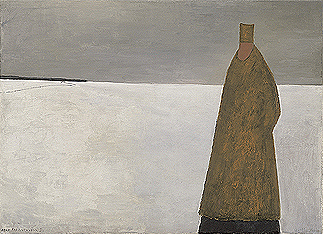
Lemieux returned to Quebec determined to show what made the province’s landscapes distinct from those of the mother country. His canvases employed huge horizons to convey the wealth of space (and dearth of life per square foot) in his home province; Quebec’s superlatively cold winters supplant the springs favoured in his earlier pieces. Typical of this period are The Evening Visitor (1956), which features a ghostly figure on a wintry plain, and Winter at Port-au-Persil (1957), with its stylized geometrical outbuildings.
During his sabbatical year, what he first liked about Gauguin changed; Lemieux came to appreciate the ur-existential title of Gauguin’s 1897 painting Where do we come from? What are we? Where are we going? Lemieux, too, would become preoccupied with man’s place in the cosmos, and would attach similarly extravagant titles to his understated works — one of the paintings in the McMichael show is called Julie and the Universe (1965).
But unlike Gauguin, who depicted the Polynesians’ vitality and interconnectedness in a hospitable natural setting, Lemieux tended to show lone individuals bundled up to survive hostile barrens.
Lemieux’s Terre blanche (1958) shows a vast, unpeopled plain of snow under a grey sky and recalls the title of his fellow Quebecer Gilles Vigneault’s folk song, Mon pays ce n’est pas un pays, c’est l’hiver — crudely, my country is not a country, it’s winter. In other canvases, broad, empty vistas dwarf a solitary individual, back turned unsociably to the viewer, as he or she faces the immensity of nature.
In Lemieux’s clan portraits, family members seldom touch; their rigid poses do not communicate shared intimacy. In 1910 Remembered (1962), Lemieux’s own father and mother (who separated in his youth) stare stonily at each other across a divide; between them, Lemieux’s boyhood self, attired in a sailor suit, looks wistfully out at us.
Here, as always, Lemieux’s characters are well dressed, but the formality of their vestments has constricted them; if they are vital, sensual beings, they have hidden it under comme-il-faut clothes and their well-modulated facial expressions. Lemieux’s palette is as subdued as the emotions he conveys; he mingles greys, browns and, in the winter canvases that vastly outnumber the summer ones, whites.
And yet, there is a serenity to 1910 Remembered: it communicates a nostalgia for the restful summer holidays once enjoyed by the well heeled. This is what a curator once called “the Lemieux effect” — a simultaneous evocation of wonder and angst, an odd combination of pretty and ominous.
In a rare interview (mentioned in the show catalogue), Lemieux attempted to describe the sensation he’d been trying to convey in situating individuals in vast, barren spaces: “Life is hard, and people don’t understand the world they live in.” A harsh view, and yet, even in Lemieux’s bleakest, emptiest canvases, there’s that light.
Lemieux leaves behind him a curiously mixed legacy: of mystic exultation and harsh appraisal, of literal luminosity and metaphorical darkness. For Lemieux, the spring is but a brief prelude to an almost endless winter, but the winter has its charm as well.
Homage to Jean Paul Lemieux runs at the McMichael Canadian Art Collection in Kleinburg, Ont., until Sept. 5.
Alec Scott is a Toronto writer.Copyright © 2005 Canadian Broadcasting Corporation - All Rights Reserved
More from this Author
Alec Scott
- Crowd Pleaser
- Sizing up Toronto's new opera house
- Write of Passage
- Madeleine Thien's quest for Certainty
- Happy Birthday, Bob
- Sixty-five quotes about Dylan
- Unscripted
- Tara Rosling follows her instincts
- Small World
- Books offer history in a nutshell


