Illustration by Jillian Tamaki.
In 1981, William Gibson published “The Gernsback Continuum,” a science-fiction story that also served as a new manifesto for the genre itself. The story’s narrator, a fashion and architecture photographer, is haunted by “semiotic ghosts,” visions of a utopian future that never came to be: strange airships, gleaming cities and perfect people. Horrified by the sheer unreality of these visions, he seeks to escape them by immersing himself in the detritus and catastrophes of the present: the petroleum crisis, bad porn, nuclear hazards and talk shows.
"The Gernsback Continuum" announced the death of classic sci-fi. The Vancouver-based Gibson and other members of the cyberpunk movement — mainly Neal Stephenson, Bruce Sterling and Rudy Rucker — rejected the “architecture of broken dreams,” as a character in Gibson’s story calls it. In their novels and stories, the cyberpunk writers replaced the fanciful devices of alien invasions and jetpacks with more realistic and immediate concerns: multinational corporations run amok, the decay of urban centres, bioengineering, environmental collapse, addictions to technology. In the process, they created not only a cultural phenomenon but a brand new future.
As it turned out, the old future didn’t fade away as smoothly as the visions in Gibson’s story. In fact, as the cyberpunk movement shows the rust of its aging ideas, classic sci-fi is enjoying a sort of renaissance, thanks to a group of Canadian writers. While Gibson and his pack set out to destroy the old sci-fi tradition, writers such as Robert Charles Wilson, Robert Sawyer and Karl Schroeder have chosen to deliberately incorporate it into their works, reinventing the tired themes and devices to fit our strange new world.
 Courtesy H.B. Fenn and Company. |
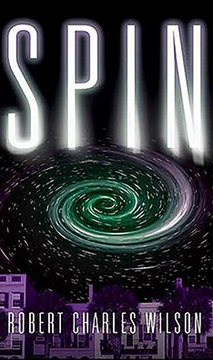
In any ordinary sci-fi book, this would be the cue to jump to thriller mode, as scientists race to solve the mystery by inventing all sorts of high-tech gadgets and the military prepares for the inevitable war with the aliens behind the sneak attack.
Instead, Wilson uses the plot devices of yesteryear to focus on the social upheaval of today. He follows a trio of childhood friends whose lives are drastically changed by the event. One character embraces the latest form of religious fundamentalism, while her brother searches for rational answers, threatening to slip into the dark side of moral relativism. The narrator, a friend of both, tries to negotiate a relationship between the two, with limited success — a direct comment on the culture wars currently dividing the world.
While the novel’s setting is contemporary, Spin still contains plenty of nods to past futures. The vanishing of the stars, for instance, invokes Arthur C. Clarke’s “The Nine Billion Names of God,” one of the classics of sci-fi; Spin’s Martians are an homage to nearly every early sci-fi tale.
It’s not the first time Wilson has turned to the past for inspiration. His novel The Chronoliths (2001) also uses time travel to examine the problems of the present. The Chronoliths are giant artifacts that arrive from a few years in the future, appearing in such places as modern-day Bangkok and Jerusalem. They destroy the cities and kill tens of thousands of people. As in the case of Spin, the real subject matter of The Chronoliths is not sci-fi visions of the future — in fact, the future always remains a mystery in the book — but the social issues of the present. Weapons of mass destruction, religious fundamentalism’s ongoing clash with science and the troubles in the Middle East form the real heart of the novel.
In his best-known novel, Darwinia (1998), Wilson deliberately writes in the spirit of Jules Verne and Edgar Rice Burroughs, invoking not only the subject matter of old-fashioned sci-fi but also the form itself. Darwinia begins in 1912 with the Miracle, a mysterious event in which Europe vanishes and is replaced by a strange new land complete with alien plants and deadly creatures. It’s the archetypal lost-world yarn, populated with brave explorers, adventurous scientists and mystics who dabble in the occult.
But Darwinia is more than just an homage to the genre’s founding fathers — Wilson also speculates on the dynamics of imperialism and American religious fundamentalism, and he even out-techs the cyberpunks by introducing some very advanced scientific ideas. Darwinia actually transforms its historical milieu as it progresses, moving from the Victorian era to an ultra-futuristic end-of-the-universe scenario, in which the ghosts of the First-World-War-that-wasn’t haunt the book and the lost world gives way to a more complex, Matrix-like scenario. It’s Jules Verne meets Timothy Findley’s The Wars meets Tony Daniel’s "A Dry, Quiet War."
In a recent interview in the Victoria Times Colonist, Wilson acknowledged sci-fi’s early visions may have been unrealistic, but he feels it’s worth maintaining their hope that the world’s problems can be alleviated by technological means.
"We don't have the Buck Rogers future, the Jetsons future, to imagine any more," says Wilson, "but, as science-fiction writers, we can look at the crunch we're facing as a species and look past it and try to actually imagine a better future that might in some sense be practical. What we're looking at might be a little more dour and unprepossessing, and maybe a little harder to sell to people as a fantasy adventure, but on the other hand, I think we're doing increasingly important work for the same reason."
Wilson’s use of conceptual frames from the genre’s past is more than just a stylistic decision — it also maintains some of the classics’ social vision. The emphasis is on rebuilding society, rather than cyberpunk’s appetite for destruction.
 Courtesy Tor Books. |
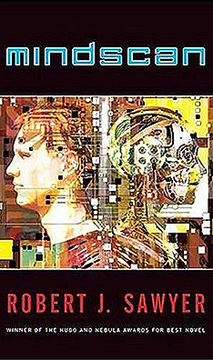
Robert Sawyer is Canada’s best-known sci-fi writer next to Gibson and, like Wilson, he displays a fondness for the classics. Sawyer adapts the genre’s old conventions to a new era by juxtaposing them with such ideas like quantum theory and cloning. Like Wilson, he also uses them to try to address the rift between science and religion. In Sawyer’s Far-Seer books, intelligent dinosaurs on another world must overcome their religious superstitions and embrace their own Renaissance to escape annihilation. In Calculating God (2001), humans are confronted with a race of theistic aliens who believe proof of God can be found in the universe’s disasters. In Sawyer’s latest, Mindscan, the ability of humans to download copies of their consciousness into new bodies creates questions about the existence of souls and the ethical dilemmas of creating or ending lives. Coincidentally enough, Mindscan was released at the height of the Terri Schiavo protests in the U.S.
Toronto writer Karl Schroeder embraces a similar esthetic in his new short-story collection, The Engine of Recall, reworking the outdated space-opera formula — tales set in the far future featuring intergalactic civilizations, warp drives and alien races — to grapple with contemporary anxieties about nanotechnology, artificial intelligence and, yet again, religion. The stories in The Engine of Recall range from archetypal space adventure yarns set on distant planets to quasi-realistic adventure yarns about new models of life found in the ruins of Chernobyl. (Interestingly enough, the collection is published by Robert J. Sawyer Books, the science-fiction imprint of Red Deer Press.)
Wilson has dismissed any notion of a broad Canadian sci-fi movement, but clearly the direction these writers are taking in their work is more than just a trend. Perhaps it’s more accurate to call them a bridge, one that links the sci-fi of the past with the sci-fi of the future. Call them the old new wave.
Peter Darbyshire is books editor at the Vancouver Province and author of the novel Please.
 CBC
does not endorse and is not responsible
for the content of external sites
- links will open in new window.
CBC
does not endorse and is not responsible
for the content of external sites
- links will open in new window.
Copyright © 2005 Canadian Broadcasting Corporation - All Rights Reserved
More from this Author
Peter Darbyshire
- Back to Futures Past
- The new Canadian sci-fi tradition
- Bedrooms of the Nation
- Stephen Marche's racy debut proves that sex in CanLit is rarely just about pleasure


