Film director Robert Altman during the 2006 Sarasota Film Festival. (Carlo Allegri/Getty Images)
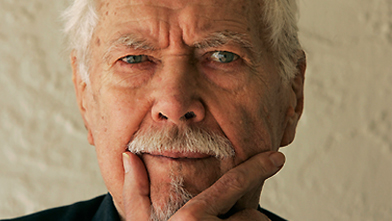
In 2003, I interviewed American director Robert Altman for a newspaper. He was in Toronto promoting a dance film called The Company, a low point of his erratic, epic career. Seventy-eight years old, he sat alone in a hotel garden looking ashen, and very thin. But he had a firm handshake, and when he spoke, he was fierce and funny. Lacking originality, I asked him why, after nearly a half-century and over 30 films, he kept making movies. Why be so prolific in an industry he clearly loathed? Grinning, he said: “It’s fear. I’m Little Eva running across those ice floes, the dogs snapping at her ass. I don’t want to get caught.”
Altman died on Nov. 20 at 81, from complications due to cancer. He was a director who reveled in the mess. His signature uninterrupted tracking shots, like the opening of The Player (1992), snake through a scene, pulling in pieces of conversation, body parts, furniture; the chaos of real life cheerfully bleeds out of his frames. “He won’t be bound by rules and he doesn’t expect you to be, either. He doesn’t like safety, even in conversation. And he doesn’t expect people to be sheep,” Julie Christie, who starred in his frontier requiem, McCabe and Mrs. Miller (1971), has said of him.
Critics heralded Altman as a pioneer of avant-garde independent filmmaking, an American filmmaker who came of age in the ’70s, when European cinema was challenging Hollywood. In the overlapping dialogue of McCabe and Mrs. Miller and the unstructured structure of the Raymond Carver-inspired Short Cuts (1993), there are hints of the French New Wave. Altman’s films are at once naturalistic, but also consciously filmic; one is always aware of the camera at play even as it pretends to hover and eavesdrop invisibly.
But Altman’s subjects are quintessentially American. In the two films for which he will be most remembered, the campaign satire Nashville (1975) and the macabre Korean War sex romp M*A*S*H (1970), he showed a country suspicious of institutions, collapsing on itself in a flurry of slapstick and deceit. In other words, he embodied the 1970s, the era in which he perfected a kind of leisurely ironic detachment with films like The Long Goodbye (1973), Thieves Like Us (1974) and California Split (1975).
Robert Altman, circa 1975. (Paramount Pictures/Associated Press)
Altman claimed to be apolitical (he did threaten to move to France if George W. Bush was elected; only one of those things happened), but his films articulated a political skepticism that defined the baby boomers, though he was not of that generation himself. Born in 1925 in Kansas City, Mo., Altman was one of the last directors to have a life before he had movies; many of those who came after him — Steven Spielberg, Martin Scorsese — spent their formative years in film school. In contrast, while still in his teens, Altman was flying B-24 bombers over the Dutch East Indies, developing the eye for the absurdity of war that would make M*A*S*H a phenomenon. After being discharged from the military at age 20, Altman worked in industrial films, making shorts like How to Run a Filling Station. Those years in documentaries and television taught him the technical proficiency required to achieve his perfect messes. By the time he made M*A*S*H, his first successful feature, Altman was 45, a middle-aged late bloomer whose films spoke to young iconoclasts.
The fact that Altman lived so fully before making movies — he was married three times, and had five children — might explain why his films have no genre, except for the genre of Robert Altman. The world is big; why visit the same place twice? Period pieces, film noir, plastic surgeons, waitresses, the fashion industry: Altman’s films are immersions into cultures linked only by characters who flail — un-beautiful losers. He encouraged his actors to improvise and contribute, and was adored for it. “He’s like the host of a good party. That’s why you never see a bad performance — because everybody’s relaxed,” the actor Michael Murphy, who collaborated with Altman on several films, has said. (Also helping with relaxation: the infamous pot smoking on his sets in the early days.)
Altman would ask everyone, including electricians and gaffers, to watch his films’ rushes (footage of scenes shot that day), and he claimed that he would often be as surprised as his colleagues at what he saw. “I am a blunderer,” he once told a reporter. “I usually don’t know what I am going into at the start. I go into the fog and trust something will be there.”
Sometimes this process produced genius, sometimes disaster (the 1980 film Popeye was an unfocused, pointless, live-action cartoon, and for once, it was not just Robin Williams’ fault). As David Thomson writes in his entry on Altman in The New Biographical Dictionary of Film: “No one else alive is as capable of a dud, or a masterpiece.”
When I talked to Altman, he had been immersing himself in the world of dance to make The Company. The resulting film about Chicago’s Joffrey Ballet, starring Neve Campbell, was chaotic and far too long, as his films could be, but also too reverential. This earnestness makes sense: Altman was interested in the high art of ballet because to him, Hollywood — so viciously satirized in The Player — was a brainless quagmire. “There’s no letting the audience follow a path and make discoveries as they go. Studios take a film out and test it in a mall,” he told me. Notoriously, he punched out an executive who demanded he cut seven minutes from California Split. Needless to say, he worked outside the studio system as much as possible.
Robert Altman poses with his honourary Oscar at the 78th Academy Awards, presented March 5, 2006, in Hollywood, California. (Robyn Beck/AFP/Getty Images)
In 2002, Altman earned his fifth Oscar nomination for the Agatha Christie-esque Gosford Park, a darkly funny 1930s thriller about class. He lost the Oscar, but won an honorary statue at the 2006 Academy Awards. On stage, he said: “No other filmmaker has gotten a better shake than I have. I’m very fortunate in my career. I’ve never had to direct a film I didn’t choose or develop. My love for filmmaking has given me an entree to the world and to the human condition.”
During that speech, he admitted that he had a heart transplant a decade ago. After that, it became difficult for Altman to get the proper insurance to work. On the set of his last film Prairie Home Companion (2006), the young director Paul Thomas Anderson (Magnolia, Boogie Nights) sat in a chair near Altman most days, ready to take over in the event of an emergency. Anderson, like many of his generation, owes Altman a debt: his wit, his tracking shots, his refusal to kowtow to studio demands — his nerve, in other words — all come from Robert Altman.
The musical adaptation of the Garrison Keillor novel about the final broadcast of a radio revue featured Virginia Madsen as an angel in white making the rounds backstage, contemplating the mortality of the aging performers. Prairie Home Companion was well reviewed; a final hit. In an interview, Altman described it as “a film about death.”
Katrina Onstad writes about the arts for CBC.ca.
 CBC
does not endorse and is not responsible
for the content of external sites
- links will open in new window.
CBC
does not endorse and is not responsible
for the content of external sites
- links will open in new window.
Copyright © 2005 Canadian Broadcasting Corporation - All Rights Reserved
Related
Internal Links
More from this Author
Katrina Onstad
- The Outsider Makes His Exit
- Robert Altman, 1925-2006
- Oscar Buzzing
- Christopher Guest's misfits return in For Your Consideration
- Faux Fur
- Diane Arbus biopic offers a mythical, misguided take on the photographer's artistic awakening
- Character Assassination
- Will Ferrell stars in Stranger Than Fiction
- Good Year Tires
- Ridley Scott's French folly


