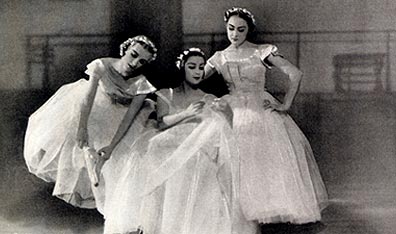
"Baby ballerinas": Tatiana Riabouchinska, Tamara Toumanova and Irena Baranova, of the Ballet Russe de Monte Carlo, circa 1934. Courtesy Capri Films.
You don’t need to know a plié from a pirouette to appreciate the elegance and exuberance of Ballets Russes. Dayna Goldfine and Dan Geller’s documentary about two legendary, competing dance companies is not only a primer on the history of modern ballet, but a sweet celebration of old age.
The original Ballet Russe was formed in 1909 by the fabled Russian-born, Paris-based impresario Serge Diaghilev. Diaghilev’s work with Picasso, Stravinsky and Nijinsky revolutionized the form, taking ballet out of the dingy music hall and into the world of high art. After Diaghilev’s death in 1929, the Ballet Russe regrouped under the direction of Colonel Wassily de Basil, a Diaghilev manqué better known for his temper than his artistic vision. De Basil hired the distinguished Russian-American George Balanchine as his principal choreographer and introduced a trio of popular prepubescent “baby ballerinas”: Irina Baronova, Tamara Toumanova and Tatiana Riabouchinska.
A rival troupe, the Ballet Russe de Monte Carlo, was formed in 1938 under the direction of René Blum (de Basil’s former partner) and Léonine Massine, one of Diaghilev’s former dancers and choreographers. De Basil would retaliate by calling his company the Original Ballet Russe. During the next two decades, the Original Ballet Russe and the Ballet Russe de Monte Carlo would compete for audiences, dancers, financial backing and artistic supremacy.
Much of their battle was fought in the United States, where audiences were in thrall to European culture. It’s remarkable to imagine these performers criss-crossing the American hinterland, bringing dance to audiences who knew ballet strictly as a vaudeville diversion. More extraordinary, however, is the fact that these cosmopolitan companies — already ethnically diverse — were the first to welcome Native and black dancers into the fold.
Ballet was hardly shielded from the events of the age: the Depression, the Second World War, the birth of the civil rights movement and the ascendance of popular culture (many dancers were recruited by Hollywood). The two companies eventually went bust in the early ’60s, as a result of in-fighting, rising tour costs and dwindling audiences. Geller and Goldfine suggest that the rise and fall of Russian ballet serves as a parallel history of the 20th century.
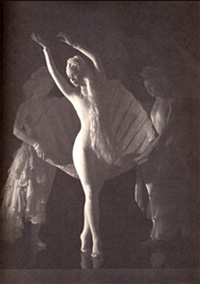
On the half shell: Nini Theilade as Venus in the Ballet Russe de Monte Carlo's Bacchanale. Courtesy Capri Films.
That Goldfine and Geller have distilled the Ballets’ 50-year history into two hours is a remarkable feat. The filmmakers follow standard doc procedure: archival footage interspersed with talking-head interviews accompanied by a smooth voiceover (by stage and film actress Marian Seldes). It’s a safe strategy with such a complex subject, but it seems somewhat static given the dynamic nature of dance. Events unfold and personalities are introduced in a strictly linear fashion, with little analysis or visual innovation.
But what footage and interviews! Much of the performances were shot with wind-up cameras in the ’30s; the jerky footage seems to give the dancers even more speed as they buck and reel, float and spin, their faces flooded with delight. This rarely screened footage, in grainy black-and-white and saturated colour, seems both primitive and revolutionary, like Joseph Cornell boxes come to life. Equally enchanting is the never-before-seen backstage footage, much of it shot by the dancers themselves.
Seeing these performers in their prime is thrilling enough; even more amazing is how vivacious they remain as senior citizens. The still-surviving Ballets Russes members — all of whom continue to be involved in dance in some fashion — retain the effervescence that once lent their performances such allure. Dancers like Tatiana Riabouchinska, nonogenarian Freddie Franklin, Alicia Markova and George Zoritch are born raconteurs. Their recollections are precise, often moving; their affection for gossip, and each other, is infectious. Though they glide more slowly across a stage now, there is a gusto to their movement that would make Rex Harrington envious. (The only irritation for this viewer is that the film offers no archival interviews with the deceased choreographers and impresarios.)
When the dancers are brought back together in New Orleans in 2000 — after some haven't seen each other in 40 years — it’s like a high school reunion to which only the most charming, athletic and beautiful students have been invited. Zoritch, for one, seems awed by his continuing vitality; he keeps telling the filmmakers that he’s 83, as though he finds the fact incredible.
As Seldes intones at the film’s beginning, “It is the nature of dance to exist for but a moment.” What is most beautiful and compelling about Ballets Russes is that it transcends dance’s ephemeral spirit, transforming this elusive art into a tangible history.
Ballets Russes opens in Winnipeg, Ottawa and Toronto on Dec. 9.
Jason McBride is a Toronto-based writer and editor.
 CBC
does not endorse and is not responsible
for the content of external sites
- links will open in new window.
CBC
does not endorse and is not responsible
for the content of external sites
- links will open in new window.
Copyright © 2005 Canadian Broadcasting Corporation - All Rights Reserved
Related
Internal Links
More from this Author
Jason McBride
- The Devil Inside
- A doc looks at the troubled life of songwriter Daniel Johnston
- Dream On
- American Dreamz: a satirical nightmare
- Bringing Up Baby
- The Dardenne brothers deliver Cannes-winner L'enfant
- Dead Reckoning
- Tommy Lee Jones: double threat
- Fight Club
- Antiwar documentary Why We Fight offers simplistic answers


