Family matters: From left, Sonia (Déborah François), Bruno (Jérémie Renier) and baby Jimmy in Luc and Jean-Pierre Dardenne's film, L'enfant. Photo Christine Plenus/Mongrel Media.
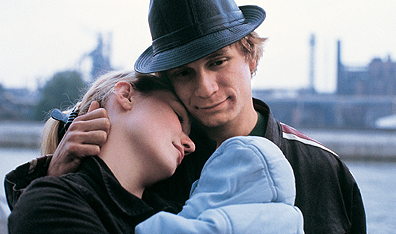
What the Farrelly Brothers are to fart jokes and the Coens to neo-noir, the Belgian filmmaking siblings Luc and Jean-Pierre Dardenne are to liberal humanism. The Dardennes have made their reputation with award-winning movies — La Promesse (1996) and Rosetta (1999) are the most famous — of uncommon empathy and unwavering moral certitude. Trained as documentarians, the brothers typically employ hand-held cameras, have a fondness for non-professional actors, and focus their attentions on the disenfranchised quarters of Belgian society. All of the Dardennes’s fiction films take place in their hometown of Seraing, a drab, industrial backwater notable only for the chilly, grim river that snakes through it. They make Mike Leigh look like Mel Brooks.
The Dardennes’s latest film, L’enfant — the Palme d’Or winner at the 2005 Cannes film festival — looks and feels very much like their previous three pictures. All of those movies, so similar in style and subject matter, are akin to the facets of a single, hard-edged diamond. Their new film stars the same young actor, Jérémie Renier, who the Dardennes made famous with La Promesse, and it is easy to imagine the 15-year-old Igor of that film growing into the irresponsible petty thief, Bruno, at the centre of L’enfant. Bruno is a goofy, solipsistic twentysomething, down on his luck but rarely down on himself, content to squat in a river-side shack and steal what he needs to get by. His 18-year-old girlfriend, Sonia (Déborah François), however, has, at the film’s beginning, a much greater responsibility — she’s just given birth to the couple’s son, Jimmy.
Bruno is indifferent to the infant; indeed, when Sonia heads from the hospital to her apartment, she discovers that her boyfriend has sublet the place for a quick buck. When Sonia finally locates Bruno, he barely looks at the boy, more concerned with the two-bit robbery he’s currently planning. Bruno, in fact, hardly pauses throughout the film; he’s constantly moving — on foot, motorbike, the bus — hustling, pacing, escaping. Introspection is irrelevant. It’s quickly apparent that the film’s title refers not so much to baby Jimmy as overgrown adolescent Bruno. “Work is for f---ers,” he exclaims, blithely acknowledging his disregard for the conventional trappings of the grown-up world — a job, a home, responsibility, fatherhood. A punk of the highest order, Bruno lives entirely in a present of his own making.
Bruno (Jérémie Renier) pauses with baby Jimmy. Photo by Christine Plenus/Mongrel Media.
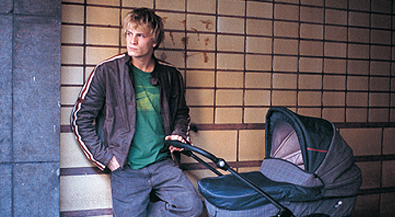
The past and the future don’t really exist in the film either. We learn almost nothing about the couple’s background, and yet feel like we know everything about them. This is one of the Dardennes’s many achievements: an ability to create fictional characters of undeniable authenticity — I can’t think of a misguided performance in any of their films — while still rendering them as unknowable as strangers on the street.
Sonia, for her part, seems unconcerned with Bruno’s behaviour. Their relationship is one of pure flirtation. Conversation is rare but affection boundless — almost all of their interaction is physical, an incessant (and convincingly teenaged) exchange of kisses, caresses and blows. When Sonia disapprovingly notes that Bruno’s bought a new jacket with her money, his response is to buy a matching one for her (along with a bassinet — he’s not completely thoughtless).
Things turn sour and much more dire when Bruno, almost impulsively, decides to sell Jimmy to a black-market adoption ring. The transaction is oddly magical: Bruno lays the baby in his coat outside the door of a deserted apartment building and, when he returns, Jimmy has been replaced by a fat wad of bills. When Bruno bluntly tells her what he’s done, Sonia’s reaction, however, is anything but demure. She collapses and must be taken to hospital.
Finally realizing his error, Bruno sets out to get Jimmy back. This proves easier than expected — he’s returned in much the same way he was taken — but there are further repercussions. The criminals he’s been dealing with are much more sinister than he could ever be, and they demand, violently, compensation for the loss of the child. Bruno is compelled to ratchet up his own thievery, with disastrous, heartbreaking consequences — consequences that, for once, Bruno can’t ignore.
The Dardennes are often called Marxist filmmakers, largely because of their obsession with work and economic oppression. But they are just as preoccupied with Christian notions of grace and redemption. All of their films have the definite texture and weight of parable, and unlike the more corrosive Lars von Trier or the mawkish Paul Schrader, two other famously Christian auteurs, the Dardennes ground their spirituality in earthy, real-world detail. Even when the film becomes a kind of thriller — L’enfant features the Dardennes’s first car chase scene! — it is a completely subdued one, eschewing pyrotechnics in favour of genuine pain.
The filmmakers’ true faith is in humanity and their obligation to represent it accurately is an expression of this faith. Theirs is a vision of hope in a hopeless world. When the Dardennes’s characters find salvation — and Bruno is distinctly transfigured by the film’s end — it feels wholly earned. The child, it turns out, is father to the man.
L’enfant opens April 14 in Toronto and Vancouver.
Jason McBride is a Toronto-based writer and editor. CBC
does not endorse and is not responsible
for the content of external sites
- links will open in new window.
CBC
does not endorse and is not responsible
for the content of external sites
- links will open in new window.
Copyright © 2005 Canadian Broadcasting Corporation - All Rights Reserved
More from this Author
Jason McBride
- The Devil Inside
- A doc looks at the troubled life of songwriter Daniel Johnston
- Dream On
- American Dreamz: a satirical nightmare
- Bringing Up Baby
- The Dardenne brothers deliver Cannes-winner L'enfant
- Dead Reckoning
- Tommy Lee Jones: double threat
- Fight Club
- Antiwar documentary Why We Fight offers simplistic answers


