On the receiving end: Daniel Auteuil as Georges and Juliette Binoche as Anne in Caché (Hidden). Courtesy Les Films du Losange and Sony Pictures Classics.
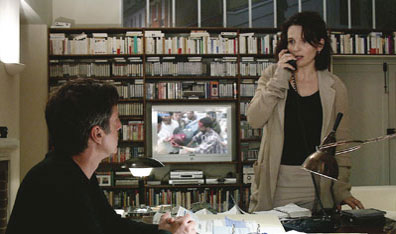
Michael Haneke’s enigmatic and arresting new film, Caché (Hidden), begins and ends with two long, static shots that compel viewers to watch carefully — and then to question, just as carefully, what it is they’re watching. The first image, of an unremarkable Parisian townhouse, begins as a conventional establishing shot that lasts a full three minutes; cars and pedestrians pass by. Abruptly, the image is rewound, its placid surface disturbed, and two disembodied voices begin discussing the image. As it turns out, what we, the audience, have been watching is a tape recording of the house. Stranger still, we’ve been watching it with the people who live there, and who are just as baffled to why somebody should be videotaping them.
Georges (Daniel Auteuil) and Anna (Juliette Binoche) are a quintessentially bourgeois French couple. He hosts a TV book show, she’s involved in publishing; they have a 12-year-old son, Pierrot, obsessed with swimming and Eminem. The family eats elegant meals together in a book-lined dining room. This outwardly comfortable and safe life, however, is poised to fall apart. Videotapes keep turning up on their doorstep, enveloped in crude, crayoned drawings. The drawings depict a child-like figure awash in blood. The scenario is at first reminiscent of David Lynch’s Lost Highway. In that film, illicit video footage of a couple’s home leads to a nightmarish world of crime, parallel worlds and pornography.
Caché’s journey is somewhat more mundane — and a fair bit more restrained — but no less frightening.
Georges and Anna search for possible explanations — is this a prank being played by one of Pierrot’s friends? — but none suffice. The police are no help. Georges stands vigilant at the window of the house vainly looking for their anonymous stalker, who never appears. The tapes become increasingly unsettling and intimate, until a climate of paranoia and deceit smothers the entire household. Auteuil has a face like a catcher’s mitt and a world-weary slump to his shoulders, and Georges experiences this ordeal almost physically, like a boxer slowly being pummeled to death.
The figure from the drawings — an Arab boy gagging on his own blood — begins to haunt Georges’s dreams. With growing dread, Georges starts to suspect that this child is Majid, a figure from his past who is now wreaking havoc on his life. Taking a clue from one of the cassettes, Georges tracks down Majid (Maurice Benichou), now a melancholic adult living in a dead-end Paris suburb. The two men haven’t seen each other since childhood, and Majid’s initial surprise and delight at Georges’s appearance gives way to confusion and hurt. Majid insists that he knows nothing about the videos; Georges refuses to believe him.
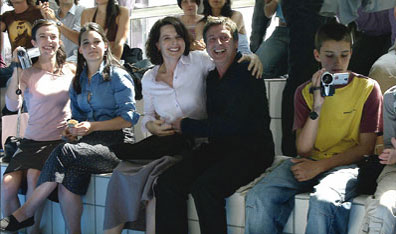
Finding comfort in a crowd: Anne and Georges caught in a moment of happiness. Courtesy Les Films du Losange and Sony Pictures Classics.
Majid, we learn, was the son of Algerian farmhands who worked for Georges’s parents. Georges’s family adopted Majid after his parents were killed by Paris police during a street rally in 1961; his elders were protesting a curfew imposed on Algerian immigrants to curtail further demonstrations in favour of Algeria’s independence from France. (To this day, the number of protesters killed remains a source of debate; the film suggests it was 200.) The young Georges was jealous of Majid, likely for the attention he was getting from Georges’s parents (it’s never made entirely clear); eventually, Georges betrayed his adopted brother.
Georges never reveals the exact nature of this betrayal, much to Anna’s frustration. For her, Georges’s inability to confide in her is tantamount to infidelity; the film’s suggestion that Anna may be more conventionally unfaithful only complicates their arguments. In one drawn-out scene, Georges and Anna fight while on a large screen TV — placed precisely between them in the frame — the nightly news depicts a parade of violent events (in Iraq, Israel, India), ostensibly all the result of past (and present) colonialism. The couple ignore the television’s bleat, even when its volume nearly drowns them out. It’s a powerful illustration of their seeming obliviousness to the world’s affairs. Smaller, more ambiguous clues later in the film — like Georges’s confrontation with a black cyclist or Pierrot’s temporary disappearance — suggest their ignorance might have greater consequences.
Haneke’s critical point – that Western comfort stems from complacency, willful amnesia and tacit complicity – may not be exactly original (Syriana promoted similar ideas). But he so thoroughly implicates the viewer that it’s impossible not to share his characters’ distress. The real genius of the film, however, is that even while insisting on this identification, Haneke complicates just whom you’re supposed to identify with. The camera’s POV shifts constantly, from Georges to Majid to Pierrot to… whom? The boundaries between dream, reality and videotape are rarely acknowledged. I kept asking myself, what am I watching now? Each character’s tendency to hide the truth — and Haneke’s own refusal to indicate what is real or simulated, imagined or feared — makes the film a relentlessly intense, dizzying experience. Caché is a thriller, but without the genre’s customary closure. It’s less a whodunnit than a whydunnit.
Georges’s ongoing nightmare clearly embodies France’s collective guilt over its colonial past. The film is eerily prescient: Haneke won the best director prize at Cannes last spring just months before France erupted in real-life racial violence. The riots revealed an unresolved national shame. Caché reveals that this shame has long been hidden in plain sight.
Caché opens Jan. 27 in Toronto and Vancouver.
Jason McBride is a Toronto-based writer and editor.
 CBC
does not endorse and is not responsible
for the content of external sites
- links will open in new window.
CBC
does not endorse and is not responsible
for the content of external sites
- links will open in new window.
Copyright © 2005 Canadian Broadcasting Corporation - All Rights Reserved
More from this Author
Jason McBride
- The Devil Inside
- A doc looks at the troubled life of songwriter Daniel Johnston
- Dream On
- American Dreamz: a satirical nightmare
- Bringing Up Baby
- The Dardenne brothers deliver Cannes-winner L'enfant
- Dead Reckoning
- Tommy Lee Jones: double threat
- Fight Club
- Antiwar documentary Why We Fight offers simplistic answers


