On the set of his new film Millions, director Danny Boyle with actors Alex Etel (Anthony) and Lewis McGibbon (Damian). Courtesy Fox Searchlight Pictures.
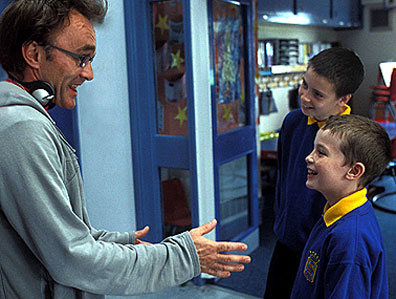
After several years handling junkies and zombies and mega-celebrities like Leonardo DiCaprio and Cameron Diaz, director Danny Boyle has decided to bring it down a little – literally. He shot much of his new film, Millions, from the eye-level perspective of a seven-year-old boy. The Manchester-born filmmaker, a frequent stage director with the Royal Shakespeare Company, is still most recognized for the good-hyper drug classic Trainspotting. But he never quite lived up – or down – to the film’s massive cult success, offering glossier fare like the bad-hyper mess, A Life Less Ordinary, starring Diaz and Ewan McGregor, and the not-hyper-enough DiCaprio bust, The Beach. Then, two years ago, Boyle went back to basics with a digital video zombie smash, 28 Days Later. Switching tracks yet again, he follows up his horror film with something like a kiddie movie, about two children who find a bag of stolen cash. (Still, the surreal touches of computer-generated imagery and a grim, terrifying bad guy who wants his money back will keep grown-ups alert). The youngest boy, nurturing an obsession with saints in the wake of his mother’s death, wants to give it away; his brother wants to buy real estate.
At 48, Boyle looks like a cross between Morrissey and Canadian actor-playwright Daniel MacIvor, at least in photos. First-hand evidence could not be gathered, as snow waylaid a scheduled interview in Toronto. On the phone from New York, where he was escorting his young star charges to a children’s film festival, Boyle spoke to us – something he does very fast and animatedly, with a heavy northern accent – about not being a weirdo, why all directors should work with kids and how hard it is to make Gladiator.
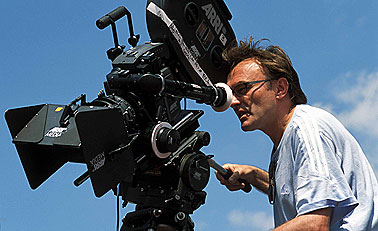
Danny Boyle behind the camera during the filming of Millions. Courtesy Fox Searchlight Pictures.
A: Were you devastated?
A: Excellent, excellent! It’s all about moms, really. The marketers all say: but how are we going to market this? Who’s it for? The people who want 28 Days Later 2 are going to be disappointed because it’s not violent. And I say, well it’s for anybody who’s got a mom. That stuff runs pretty deep in everybody, though we like to deny it. We like to be tough and cool and deny it, but it’s there.
A: My kids are a bit past kids’ movies. The eldest is 19. I’ve got a 16- and a 13-year-old as well. It was more to do with my parents, actually. [Millions] is not autobiographical but I was brought up a very strict Catholic with a very devout mom who’s dead now, God bless her. She died about 15 years ago. She wanted me to be a priest and I was going to be a priest until I was about 14, so all that saint iconography is very recognizable. You never leave it behind.
And also, the dad in the film moves the kids from the house [they lived in with their mother] to a new school and a new house. My dad did all that for me and my sisters to try and improve our lives, to get us out of our backgrounds in an aspirational way.
A: People depict Manchester and the northwest as an industrial, bleak landscape. I wanted to depict where I come from in the way that I see it, which is really the way that a little kid sees it, like it’s filled with Mediterranean colours, and it’s a busy, life-affirming place. We shot it in summer because I wanted the skies to be blue and then we tried to make it look like Christmas. The kids had to wear their woollies in the sun, which they hated.
A: Lots of images from many, many different places: magazines, books, what I take myself on location. We did use El Greco a lot on this one. We based the saints on his representations because you have to pick one representation, there are just so many. But it was also the colours in El Greco – saturated, primary. I felt like it connected with a child’s-eye view.
A: [In snotty kid’s voice:] “Who? What? Who’s he, then?” That’s their response. They don’t hang about for much.
A: Not only would I say don’t be afraid of working with children, I would recommend it. You can’t direct in the way that you would normally because their presence kind of hovers there and you can end up putting your thumbprints all over them very easily, and you spot the thumbprints right away. You don’t spot it with adult actors, for whatever reason, but with kids, it feels like you’re cramming things into them and it’s a bit manipulative and it’s a bit vile. Working with kids forces you to back off, which gets you out of the way that you normally direct, and that’s a very good thing. It’s much more like going back to your first film when it’s all a bit in the lap of the gods, how it’s going to turn out.
A: It’s true, you usually want to strangle kids [in movies] after about 40 minutes. I wasn’t going to interfere with them. I think the saccharine is often drizzled all over children by adults in movies. When I watch those films, I think about the makeup person dropping water into the kid’s eye to make him look tearful. We didn’t do any of that stuff. You just play it honestly and truthfully with the kids that you’ve chosen. You live in hope and expectation, which is a good place to be.
A: When people meet me, I think they’re expecting some rabid beat poet or something. I’m not really like that so it does confound people’s expectations a bit. The problem is if you confirm people’s expectations, they soon get tired and bored. Surprise is a very difficult thing to keep up, and in a way, one shouldn’t try to because that can become very expected as well.
In fact, someone just sent me a little script, she’s not a professional writer and it’s an odd little film, and I’d love to do it. It doesn’t make any sense on a business level. Agents and marketers say: “No, no, you should make something really similar to 28 Days Later now,” but you’ve got to follow your heart. I know it’s a cliché but if you do that you won’t go wrong because even if the film doesn’t work at least you’ll feel proud of it. I am very proud of Millions.
A: I love big movies. I love watching them and when they’re good, it’s the best. When the whole world is watching something like Gladiator, it’s wonderful cinema, it’s an international language. But I’m not very good at the big movies. I kind of learned that. They are not my strongest suit. You have to learn and you still attempt it. The next film I’m preparing is called Sunshine, and it’s a bigger sci-fi film [about a mission to the sun]. I’m working on the script with Alex Garland [author of the novel and screenplay The Beach, and screenwriter of 28 Days Later].
A: It’s very much a long-term project. The whole idea is to take the same characters played by the same actors when they’re 20 years older so they genuinely look like they’re approaching middle age, and not as a result of makeup or prosthetics. Particularly since this group of people were hedonists who abused themselves so much, to see what it felt like when they hit middle age would be really interesting. But it might take another 10 years because I’ve seen all the actors recently and they all look virtually the same as when they made the film! It’s scary the way that actors kind of stay frozen in time. It’s just Dorian Gray. It must collapse at some point, but for a period they moisturize, they go to bed early despite their reputations, and they look after themselves so they look good on camera.
A: It hasn’t gotten that far yet. We’ve done the script for ourselves and we have Irvine Welsh involved, the writer of the original, and the writer of the book Porno upon which some of it will be based. There’s no point in giving it out to anybody until it looks like they’ll be able to do it.
A: It is very difficult to say. It has lived a long time, and usually movies don’t; they take their place in the library. But this one stays out there and people still talk about it an awful lot. I don’t know why. Obviously, movies are all attempts to hold a kind of mirror up to life, and I suppose it’s a pretty good mirror for people. It’s not just entertainment. People see themselves in it and their friends and their lives. You’d think: how could they? These are junkies in Edinburgh. What resonances can that have for the rest of the world? But that’s often the case, isn’t it: the smaller the focus, the bigger the resonance.
More from this Author
Katrina Onstad
- The Outsider Makes His Exit
- Robert Altman, 1925-2006
- Oscar Buzzing
- Christopher Guest's misfits return in For Your Consideration
- Faux Fur
- Diane Arbus biopic offers a mythical, misguided take on the photographer's artistic awakening
- Character Assassination
- Will Ferrell stars in Stranger Than Fiction
- Good Year Tires
- Ridley Scott's French folly


