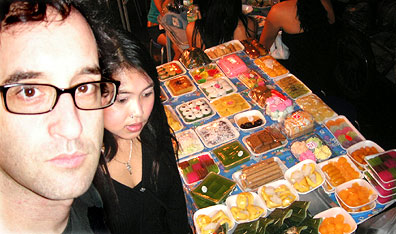
Late night treats: Patpong, Bangkok. Courtesy Don McKellar.
Last month, Canadian actor-writer-director Don McKellar took his latest film, Childstar, to the Bangkok International Film Festival. Here’s what happened.
Day 1
After touring my new film, Childstar, to every last
corner of Canada, I am finally flying to my first international
film festival. Bangkok. Twenty-four hours of travel. As is
often the case, I see more films on the flights over and back
(seven) than I do at the festival itself.
Day 2
I check into the newly renovated Shangri-La, one of three
famous luxury hotels overlooking the Chao Phraya River. My
penthouse room, as current design trends dictate, is basically
a massive bathroom with adjoining walk-in bedroom. The walls,
floor, shower stall and bath are cut stone of some variety
that doesn’t evoke Thailand. It’s all hard and absurdly polished,
save for the cut orchid on the vanity. The phone rings. It’s
midnight. My old pal Mark invites me out to play. He’s carousing
at “The Tunnel” with some crazy visiting linguists.
Mark and I, among others, shared a house together in college, and Mark was pretty much King of the Castle. He lived in the attic, remodeled as a stylish, radically chic, minimalist, bachelor pad. Now he has silver hair and works at the Canadian Embassy in Bangkok. The last time I saw him was in Taiwan when he was stationed at the Trade Commission. He took me out on the town and every young lady in Taipei seemed to know his name.
I look out my window, cityside, at the lights of Bangkok writhing below. I’ve been to this town before, with my girlfriend. I caught a whiff then of the sweaty streets, the tuk-tuks, the boutique brothels, the limitless nightlife. I try to imagine the diversions Mark might have to offer. I try to imagine “The Tunnel.”
Tonight, I decide to stay in.
Day 3
I am in Bangkok three weeks after the tsunami. More than 5,000
lives were lost on Thai shores. Within days of the tragedy
the festival was transformed into a charity event with all
the profits going to emergency-relief programs. Nevertheless,
many acquaintances at home were appalled to hear I was still
planning to go. A film festival, they seemed to imply, is
an unforgivable obscenity in the face of such tragedy. In
the hotel lobby, on the way to pick up my accreditation, I
run into a film critic from New York who confesses that, in
coming to this festival, he has never felt more like a whore
– a remarkable confession from a critic.
I myself have mixed feelings. But if this festival is obscene – as I’m perfectly prepared to accept – then surely all festivals are obscene. There’s never been a time when the world was calm and equitable and red carpets, designer clothes and celebrity posturing were justified. This year the Bangkok Festival has toned down the parties that last year, by all reports, were very lavish indeed (helicopters, semi-clad acrobats, etc.). But even these new austerity measures can’t keep Bai Ling, Chinese superstar, from flaunting her attributes at the opening night party. And why not? They’re not cancelling the Golden Globes broadcast during the festival. They’re not toning down Bush’s inaugural ball. In any case, squeamishness about festival decadence seems to betray a serious cynicism about cinema. Festivals like this are, in most communities, the only occasions when international, independent movies are screened, discussed and championed, the only chance, in fact, to show that movies are something other than glamour, celebrity and decadence.
That’s the argument I repeat to myself as I bathe in my beautiful marble tub.
Before my screening I venture out and find myself in a rather seedy, traditional Thai massage parlour. It’s mid-afternoon and almost eerily empty. A girl approaches me, and without saying a word, washes my feet and leads me through the labyrinthine corridors to a small, unadorned room. For two hours she expertly prods and manipulates my body, flips me over her back and wrenches my contorted spine. And all this without a word spoken. Complete silence. Not even any of that crappy “relaxing” music. At one point, at tea break halfway through, I consider asking her her name. But I decide against it. I don’t want to seem like one of those creepy Western guys who wants to be her friend. I prefer instead to remember her as #23, the number on the badge pinned to her chest.
That night I introduce my film, have a drink at a night market, return for a lively Q and A, and meet Mark at a club of his choice. After hours, some local girls try and encourage us to join them at Oliver Stone’s hotel suite. He shot Alexander in Thailand and he’s well acquainted with the Bangkok nightlife. “He told us to bring friends,” they say. But I have a strong feeling we are not the kind of friends he was imagining.
Day 4
In the morning I do some interviews, have lunch with an incredibly
informed Thai critic, and head back downtown to my second
screening. I am accompanied by Joy, the Thai “liaison” provided
for me by the festival. (For the amusement of the foreign
guests, the liaisons all have names like “Joy”, “Eye” and,
alas, “Head.” Imagine the witticisms!)
Joy, like most of the Thai natives I speak to, seems reluctant, almost embarrassed, to talk about the tsunami. For one thing, she doesn’t feel as close to the tragedy as one might expect. The tragedy struck in the far south and almost half the Thai deaths were foreign tourists. The remaining casualties were, for the most part, migrant workers or very poor fisherman. This is not to say that Joy is callous – by no means – but she has viewed the devastation through the storm windows of the media. And it is the people on the TV that need the world’s assistance. Not her.
The day before I arrived, the Thai Prime Minister made a statement: Thailand will not ask the world for aid. It is not a Third World country, and it will never be taken seriously again if it presents itself begging for money. Joy tells me how these words filled her with pride.
After I introduce my film that night, a garishly attired African-American woman beckons me out of the screening room. She wants to give me a talking to. As an American in Southeast Asia, she’s hyper-attuned to anti-American posturing and I’ve crossed the line.
“I don’t think I said anything offensive. I just said that my film was about a big American movie shooting in Toronto and I hoped they could identify.”
“You said American movies were taking over.”
“I just pointed out that every other movie playing in this multiplex is American.”
“Thai films play here, too. Sometimes. And I didn’t appreciate your insinuations—”
“I think, perhaps, you are being a little sensitive—“
“I AM sensitive! You think because I’m American I have no sensitivity?”
While my film is playing, I see a Korean film in another cinema. After that I go to a hockey game. Yes, a hockey game. It’s a tsunami relief fundraiser slapped together by the Canadian ex-pats in Bangkok. (While the Thai people are not inclined to ask for charity, they’re perfectly grateful in accepting it.) It’s Canada vs. the World, and the capacity crowd is psyched. It’s oddly moving to see all the six-packs of beer and handmade Canadian flags. I talk to a couple of the players who, understandably, are surprised to see me in Bangkok.
“Well, these days, you have to go a long way for a good game of hockey.” I’m not the only one to use this line tonight.
The embassy helped sponsor the event, so my friend Mark is there to drop the puck (with the able assistance of Miss Thailand). Post game, it’s a little early for Bangkok nightlife, so we head back to Mark’s place to hang a bit with his family. Mark resides with his charming Taiwanese-Canadian wife, their kids and live-in nannies in a modernish Sukhumvit high-rise. On Boxing Day, a far-reaching shiver of the fatal earthquake shook the building and it was promptly evacuated. Mark called around, but no one else at the embassy had felt the tremor. A couple of hours later a vacationing colleague called from Phuket, frantic, and it was easy to piece together the puzzle. Embassy workers were immediately called in from vacation.
I had e-mailed Mark on the afternoon of Dec. 26. I was reluctant to bother him – I could only imagine the chaos at the embassy – but a close friend of mine was trying to locate her missing brother and I wanted to know who was dealing with her case.
That would be me, was Mark’s reply.
Since then, the embassy has been open 24 hours a day: organizing searches for lost Canadians, contacting loved ones, housing stranded Canadians, arranging travel papers for those who had lost their belongings and passports (which they did immediately and free of charge, despite what you may have heard on the news). In fact it was clear, if you looked close enough, that my friend was uncharacteristically exhausted.
I explained that, if he didn’t feel up to it, there was no obligation for Mark to entertain me tonight. But as it happened, he had to stay up all night anyway. Today Paul Martin was viewing the devastation in Phuket. Most of our Foreign Service office was down there assisting and it was Mark’s job to stay behind and man the phones on the night shift. He was starting work at 4 a.m.
Swelling with patriotic pride, I promise to do my bit to keep him awake till duty calls.
And off we go to Pat Pong road and the Silom bars...
Day 5
The next morning I sleep in.
Over breakfast, I see in the Thai papers that Paul Martin’s visit was trumped by the Scandinavian leaders’ visit. Their press conference is front page; Martin’s page four, no picture. The hockey game, on the other hand, got very handsome coverage.
In the morning I take a contemplative boat trip down river to a lovely temple that I remember from my last trip to Bangkok. At lunch, I speak with a Boston critic about how my experience here at the festival is oddly resonating with Childstar. My film is, among other things, about the grotesqueries of the movie industry and how they must be battled or endured to allow for the fragile possibility that something relevant or human might unreel – something that’s been very much on my mind the last couple of days. The incongruity of this lavish festival here, now, in this scrambling city has given me plenty of time to reflect on my chosen profession.
Then a movie. Then dinner with the other Canadians at the festival. And then it’s my turn to stay up all night. My flight leaves at 8:00 in the morning, so there doesn’t seem to be any point going to bed. Mark recommends a happening club, Bed, that he has saved for my last night.
Don McKellar (left) reacts to police visit at a Bangkok nightclub. Courtesy Don McKellar.
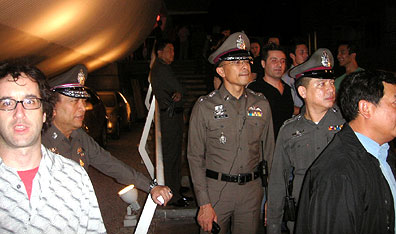
Unfortunately tonight, it is a little too happening. The police have raided it, flipped on the lights, taken everyone’s I.D. and rounded them up outside for mandatory pee samples. Drug use is bad news in Thailand – when, for some capricious reason, the police decide it is. At times like this, it’s handy to have a pal with diplomatic papers.
So off to Soi Cowboy, and Lao treats at closing time. And on and on – I’m sure you can imagine. Suffice it to say we end up around 3:00 with a lovely, transsexual nightclub hostess named Jane trolling the food stalls at some night market way off the beaten track. The market stays open especially late so that entertainment and sex trade workers can have a bite to eat and do some shopping before heading home. The clothes on sale obviously cater to this particular clientele.
One vendor displays an aquarium filled with tiny live shrimp. They are the favorite snack of one of Jane’s friends. The shrimp are tossed into an earthenware bowl and vigorously shaken until stunned — until they are doing the “shrimp dance,” as Jane calls it. Then, spasming, they are swallowed.
Somehow this delicacy gets me thinking about the tsunami again. I ask Jane how it affected her. She replies by tracing, with her finger on her cheek, the track of an invisible tear.
“Very sad, very sad. I have prayed for those people many times. Would you like to do it with me? I would like that very much.”
And so at 4:30 a.m. the three of us take a cab to a roadside temple, not far from my hotel. It is very different from the picturesque Buddhist edifice I saw this morning. This one is Chinese style, extremely utilitarian. With the fluorescent lighting and linoleum flooring you might mistake it for a bus station. Since the tsunami hit, it has been open 24 hours on a charity drive. Out front there is a wall of plywood plastered with snapshots of the tragedy – horrible, disturbing images the likes of which I have never seen in the Western press.
We give donations to the attendants inside. They give us each a small red paper with Thai writing on it. Jane says it is a prayer. We sign our names to the paper and take it behind the desk where there is a high stack of crudely constructed, saffron-yellow crates. Jane shows me how to take my paper, slather it with paste from an open pail and stick it to one of the boxes. I ask Jane to explain to me the meaning behind the strange ritual. She can’t think of the appropriate English words. She leads me back outside to the wall of photos and points to one image, a picture of a huge field lined with rows of yellow crates. Tiny red prayers are stuck to many of them. They are coffins.
Back inside we light 20 sticks of incense each, and pray – at least I try, in my own way. We pour oil into an ever-lit lamp and burn another prayer in its flame. Jane says the smoke will rise and comfort the spirits of the dead.
I say my goodbyes at the curbside. I have donated the last of my Thai money, so Mark gives me 50 Baht for the cab ride back to the hotel.
Don McKellar’s latest film is Childstar.


