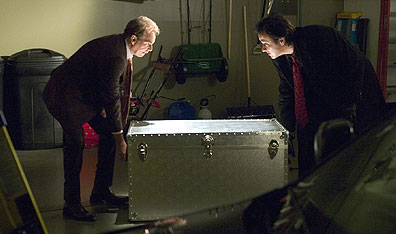
Crime usually requires some heavy lifting: Vic Cavanaugh (Billy Bob Thornton) and Charlie Arglist (John Cusack) in The Ice Harvest. Photo Chuck Hodes. Courtesy Alliance Atlantis.
I wouldn’t describe myself as the biggest Coen Brothers fan on the planet, but I will happily admit that Joel and Ethan know their noir. From Blood Simple to The Man Who Wasn’t There, they have consistently revisited and reinvented the genre, often coaxing from its clichés a fresh, wry poetry. The Coens’ admirers and imitators are legion, but I would not have expected Harold Ramis to be among them. Yet here he is, brandishing a caper-gone-wrong picture with the ungainly title of The Ice Harvest, which bears many of the hallmarks associated with the Coens’ oeuvre: bilious comedy, locales so studiedly banal they’re exotic and criminals whose malice is exceeded only by their idiocy. Oh, and a Christmas-time setting that establishes the film’s sardonic outlook from the get-go.
Ramis, of course, is better known as a purveyor of likeable comedies, some successful (Caddyshack, Groundhog Day, Analyze This), others not (Club Paradise, Multiplicity, Analyze That). All of them oscillate between frat-boy humour and a kind of conceptual art. The Ice Harvest feels more like warmed-over (or, more appropriately, freeze-dried) Elmore Leonard. This particular Ramis film calls on a couple of unlikely collaborators: screenwriter/director Robert Benton (Kramer vs. Kramer) and novelist Richard Russo (Empire Falls), notable for his mordant tales of blue-collar life, busted marriages and broken men.
This is precisely the milieu in which The Ice Harvest is set. It’s Christmas Eve in Wichita, Kans., and crooked lawyer Charlie Arglist (John Cusack) and his venomous associate Vic Cavanaugh (Billy Bob Thornton) have just embezzled $2 million from one of Arglist’s clients, a Kansas City mobster named Bill Guerrard (Randy Quaid). They’re all set to skip town, when an ice storm descends, making the streets safe only for zambonis. Arglist hopes his newfound wealth will entice Renata (Connie Nielsen), the dazzling proprietress of the Sweet Cage strip club, to join them. As the film’s femme fatale, Renata has other ideas about the men and the money.
Cool beauty: Strip club owner Renata (Connie Nielsen). Photo Chuck Hodes. Courtesy Alliance Atlantis.

Almost as soon as the money is stolen (the millions fit nicely in a gym bag), things go awry. Arglist is doggedly pursued by one of Guerrard’s burly thugs and the local constabulary takes an unwanted interest in his activities. Arglist starts drinking and can’t stop; he’s joined by a cantakerous old buddy, Pete Van Heuten (Oliver Platt). The copious amounts of holiday cheer that Pete has downed does nothing to assuage his sadness. (He’s married, notably, to Arglist’s frosty ex-wife.) Arglist, whose moral compass has long lost its needle, becomes increasingly suspicious of the evasive, surly Cavanaugh. These soul-scoured characters are all looking for a way out. And if they can’t find a way out, they will drag everyone else down with them.
There is ominous graffiti in scrawled in bathrooms all over town: “As Wichita Falls, so falls Wichita Falls.” It’s a pithy aphorism that might have been penned by some great Kansan bard, if such a thing existed. (The phrase is in fact the title of a Pat Metheny album, the relevance of which is lost on this reviewer.) Arglist et al. are trapped, Ramis suggests, by everything — the town, the weather, but especially their own venality. The entire mood of the film reflects the cynical disposition of these losers. The few genuine laughs come courtesy of Platt, whose ribald and generous scene-chewing provides welcome relief from Cusack’s glum desperation and Thornton’s now-familiar Bad Santa-esque menace.
Like a Tiffany’s box wrapped in the Sunday paper, there’s a good film hiding in here somewhere. Ramis never successfully uncovers it. He manages to avoid the self-satisfaction that the Coens often succumb to, but he also misses their sense of place and the originality of their characterizations. Wichita never feels as oppressive or authentic as it should (the film was actually shot in Chicago). Even the dreaded ice storm doesn’t look any worse than a passing shower.
The film’s creeping nihilism, and Platt’s embodiment of middle-aged angst, are provocative, but those modest achievements is undermined by a series of rote killings, all of which are played, sourly, for laughs. By film’s end, Ramis’s mirthful misanthropy is as welcome as finding a lump of coal in your Christmas stocking.
The Ice Harvest opens Nov. 25 across Canada.
Jason McBride is a Toronto-based writer and editor.
 CBC
does not endorse and is not responsible
for the content of external sites
- links will open in new window.
CBC
does not endorse and is not responsible
for the content of external sites
- links will open in new window.
Copyright © 2005 Canadian Broadcasting Corporation - All Rights Reserved
More from this Author
Jason McBride
- The Devil Inside
- A doc looks at the troubled life of songwriter Daniel Johnston
- Dream On
- American Dreamz: a satirical nightmare
- Bringing Up Baby
- The Dardenne brothers deliver Cannes-winner L'enfant
- Dead Reckoning
- Tommy Lee Jones: double threat
- Fight Club
- Antiwar documentary Why We Fight offers simplistic answers


