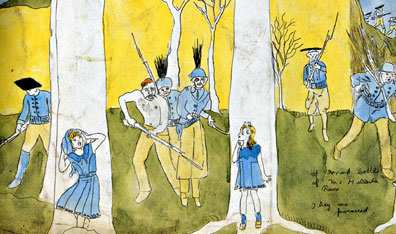
An example of Henry Darger's "outsider art." Courtesy Mongrel Media
For 40 years, an aging man occupied the same plain room in a house in downtown Chicago. Henry Darger was maybe mustachioed, maybe short, though only three curled black-and-white photos of him exist and everyone remembers him differently, if at all. After working as a janitor all day, he returned to his room each night, sometimes stopping to talk to one of his neighbors about the weather (the fallibility of meteorology was a personal obsession), or visiting church for the eighth or ninth time that week (mass was only a slightly bigger obsession than weather). If he had been British, comments an acquaintance in the documentary In the Realms of the Unreal, he would have been labeled “eccentric.” In America – “crazy.”
When Darger died at a Catholic poor house in 1973 at age 81, without family and with few friends, the landlords of the house he had recently vacated unlocked the door to his room to find a mess, and a revelation: hundreds of paintings; boxes of writing; and an illustrated 15,000 page, multi-volume novel about a war between a gang of noble school children called the Vivian Girls, and the Glandelinians, an evil army of child-nabbing slave drivers.
The pictures were sometimes dotted with bloody Biblical imagery – naïve William Blake – but more often, they resembled the loving, intricate illustrations from a child’s reader as seen through a kaleidoscope of water colour and fancy. Darger’s work was at once innocent and disturbing: the knee-soxed girls had penises and fought like warriors. His landlords, Nathan and Kiyoko Lerner, protected the sheaves of art (most of the work now resides at the L.A. County Museum of Art) and Henry Darger became one of the world’s most celebrated “outsider” artists.
Filmmaker Jessica Yu first encountered Darger’s paintings at an exhibit 12 years ago. “I thought: What a weirdo,” she says now from her L.A. office. “I felt like the work was amazing, but so alien.”
Yu went on to make Breathing Lessons: The Life and Work of Mark O’Brien, a film about an artist in an iron lung. In 1997, it won an Oscar for best documentary. Famously, Yu, a gorgeous Yale graduate who looked a decade younger than 31, took to the podium and said: “You know you’ve entered new territory when your outfit cost more than your film.”
Soon, she appeared in magazines shilling for Coach handbags and Platinum Guild International USA; she was marketed as the first sexy documentary filmmaker. But the brush with fame eventually ended. Even though television producer John Wells hand-picked her for a director’s program, leading to work shooting shows like ER and The West Wing, Yu, like most in her field, continued to fight for funding and search for projects. Five years ago, she came back to Darger at a friend’s suggestion, visiting his preserved room in Chicago (it was finally disassembled in 2000 after Yu completed filming there). She had her subject, and the result is an unconventional documentary without expert opinion or even much traditional explication. Instead, the film merges tales of Darger’s life with sequences from the great war that makes up the bulk of his tome, The Realms of the Unreal. Yu animates Darger’s art – a controversial decision – and tries to tell his story from within his strange world, rather than analyze it from ours. As with Breathing Lessons, Yu has made a movie about the sanctuary of art, and an artist who challenges the idea that solitude is the same thing as loneliness.
Q: How do you make a film about someone who nobody knew? In the film, the few neighbours who remember him can’t even agree how to pronounce his name [soft or hard G]. This seems to go against the very idea of a documentary as revealing a truth about a subject. Your film doesn’t claim to reveal him at all, really.
Director Jessica Yu. Courtesy Mongrel Media

A: There’s one type of documentary which would be sort of an analytical, biographical film about Darger, which I wasn’t interested in and it’s probably not possible. I did have kind of a delayed reaction in terms of realizing there was such a dearth of biographical information on him. I sort of knew, but I thought: Oh I’m sure we can uncover more stuff. I expected more people who knew him, more correspondence or records but there was just nothing. In any case, I was hoping to make a film that was more of an imaginative, emotional experience. I was drawn into this body of work, this avalanche, this mountain of evidence of who this person might be. I felt like if we had some understanding of that work and where it came from, maybe we’d have some greater appreciation of who this person was.
There’s that quote in the film where Kiyoko Lerner [Darger’s landlady] paraphrases her husband: “Just because there are questions doesn’t mean there are answers.” Even before I heard that I think I was trying to embrace the idea of the mystery of this person and make that part of the thematic substance of the film. So we kind of missed our chance to know him but what we have instead is the makings of this other world that he seemed to live in.A: I know. I have a friend who runs an art collective at a psychiatric centre and he says outsider art is anything outside of Manhattan, which I love. If you think about it, Darger was the ultimate insider. He didn’t even acknowledge the outside world. But I suppose [outsider] means someone who’s untrained.
A: I really had the arrogance to think: I’m going to be the first one to read the whole thing. I had it mapped out: “I’ll read, like, 200 pages a day for a year and a half!” I got a little microfilm reader, but I couldn’t do it. It completely defeated me. It’s dense and wild and extremely repetitive. What was really apparent early on was that the experience for him was much more in the writing of it than in the reading, which makes sense. He had this incredibly boring job and he wanted to come home and create something exciting.
A: There were times when it was a very sad project, particularly in terms of his early life. But he lived most of his life in this world of making his art. I remember for days being in a state of wonder looking at this stuff. It was almost mystical the way he made things up. You could see that this world he created provided him a lot of excitement, and solace in a lot of ways.
A lot of times if there’s an exhibit there’s usually a few pictures of the crucifixions and these bloody images so my impression before the film was that that was the primary focus of his work. But in the hundreds of images, in fact, there’s just a fraction that are those images. It surprised me, but as I got to know more about him, it started to make sense: he needed to have those images in there, needed to have some violence, some outrage to propel that narrative, and maybe express that rage deep inside, but for the most part he just liked creating the landscapes, odd little girls and flying creatures and plants and trees. Just much more whimsy than I had expected.A: He’s like a Rorschach test in a lot of ways. People’s reactions can be extremely varied. Some people are absolutely convinced this was what was wrong with him: “Oh, he must have been a pedophile.” I know there’s a lot of negative speculation about what he did in his real life, which I don’t think is warranted at all. Believe me, in researching, if I’d found anything, I would have pursued it.
A: I wanted to make his imaginative world take off in a magical way. It seemed like a natural thing because that’s what you can do in film. His work has so much motion and energy, he even wrote battle songs. He was trying to engage all the senses, so it doesn’t take a huge leap to imagine his work animated. But we tried to acknowledge we were working with paintings. We didn’t clean things up. We left all the paper seams in there. We only animated using elements within the paintings. We were trying to be respectful.
More from this Author
Katrina Onstad
- The Outsider Makes His Exit
- Robert Altman, 1925-2006
- Oscar Buzzing
- Christopher Guest's misfits return in For Your Consideration
- Faux Fur
- Diane Arbus biopic offers a mythical, misguided take on the photographer's artistic awakening
- Character Assassination
- Will Ferrell stars in Stranger Than Fiction
- Good Year Tires
- Ridley Scott's French folly


