Portraying a killer: Laura Prepon as Karla Homolka in the film Karla. Courtesy Christal Films.
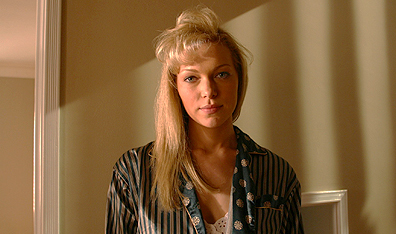
The men behind Karla, the dramatization of the life of murderer Karla Homolka (in theatres today), are producer Michael Sellers and director Joel Bender. Sellers, the president of L.A.-based Quantum Entertainment, has made a string of straight-to-video releases (Legacy, Doomsayer) starring a battery of actors who, well, remain big stars in Europe: David Hasselhoff, Corbin Bernsen, Brigitte Nielsen. Bender, for his part, began his directorial career with 1979’s Gas Pump Girls; his CV includes episodes of Sweet Valley High and Hollywood Safari. They talked to CBC Arts Online about researching the movie, Canadian sensitivity to the subject matter and what they would say to Karla Homolka if they ever met her.
Q: What first drew you to the story of Karla Homolka?
Michael Sellers: I saw Monster, and
I thought it was an impressive movie and, at the same time,
a very simple movie, from a production point-of-view. I
could have made that movie for one million dollars plus
whatever you pay Charlize Theron. So I put out feelers
and said maybe we should consider doing a true-crime story.
Joel was the one that came to me with this.
Joel Bender: I saw a little story about [the Karla Homolka case] on HBO’s Autopsy, and I said to myself, this is something I wanted to make — because of the unusual relationship. [Paul Bernardo and Homolka] seemed like your normal couple next door. I’ve been interested in the subject matter for many years. The first thing I did when I got out of film school was write a script about [1920s killers] Leopold and Loeb. This is not such a dissimilar relationship.
MS: I had never done anything like this, never even contemplated doing something like this. I felt the story was very compelling, much more so than Monster. The criminals, the personalities, the dynamics that are at play. It was also very challenging in the sense that you go, ‘Well, how are you going to film that?’ And then, of course, that there would be this reaction in Canada, which caused me, as a producer setting up a project, to take Canada right off the table in building the business model.
MS: It’s one thing to be aware of the sensitivity, it’s another thing to experience it. We thought there was a good possibility it wouldn’t be releasable here because of the sensitivity. Over the last year, since the media got involved and started asking a lot of questions and it became a legitimate controversy, it became inevitable that some kind of release would happen here.
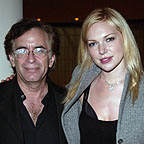
Director Joel Bender and actress Laura Prepon. Courtesy GAT Productions.
Q: What research materials did you have access to?
JB: We had the original court transcripts.
MS: Everyone knows there was a publication ban, but there’s a widely held misunderstanding in Canada that the tapes were covered by the publication ban. They are not. The tapes were played for the jury. The audio from the tapes was entered into the transcripts and that’s part of the public record. So we had those and we made good use of that.
JB: There are parts of the tapes that can be seen. Before the crimes took place. Home-movie stuff. There are a lot of keys in that.
A: When she came in [to audition], the process stopped. She really wanted to do it. She actively campaigned for the role. We never would have thought of her going in, that’s for sure.
Q: If Karla Homolka herself agreed to talk to you, what
would you ask her?
JB: I would let her ask me questions. If
she wanted to know something about my motivations for doing
a story about her, I wouldn’t have any problem discussing
it with her.
MS: I’m not sure. On one level, it would be interesting to have such a conversation. But there are a lot of reasons not to as well. I don’t think it’s likely to happen. And the movie isn’t made for Karla at all. Any time you make a movie that’s based on a true story and you try to get it as right as you can, you have some interest, perhaps, in finding out what the subject of the film actually thinks about it. But is Karla able to look at what happened in an objective manner? I don’t know.
JB: You might be surprised. And even if not, it would be an interesting learning experience. Maybe you’d learn a little more about life.
Q: What do you hope people take away from the film?
JB: For me, it’s a dark commentary on what
human beings are capable of. We see it every day. Here, it’s
more of a wolf in sheep’s clothing. I think the dark side
of human nature needs to be explored creatively. I think
anybody who sees the movie will know that it’s not there
to exploit or titillate in any way. It’s as honest as we
could be in dealing with the subject matter. With Monster,
I think they manipulated the audience into identifying with
Aileen Wuornos. We don’t try to do that.
MS: I think it’s a cautionary tale on many levels. I was always fascinated by the fact that Karla begins from a rather benign starting point. She’s still in high school, working in a vet clinic. Maybe she’s a little rambunctious, maybe she’s a little sexually adventurous, but certainly nothing off the charts. She meets Paul and she makes a series of decisions which, at each moment the decision is made, makes sense to her. You can step back and say, ‘How could you possibly do this?’ But if you climb back inside the story, you can feel that. I think there are people in abusive relationships who constantly make those kinds of compromises. And each time you make that kind of decision, it creates a “new normal.” And that new normal makes it a little easier to go to the next step. And pretty soon, you’re in some place you never thought you could be.
I think it’s also a cautionary tale in the sense that Joel means: that
evil comes in all shapes and sizes, sometimes hidden by a beautiful exterior.
So, certainly, predator awareness is part of it. But I also think that
movies take us to different places. Places that we don’t normally get
to go. A science fiction movie takes you to another planet. The
Insider takes you inside the tobacco industry. Certain kinds of movies take you
inside the criminal mind and give you an opportunity to experience it.
I think the film shows how the most horrific crimes you can imagine can
somehow be committed by people who look and act like everyone else. It’s
disturbing.
Jason McBride is a Toronto-based writer and editor.
 CBC
does not endorse and is not responsible
for the content of external sites
- links will open in new window.
CBC
does not endorse and is not responsible
for the content of external sites
- links will open in new window.
Copyright © 2005 Canadian Broadcasting Corporation - All Rights Reserved
Related
More from this Author
Jason McBride
- The Devil Inside
- A doc looks at the troubled life of songwriter Daniel Johnston
- Dream On
- American Dreamz: a satirical nightmare
- Bringing Up Baby
- The Dardenne brothers deliver Cannes-winner L'enfant
- Dead Reckoning
- Tommy Lee Jones: double threat
- Fight Club
- Antiwar documentary Why We Fight offers simplistic answers


