Bearing Witness director Barbara Kopple. Courtesy Hot Docs.
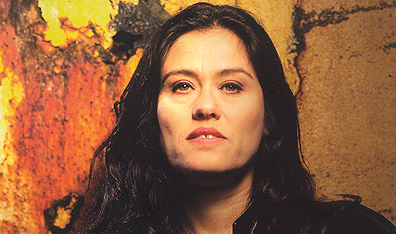
When searching “Barbara Kopple” in various newspaper databases, the American documentary director-producer’s name often comes up as a synonym for serious-minded filmmaking. Industry types make statements like (to paraphrase): “We're not trying to be Barbara Kopple here — Real World: Stockholm is entertainment!”
Kopple’s reputation is not entirely unwarranted; she did start her career working with cinéma-vérité pioneers the Maysles Brothers (Gimme Shelter), and is perhaps best known for the Oscar-winning 1976 film Harlan County, USA, which she shot while living among striking coal miners in Kentucky. Thirteen years later, American Dream, about labour disputes in a Minnesota meat packers plant, earned her a second Oscar for best documentary film.
But on the phone from her production office in New York City, Kopple, though warm and almost girlish at 58 years old, sounds a little annoyed when the “earnest” moniker is brought up.
“I think they just latch onto a name,” she says with a sigh. “They do that with Ken Burns, too.”
Kopple’s irritation is not entirely unwarranted, either; over the course of her prolific career, she has made many entertaining films that don’t involve striking workers (“I like to laugh,” she swears). She followed Woody Allen on a jazz-and-neuroses tour of Europe in Wild Man Blues, and just completed a series about rock-star spouses for VH1. In fact, Kopple’s strength is that she is all things: her seemingly frivolous work, like a TV miniseries on the rich and gaudy citizens of the Hamptons, is marked by a subtle, smart political perspective, and her more earnest films are as accessible as any good drama.
This week, the Toronto film festival Hot Docs will screen Bearing Witness, a collaborative effort that is being billed as a “Barbara Kopple” film, presumably because of all that the name implies.
In Bearing Witness, Kopple and her co-filmmakers Bob Eisenhardt and Marijana Wotton tell a multitude of harrowing stories from the perspective of five women journalists: how veteran London Times reporter Marie Colvin lost her eye to a grenade in Sri Lanka; how freelance photographer Molly Bingham was kidnapped and held in Abu Ghraib prison at the start of the Iraq war. These experiences are harrowing but perhaps universal in tone, if not detail, among reporters on foreign assignments. Bearing Witness is more fascinating when the subjects reveal a different form of sacrifice, one that perhaps only female reporters truly understand. Talking from a variety of locations including Iraq, Palestine and London, these women reject the macho posturing that characterizes fictional depictions of their work (think of the one-upping, weathered journalists in The Year of Living Dangerously). They speak frankly, sometimes with distressing poignancy, about personal sacrifices made in the quest to become top professionals. We talked with Kopple about the same.
A: It was a working title that A&E [the channel that funded the film] gave it. Our title was Bearing Witness because it’s about being a survivor, an onlooker, someone who is really trying to expose the different costs of war, or the hidden costs of war. It’s also about bearing witness to the causes behind atrocities, tortures, war crimes or genocide. The women we covered included a still photographer, a CNN camerawoman, an American woman who was working for Al-Jazeera and two incredible veterans who work for the London Times. They are sensational women and witnesses.
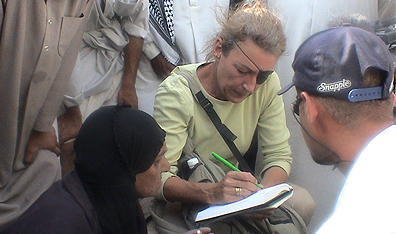
London Times reporter Marie Colvin, who lost her eye in a grenade attack in Sri Lanka. Courtesy Hot Docs.
Q: Did you go to any of these war-torn locations yourself?
A: No, [director-producer] Marijana Wotton was in Iraq and I was on some shoots in America. It took a lot of people to make this film happen. Our editor, Bob Eisenhardt, had 350 hours of footage and he really had to shape it and put together the storylines. When you have five different characters, you don’t want to get lost. It took a lot of finessing. Some of the footage was stock and many of the women had their own photos or their own home movies. When [London Times reporter] Marie Colvin [visits mass graves in Iraq], that was something that had already happened quite a few years before. Molly [Bingham, photographer] had already been out of Abu Ghraib prison, but we were with her when she went back to shoot the women who [were imprisoned] there.
A: I think there are no rules of how to work. Films aren’t made by one person, ever; they are made by a lot of different people working together making things happen. You’d be amazed. For Michael Moore’s film Fahrenheit 9/11, he had people that he hired to film the soldiers in Iraq, and tons of other stuff. Somebody has to be at the centre of it to make sure everything works, but you have to have tentacles everywhere.
A: I think there are so many different brands of documentary filmmaking and the wonder of doing it is that there is no one way to do it. It just depends what your story is, and the best way you feel you can tell it. I’m in favour of anything that tells a wonderful story.
A: No. That’s a personal choice. I like to pretend to be invisible. But that doesn’t mean I wouldn’t do it at some other point. You just have to be open. Fiction directors do films that are sometimes comedies, sometimes serious drama. It’s the same with non-fiction filmmakers. We don’t want to be put in a box. We want to be free to breathe and to try all different kinds of methods in our work.
A: Wonderful. It’s like opening your wings and flying. It maybe wasn’t that different [from documentaries] because we shot it in a very real and gritty way. All my life, I’ve been struggling to find some sense of truthfulness and that’s the same kind of thing that you strive for when getting an actor to portray a character. We’re doing a Jack Kevorkian piece that’s going to be fiction, too.
I think whatever way you can express yourself is something you should buy into. Anything that sharpens your craft. But documentaries are my favourite and if I never got to make another fiction film that would be fine as long as I could keep making documentaries. They’re so alive, so in the moment, you never know what corner you’re going to go around.
A: Janine has done it. She has 13-month-old Luca and a wonderful husband. She has done it.
A: Don’t count her out. She’s written a book, a memoir of war, and since Luca has been born she’s gone to refugee camps [in Israel]. She has to think twice about it now, but compare her with Mary Rogers [CNN camerawoman] in the film who says: ‘When I was 20, I met this guy and really liked him and he was my best friend [and we could have been married], but I wanted to continue the work. And now I go home and there’s no one there. There’s just me.’ Those are decisions that we all make in our lives, about family and kids, in particular if you're a woman because you have that ticking clock.
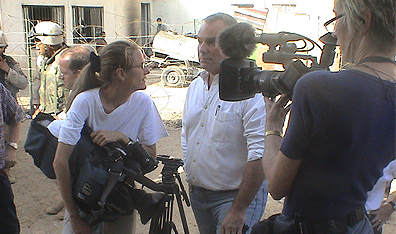
CNN camerawoman Mary Rogers, left, is filmed during the making of Bearing Witness. Courtesy Hot Docs.
Q: You won your first Oscar when you were 21, and you’ve had a very high-profile, very successful professional life. Have you confronted these issues yourself?
A: I have a son. He’s now 23. It was very hard, but I took him a lot of places, nowhere dangerous, but he came on a lot of shoots. I remember I took him to Minnesota [during the filming of American Dream], and we had an apartment there. He played with other little kids who were around, but then we left, and it was hard. Do I regret it? I don't think so. I think that we love each other so much. I’m proud of him; he’s going for a medical degree. But I don’t think I could have gotten through my life without having a child. I think having children, at least for me, or at least being lucky enough to have him, was something that was really important and gave me balance.
A: Oh, it’s a much better time to make films. There’s more funding. Not only are there now films that can say something deeply, they are also done in a way that makes larger audiences want to see them. If reality series have raised the temperature for understanding docs, that’s great, that allows us to do the kind of work that we want. I mean, it’s always hard, you’re always struggling, you’re always trying to figure out how you can make a particular film or how to finish a film you’ve started, but people want to see them these days. They want that sense of communication. For once we’re being appreciated.
A: Because look at the world right now. We need to hear the world’s stories. It’s a time when we need to reflect.
A: [Laughs] I never consider my reputation. I just think that I’m a filmmaker. I don’t think that I’m a serious filmmaker. Social issues are important to me, but during the Woody Allen film, I couldn’t stop laughing. I remember, I think he was in Turin, and there were zillions of people outside in the streets, and he parted the hotel curtain and he looked out and he got really scared and didn’t want to go out. Soon-Yi [Previn, Allen’s wife] said: ‘Why don’t you go to the door and wave?’ And he said: ‘What if they’re not here for me?’ And I would hear that and double over with laughter and just hope that my voice wasn’t getting on the mic.
Bearing Witness plays at the Hot Docs Film Festival in Toronto, April 28 and April 29.
Katrina Onstad writes about the arts for CBC.ca.
Copyright © 2005 Canadian Broadcasting Corporation - All Rights Reserved
Related
External Links
- Hot Docs Film Festival
- CBC does not endorse and is not responsible for the content of external sites - links will open in new window
More from this Author
Katrina Onstad
- The Outsider Makes His Exit
- Robert Altman, 1925-2006
- Oscar Buzzing
- Christopher Guest's misfits return in For Your Consideration
- Faux Fur
- Diane Arbus biopic offers a mythical, misguided take on the photographer's artistic awakening
- Character Assassination
- Will Ferrell stars in Stranger Than Fiction
- Good Year Tires
- Ridley Scott's French folly


