Jimmy Fallon and Drew Barrymore attend a Red Sox game in Fever Pitch. Photo by Darren Michaels. Courtesy Twentieth Century Fox Film Corporation.
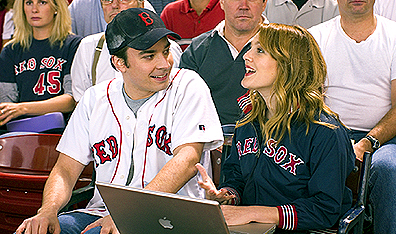
A barrier must temporarily keep the leads apart in a romantic comedy, but any student of the genre can pick up certain clues indicating that the handsome pair will end up together. Some such hints: a peppy soundtrack; the presence of actors who are not skilled enough to pull off depressed and solitary, though twinkly and together comes easy; the fact that beautiful people in movies travel in twos, like partridges and policemen.
But in Fever Pitch, the major clue that Lindsey (Drew Barrymore) and Ben (Jimmy Fallon) will leap past their barrier – he’s a Red Sox fanatic; she’s normal – is Ben’s last name: Wrightman. The film is loosely (like, size 45 pants loosely) based on the book Fever Pitch, an autobiographical account of a lifelong obsession with British soccer team Arsenal. It’s no wonder screenwriters Lowell Ganz and Babaloo Mandel adjusted their lead’s name, as the author in question is saddled with a decidedly un-cuddly, un-rom-com nom: Fever Pitch is written by Nick Hornby.
There was a time when directors Peter and Bobby Farrelly wouldn’t have shied away from a good horny-Hornby joke – think what they could have done with Arsenal! – but the gross-out brothers have become less bodily inclined of late. Their fans aren’t pleased, and gentler movies like Stuck on You and Shallow Hal have struggled at the box office compared to scatological hits Dumb and Dumber and There’s Something About Mary. Fever Pitch will not win back the teenaged boys, though their neglected girlfriends might like it. The film is fine and okay, a schematic throwaway with hints of surprising maturity, but it’s hardly inventive. Whatever you thought of them, early Farrelly movies posed a challenge to mechanical screen comedy. For those anticipating – or dreading – something as radical as the infamous diarrhea scene in Dumb and Dumber, the only shock in Fever Pitch is when the end credits role and the Farrelly names appear. (Actually, there is one strange, sort of funny moment involving testicular shaving that makes absolutely no sense except in the Farrelly universe.)
Barrymore, as an intense businesswoman, does smitten very well, though Fallon, as a math teacher, can’t do more than self-conscious. Is this pointy eunuch really supposed to be the first heartthrob to graduate Saturday Night Live? Empirically good-looking (if non-threatening boy-men are your thing), Fallon is crippled by such a nervous, asexual energy that when Barrymore gives him the mating-call grin that says, “You’re adorable. Am I adorable?”, he doesn’t smile back because he’s actually glancing off-camera; the guy never stops tic-ing.
Then again, his character, Ben, is in a constant state of distraction. His true love is baseball, and as the legendary 2004 season gets underway, he turns obsessive, traveling to Florida for spring training and squirrelling away Red Sox paraphernalia (“You don’t live in an apartment; you live in a gift shop,” says Lindsey). Lindsey’s parallel mania is work, and working out; many of the scenes in which she gets bad advice from her friends take place at the gym.
Though gyms and clothes and apartments say more than the characters in romantic comedies, Fever Pitch doesn’t rest entirely on the surface. Lindsey is the rare heroine who resists harping on her boyfriend, and she appears immune to Bridget Jones’s strain of self-hating madness. Ben’s fandom is slightly more interesting than hooliganism; he loves baseball as much for the community – a village of overly quirky Fenway Park neighbours with season’s tickets – as the sport. Though sitcom slapstick keeps the lovers apart, there’s a tinge of truth in the way the two struggle towards compromise, each realizing something will have to be sacrificed for the other, each wondering how much to give.
From left: Jack Black, Todd Louiso, John Cusack, and Lisa Bonet appear in High Fidelity, based on Nick Hornby's novel. AP Photo by Melissa Moseley. Courtesy Touchstone Pictures.
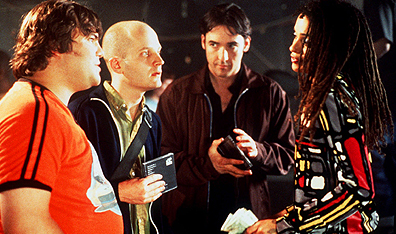
These smatterings of respectfulness can only be attributed to Hornby’s ghostly presence. His books – so conversational, so easy – cry out for adaptation, and High Fidelity and About a Boy both became conversational, easy, minor films (an earlier version of Fever Pitch was made in England in 1997 but it stuck with soccer and barely reached North American theatres). Hornby in screen form always elevates pop films, if just a little, because his books are something unique: he writes romantic comedies from a male perspective.
Usually his female characters are more successful than their unambitious boyfriends. The boyfriends aren’t louts or buffoons, but they are slightly in awe of their women - both envious of and irritated by female seriousness; both put off by and attracted to a woman’s ability to quietly shame a man for his boyish things. Hornby men wallow in their lists of CDs and books and soccer players, but they’re intelligent enough to know better. In the movie Fever Pitch, Ben presents Lindsey with a list of “all the things I like about you.” Ben has to figure out, slowly, that love is unquantifiable. As he says: “Baseball isn’t messy like life.”
Hornby would never come up such a clumsy piece of dialogue; his insights arrive more softly. He writes in Fever Pitch of attending games as a sad adolescent, a child of divorce: “What I needed more than anything was a place where unfocused unhappiness could thrive, where I could be still and worry and mope; I had the blues, and when I watched my team I could unwrap them and let them breathe a little.” It’s a gorgeous, simple line. He sees soccer, that latently violent pastime, with less romanticism than any American could ever view baseball, which, in the Farrelly version, is a game as cute and straightforward as Barrymore’s nose.
Nothing in the film Fever Pitch comes close to the book’s emotional honesty about male obsession. Though Hornby’s smarts save all of his adaptations somewhat, from the strongest (About a Boy) to the weakest (Fever Pitch), the adapters make the same error over and over: they mistake his effortlessness for simplicity. And in movies, as in baseball and literature and love, making it look effortless is hard.
Fever Pitch opens across Canada on April 8.
Katrina Onstad writes about the arts for CBC.ca.
Copyright © 2005 Canadian Broadcasting Corporation - All Rights Reserved
More from this Author
Katrina Onstad
- The Outsider Makes His Exit
- Robert Altman, 1925-2006
- Oscar Buzzing
- Christopher Guest's misfits return in For Your Consideration
- Faux Fur
- Diane Arbus biopic offers a mythical, misguided take on the photographer's artistic awakening
- Character Assassination
- Will Ferrell stars in Stranger Than Fiction
- Good Year Tires
- Ridley Scott's French folly


