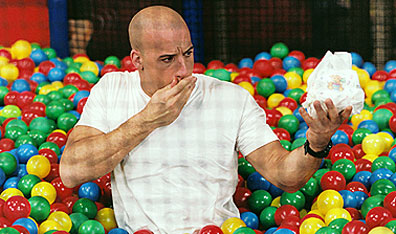
Vin Diesel in The Pacifier. Photo by Kerry Hayes. © 2005 Disney Enterprises, Inc.
If a man can neither change a baby nor overtake a pet duck named Gary, is a man a man at all? Such is the Iron John koan whispered by the new Disney film The Pacifier, a movie, like so many, about incompetent fathering and the laughs therein.
With ham-fists, -arms and -head, Pacifier star Vin Diesel plays Shane Wolfe, a Navy S.E.A.L. fresh out of Somalia and Serbia, whose next assignment is to guard the suburban progeny of an assassinated scientist, as well as the kids’ pet duck. He soon discovers that anti-American rage and ethnic cleansing have nothing on the trauma of changing a dirty baby. Shane attempts to impose military order, but what he ultimately learns is that these nutty, unruly waifs have lessons to teach him about life, love, and – most important – himself.
It takes Homer Simpson, a television star, to best articulate what movies like The Pacifier only imply: “I won’t lie to you. Fatherhood isn’t easy like motherhood.” It’s been 22 years since Michael Keaton played a stay-at-home dad in Mr. Mom, but the male mommy movie template – loyally followed in Three Men and A Baby; given a slight tweak in Mrs. Doubtfire – has barely altered: manly man careerist is forcibly domesticated, and for his own good, too. (Shane isn’t the kids’ father, but he’s a surrogate, like Arnold Schwarzenegger in Kindergarten Cop, who also played a literal surrogate father in the ultimate male mommy movie, Junior, about a man who gives birth.) The decline of the Atticus Finch-noble dad archetype in favour of the buffoon dad isn’t just about poking fun at that last pokeable social group, men, but it’s also about the rise of the child. These movies venerate youth as much as they mock fatherhood, and in doing so, tell moms to stop bitching; this parenting stuff’s a breeze.
In Daddy Day Care, Eddie Murphy plays Charlie Hinton, an ad executive with a cell phone, a beeper, a Blackberry and an ignored four-year-old son. When he, like the original Mr. Mom, loses his job, his wife decides to break out her shelved law degree. Dad must stay home. (In male mommy movies, a man never chooses to raise children; the job is foisted upon him.)
The genre requires at least one scene of a naked-from-the-waist dirty baby held at arm’s length while a grown man runs on tip-toe through an imaginary obstacle course screaming: EWW! AAH! ICK! But Charlie’s four-year-old is toilet trained, so in a feat of screenwriting invention, he joins forces with another emasculated, laid-off executive, played by Jeff Garlin from Curb Your Enthusiasm, and this time, the sidekick is the lucky recipient of a pee arc in the face while changing his own neglected son (EWW! AAH! ICK!).
Nonetheless, the two open a day care where the kids go Scarface in mountains of sugar and subsequently tear up the garden. Finally, of course, the dads learn that little whippersnappers are cuter fuelled by mini carrot sticks and scheduled naptime. Child wrangling proves so rewarding that when Charlie gets his job back, he no longer wants it. At a meeting to discuss a new junk food product, he’s asked a life-altering question by his clueless, childless boss: “What’s the most important thing? What’s the core value?” Epiphany. It’s the kid.
In male mommy movies, that’s true. Kids are wisenheimers, but also wise, while men are idiots, and women are absent. Two decades of movies featuring dads with their mouths agape and knee-deep in kiddie chaos strike some cultural theorists as reflecting a loss of control. (The Pacifier manages to squeeze in four comical diaper incidents, including one particularly repulsive moment involving a windshield.) The madness loosed around men mirrors internal angst about the real-life shifting daddy role. Writes Lynne Segal in the 1997 book Slow Motion: Changing Masculinities, Changing Men: “The growing stress on fathers has occurred at a time when men’s actual power and control over women and children is declining. … Men’s hold on their status as fathers is less firm and secure than ever before.”
But while off-screen dads are no longer pipe-chomping bacon-bringers, they’re hardly passive bunglers devoid of domestic skill either. In fact, according to Statistics Canada, men are doing more housework than they did 10 years ago, and between 1997 and 2002, there was a 38 per cent increase in the number of Canadian stay-at-home dads. And yet, there’s Steve Martin in Cheaper by the Dozen, forced to play mommy to a brood of 12 while his wife goes off on her book tour, a man so domestically useless that he’s flummoxed when one kid vomits and another slips in it. What to do, what to do…?
"I want my male mommy!": Vin Diesel in The Pacifier. © 2005 Disney Enterprises, Inc.
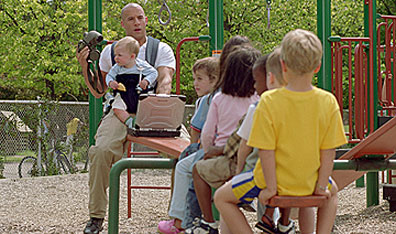
In the course of belittling fathers, and eliding mothers (once they go back to work, the vanished women come home late, hands on hips, shaking their heads at the messy kitchen), these films deify children. Skateboarding boys and precocious little girls prove, over and over, that they’re not such pains in the ass after all. The chaos they create isn’t a problem, but in fact, just harmless self-expression; we should learn from their mess, not force them to clean it up. Kids are fountains of truth that adults need only drink from to ensure their own youth. Shane, in The Pacifier, learns that he may not need the military after all; performing the panda dance for toddler Peter is satisfying enough. On screen, staying at home has nothing to do with equalizing the father-mother roles, and everything to do with men finding themselves. Balance is never an issue; it’s either parent or work, play or be a slave to the man.
Ollie Trinke (Ben Affleck), hero of the film Jersey Girl, is a ruthless New York music publicist thrust into the male mommy part when his wife dies at childbirth. After only one Hare Krishna-style dirty diaper jig, Ollie comes to adore his back-talking, curly-haired daughter; he gives up his professional dreams and moves to New Jersey to work as a street cleaner. When finally offered the opportunity to return to New York, Ollie sits in the waiting room of a big PR firm before a job interview and has a profound encounter with the actor Will Smith. The two heart-to-heart about the joys of fatherhood, and Smith says: “If I had my way, I’d be home playing in the dirt with my kids right now.” Did someone say “play” (I think most women would have heard “dirt”)? Epiphany. Affleck moves back to New Jersey.
Male mommies see their children as talismanic. It is a remarkable achievement that these films take the most selfless act, childrearing – sacrificing one’s identity, one’s work life, and where women are concerned, often one’s body – and turn it into something selfish; parenting as a quick-hit self-improvement course, an 18-year therapy session. The 1979 film Kramer Vs. Kramer may be the alpha film about fathering as a route to manly betterment. The climax has a boomer dad (Dustin Hoffman) and his estranged wife (Meryl Streep) facing off in a courtroom to measure their individual “personal growth”: hers from walking out on the family, his from finally raising their son. Adulthood isn’t the strong suit of the forever-young generation.
But celebrating the inner child by raising the outer one seems to have become an inter-generational obsession. Kevin Smith, who wrote and directed Jersey Girl, is not yet 35. When Ollie tickles his daughter and performs in her school pageant, he learns that play matters, cell phones don’t. Male mommies become men by becoming one of the kids.
And let me say that of course children better and teach their parents. And of course there’s nothing wrong with choosing home over work; women have long fought for that choice. So why do I find these films – such brainless diversions, films that clearly don’t invite serious speculation – odious and completely unfunny?
Even before becoming a mother, I always hated the idea that adults have nothing to teach children, a fashionable notion for a while now, and not only because of John Hughes. Childhood is a relatively new invention, a social construct that Neil Postman, in Building a Bridge to the 18th Century, identifies as a product of the 17th century. Before that time, the borders between childhood and adulthood barely existed; children were taken on as apprentices, no laws protected them, no special literature spoke to them as distinguishable from adults. Postman points out that the graves of young children were usually unmarked, a sign that they were not even considered individuals. Rousseau changed all that. The humanists idealized kids as living closer to a state of nature (hence, affection for ducks). Childhood, a symbolic and economic entity, was born.
The place of children among us has fluctuated throughout history – seen, heard, neither, both – but since the 1960s, western culture has been seized by youth worship. The upside is, of course, awareness of child poverty and abuse, and the downside is baby yoga. As a moms’ group dropout, I can never quite groove to the whole “kid culture” of my Toronto neighborhood. The co-sleeping, child-centred, them-first philosophy driving pricey kiddie sing-along courses and baby salsa makes it difficult to say: “I think I’d rather do yoga without a mewling infant on my mat,” let alone: “I might be ready to go back to work now.” I love my son desperately, but I have aspirations outside of motherhood, too, and to fulfill them, on a daily basis I confront issues of labour division (i.e. toilet cleaning) and finding a decent, carrot-filled day care. Male mommy movies shrug off the seriousness of parenting. The reformed movie dads ask: What’s the problem, ladies? Just loosen up, have fun. Kids keep dads young and free of workaday responsibilities, making them better mommies than mommies.
Perhaps that’s the deepest sting these films deliver. All working mothers who arrive home to Cat in the Hat bedlam would rather laugh it off than seethe. Who wants to be the hard-ass while dad and kids share a commiserating wink? But most women – and let’s hope, most men – are still engaged in an ongoing, ever-unsatisfying conversation about the challenge of making this big, muddled parenting enterprise work. Just last month, the cover of Newsweek announced the newest tome on the subject of maternal frustration, a best-seller called Perfect Madness: Motherhood in the Age of Anxiety. Shane Wolfe probably doesn’t have a copy. Male mommy movies grate because they say that the conversation is finished. Being serious about the domestic is pointless; it’s the attitude of old, female mommies, and there’s nothing funny about that.
Katrina Onstad writes about the arts for CBC.ca.Letters:

Thank you, thank you, thank you Katrina Onstad! I'm not even
a father and I take offence at those male mommy movies. I
work with 8, 9, and 10-year-olds at a summer camp and I have
washed many soiled sleeping bags, underwear, and bathing suits.
Men are not totally useless, most parents are not humourless
workaholics, and children have more to learn from adults than
vice versa. Thank you Ms. Onstad!
Graham MacFarlane
Winnipeg, Manitoba
More from this Author
Katrina Onstad
- The Outsider Makes His Exit
- Robert Altman, 1925-2006
- Oscar Buzzing
- Christopher Guest's misfits return in For Your Consideration
- Faux Fur
- Diane Arbus biopic offers a mythical, misguided take on the photographer's artistic awakening
- Character Assassination
- Will Ferrell stars in Stranger Than Fiction
- Good Year Tires
- Ridley Scott's French folly


