Notorious: A publicity shot of actors Misha Collins and Laura Prepon in the true-crime film Karla. Courtesy True Crime Productions/Quantum Entertainment.
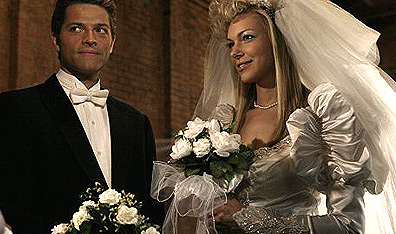
The making of a Karla Homolka biopic was always a matter of when, not if. Homolka and her ex-husband Paul Bernardo have already inspired several true-crime books, a novel, a play and at least two episodes in the Law & Order franchise, as well as hundreds of pages of newsprint and hours of television coverage. The controversy over the upcoming premiere of Karla (formerly titled Deadly) at the Montreal Film Festival — the city where a newly free Homolka is believed to be residing — was just as inevitable.
But outrage over Homolka and Bernardo’s crimes has always been matched by fascination; particularly with Homolka, whose bland prettiness and cheerleader peevishness (she once griped about the fact that Bernardo drank wine with one of their victims out of their special wedding glasses) undermine the perception that extreme violence is a primal male prerogative. She has been relentlessly scrutinized, from the contents of her high-school yearbook to details about her prison romance. All this to puzzle out the one seemingly unanswerable question: just what turns an ordinary, middle-class girl into a monster?
Filmmakers have long understood the push-pull, repulsion-attraction of sociopaths who exultantly smash all taboos and social contracts. It’s seductively dark material, and filmmakers have projected onto the cinematic serial killer our collective sinister impulses as well as myriad theories about what drives a person to kill. Here’s how some notable films have tried to make sense of serial murderers.
M (1931)
Fritz
Lang’s
noir
thriller
is one
of the
earliest
serial-killer
films
and one
of the
best.
Starring
Peter
Lorre — in
a villainous
role
that
would
pigeon-hole
him for
the rest
of his
career — M is
loosely
based
on the
case
of Peter
Kurten,
the so-called
Vampire
of Düsseldorf,
a serial
killer
whose
crimes
terrorized
Germany
in the
1920s.
With
its focus
on public
hysteria
and the
restrictive
police
crackdown
that
results, M feels
eerily
contemporary.
Cornered
by a
gang
of criminals
who have
joined
forces
with
the police,
the killer
argues
that
he is
a victim
of his
own violent
urges.
In
Cold
Blood (1967)
Richard
Brooks’
stylish,
moody
quasi-documentary
(based
on
the book
by
Truman
Capote)
is
both
a story
of
class
rage
and
a folie
à deux.
Dick
Hickock
(Scott
Wilson)
and
Perry
Smith
(Robert
Blake)
are
aimless
ex-cons
from
violent
and
impoverished
backgrounds
who
target
the
Kansas
home
of
the respectable,
well-to-do
Clutter
family.
After
breaking
in
and finding
no
money,
Smith
and
Hickock
brutally
murder
the
family — despite
never
having
killed
before.
Badlands (1973)
Based
on the
1958
killing
spree
of Charles
Starkweather
and
Caril
Fugate,
Terrence
Malick’s
stunning
debut
is
notable
in
that
it doesn’t
search
for
meaning
at
all;
the film
implies
that
it’s
folly
to
even
attempt
to
explain
human
nature.
Kit
(Martin
Sheen)
and
Holly
(Sissy
Spacek)
can’t
articulate
or
justify
their
actions,
but
share
a Bonnie
and
Clyde-like
fascination
with
their
growing
celebrity.
Henry:
Portrait
of a
Serial
Killer (1986)
Loosely
based
on
the murders
committed
by
Henry
Lee
Lucas
and
Otis
Toole,
John
McNaughton’s
graphic,
grisly
yet
dispassionate
film
was
initially
intended
to be
a straight-up
slasher
flick.
Its
artistry
and
technique,
however,
elevates
it above
the
genre.
In the
film’s
most
disturbing
scene,
Henry
(Michael
Rooker)
and
Otis
(Tom
Towles)
videotape
and
play
back
the murder
of a
family,
forcing
film
viewers
to watch
the
violence
from
the
killers’
point
of view.
The
Silence
of the
Lambs (1991)
Weighty
enough
to earn
five
Oscars,
Jonathan
Demme’s
suspenseful
thriller
is based
on the
best-selling
series
of novels
by Thomas
Harris.
The
film’s
two
killers
are
a study
in contrasts:
Anthony
Hopkins’
Hannibal
Lector
is an
ice-cold
cannibal
and
soulless
genius
with
an almost
seductive
charm;
Buffalo
Bill
(Ted
Levine)
makes
dresses
out
of the
skin
of his
victims
because
he’s
really
meant
to be
a girl — a
portrayal
that
earned
Demme
the
ire of
gay
rights
groups.
Kalifornia (1993)
In a
morally
bankrupt
America,
bored
hipsters
(David
Duchovny
and
Michelle
Forbes)
pick
up a
trashy
couple
(Brad
Pitt
and
Juliette
Lewis)
on their
cross-country
photo
shoot
of historic
murder
sites.
Despite
posing
the
big question — “What's
the
difference
between
a killer
and
any one
of us?" — the
film
offers
far more
style
than
substance.
Criminal element: Mickey (Woody Harrelson) and Mallory (Juliette Lewis) in Natural Born Killers. Photo Warner Bros./Getty Images.
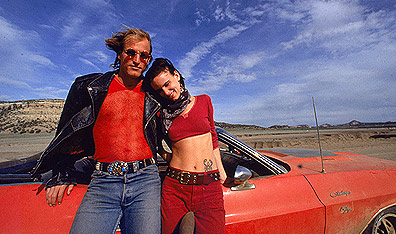
Natural
Born
Killers (1994)
Directed
by Oliver
Stone — from a story
by video
store-autodidact
Quentin
Tarantino — white-trash
outlaws
Mickey
(Woody
Harrelson)
and
Mallory
(Juliette
Lewis)
engage
in a
music
video-styled
killing
frenzy.
The
film
is a
send-up
of media
sensationalism
that
holds
those
who
produce
and
consume
the
news
as accountable
as the
killers
themselves.
Seven (1995)
Starring
Brad
Pitt
and Morgan
Freeman
as cops
on
the
trail
of a
brilliant
but
bent
and
sin-obsessed
killer
played
by Kevin
Spacey,
this
gruesome
thriller
set
the
tone
for
a
near
epidemic
of 1990s
serial-killer
films
like Copycat, Jennifer
8, Kiss
the
Girls and Nightwatch.
More
interested
in
entertainment
than
analysis,
these
films
feature
sick
yet
smart
killers
(usually
a
product
of
bad
mothering
or
sexual
dysfunction).
They
all
share
a
similar
pathology
and
modus
operandi:
they
brood
about
in
grimly
lit
dungeons
hatching
Byzantine
methods
to
dispatch
their
victims,
all
the
while
engaging
in
elaborate
cat-and-mouse
games
with
the
police.
American
Psycho (2000)
Though
written
by two
feminists — Guinevere
Turner
and
Mary
Harron
(who
also
directs) — this
adaptation
of Bret
Easton
Ellis’s
novel
was
the
target
of boycotts
and
protests
for
its
almost
fetishistic
depiction
of women
in peril.
With
his
designer
business
cards,
six-pack
abs
and
thirst
for
blood,
killer
Patrick
Bateman
(Christian
Bale)
is a
parody
of yuppie
excess,
another
variation
on the
it’s-our-society-that’s-sick
theme.
Monster (2003)
An unrecognizable
Charlize
Theron
won an
Oscar
for
her
portrayal
of one
of the
rare
female
serial
killers,
abused
Florida
prostitute
Aileen
Wuornos
(the
subject
of two
documentaries
by Nick
Broomfield).
Avoiding
easy
explanations, Monster (written
and
directed
by
Patty
Jenkins)
is
an
intelligent
and
fearless
meditation
on
Wuornos’s
motives
as
she
kills
first
out
of
self-defence
and
then,
increasingly,
out
of
blind,
unfocused
revenge.
Rachel Giese writes about the arts for CBC.ca
More from this Author
Rachel Giese
- Ladies Man
- Volver's feminine touch
- Fit to Print?
- A conversation with the Canadian distributor of O.J. Simpson's new memoir
- Yep, I'm Gay
- Hollywood's incredible shrinking closet
- Eyes on the Prize
- Breaking down this year's Giller Prize nominees
- A Passage from India
- An interview with Booker winner Kiran Desai


