The makers of The Corporation fixed their skeptical gaze on corporate culture. (from left to right, Mark Achbar, Joel Bakan, Jennifer Abbott) Courtesy Mongrel Media

When the anti-capitalist docu-screed The Corporation won the Audience Award at Sundance this year, Vancouver co-director Mark Achbar eschewed the traditional Thank-you-Ma speech. Instead, noting that the Award was sponsored by Coca-Cola, he said: “Even though it’s a transparently shallow ploy to put a caring face on a callous, psychopathic institution, it doesn’t mean the support isn’t appreciated.” In other words: “You suck. Thanks for having us!” In a way, Achbar’s soft-pedaled denouncement nicely summed up the year in Canadian documentary film.
In 2004, Canadian filmmakers looked outside national borders, coldly cut down what they saw and came home with some of the most interesting documentaries churned out by our documentary-mill country in years. The new docs are a slap in the face to the kind of rusty nationalist thinking that says: Canadian movies must tell Canadian stories; let us now shoehorn Moose Jaw into this script and grab a subsidy. As Naomi Klein and Avi Lewis tromped through Argentina in search of unemployed workers occupying abandoned factories in The Take, it suddenly seemed obvious: what are Canadians best at? Obsessing about how we stack up against the rest of the world. The first Canadian documentaries were romantic immigration films made by the CPR to lure British settlers to Canada’s wild west, and now, nearly a century later, the camera turns outwards, showing Canadians as citizens of the world. What’s funny is that the new global lens fulfills nearly the same agenda as the Moose Jaw subsidy grab; these documentaries do shape a national identity through cinema, but an identity of cultural relativism, one appropriate to borderless times.
The little-seen but powerful documentary Army of One – about three freshly minted American soldiers trying to get to Iraq – subtly indicts the American army for its dubious recruitment practices (poor black kids targeted in shopping malls), while implicitly affirming a view of Canadians as something opposite: compassionate, peaceful – not in Iraq. Though director Sarah Goodman, a graduate of Concordia University in Montreal, has been living in New York for years, the film is somehow distant from its material in a way that’s not dispassionate, but invigorating. She sees the machinations of the American military with the clarity of the outsider, a very Canadian perspective.
In Ron Mann’s charming doc Go Further, Woody Harrelson heads a hemp-fuelled road trip down the west coast of America to demonstrate sustainable living practices. The subject matter is brutally unappetizing – sympathy for vegans? – but Toronto’s Mann (Twist) has such a light touch that he makes worm composting a crowd-pleaser. His trick is to give us a human guide through granola culture, a goofball Hollywood assistant who has a moment of transformation when his grain-eating guru, Harrelson, informs him that the milk he loves is filled with blood and pus. It’s a Canadian documentary with a California counter-culture spirit.
One of the most transfixing documentaries of the year was Shake Hands with the Devil: The Journey of Romeo Dallaire about the lieutenant-general’s thwarted efforts to stop the genocide in Rwanda, and the madness that gripped him in the aftermath. Dallaire’s – and Canada’s – impotence on the world stage is reversed by this direct indictment of atrocity: at last, a response. Director Peter Raymont uses talking heads and simple narration, free of the ambush journalism and guerilla tactics that made stars out of doc filmmakers like Michael Moore and Nick Broomfield. The Corporation includes old monster movies to illustrate the psychopathic mindset of contemporary businesses, but it, too, is stylistically old-fashioned, comprised mostly of interviews and historic footage. Bucking a world trend in docs, for the most part, Canadian filmmakers remain resolutely behind the camera. Of course, with the observer position comes a tinge of arrogance: Klein and Lewis look just a little smug as they share a beer with their new union buddies in The Take.
Seducing Dr. Lewis: a big Quebec hit about a small fishing community trying to woo a Montreal doctor to move there. Courtesy Wellspring Media Inc.
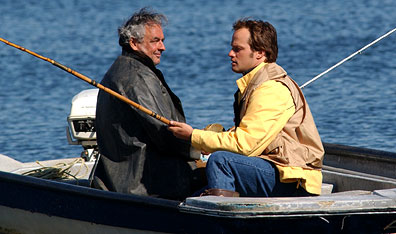
One had to look to features to find Canadians critiquing their own lives in 2004, a task left to a group of relatively unknown filmmakers. With the exception of Guy Maddin’s joyful, otherworldly beer mogul musical, The Saddest Music in the World, most known Canadian directors were largely absent or flailing this year (films from both Norman Jewison and Lea Pool came and went). And yet it didn’t matter; a new, confident group of directors took over the vacancies. Without sentimentality or romance, Nathaniel Geary’s On the Corner strode fearlessly into Vancouver’s heartbreaking downtown East Side. Perhaps the year’s biggest surprise hit was the Quebecois film Seducing Doctor Lewis (another Audience Award winner at Sundance), by Jean-Francois Pouliot. Oddly British with its quirky villagers and farcical set-up – an impoverished fishing village pulls a ruse on a visiting doctor to get him to set up shop – it’s also a quietly poignant portrait of life on welfare, and the death of the small town.
Seducing Doctor Lewis proved once again that French-Canadian films have a knack for accessibility sorely lacking in their Anglo-brethren. And yet, a couple of new films announced that English Canada can make audience-friendly fare, too (even if no one goes to see it). With Love, Sex and Eating the Bones, Sudz Sutherland pulled off a film about sex that was very downtown, and intentionally funny (intentionally is the hard part). Peter Wellington finally followed up Joe’s So Mean to Josephine with the wise ’70s period comedy Luck, a movie about gambling set in the mythic moment of Paul Henderson’s goal.
All the films mentioned in this piece appeared in a Canadian theatre at some point this year, though sometimes for only a week at a time. The struggle to get films made in this country is matched only by the struggle to get them seen. Perhaps my favourite film of the year played at the Toronto International Film Festival last fall, and then for only four weeks at an art gallery in Toronto, and finally on CBC television (it was originally made for CBC). I, Claudia is the film adaptation of the Kristen Thomson stage play about an “official pre-teen” preparing for her father’s remarriage. Thomson, who wrote the play and the film, plays four characters from beneath different masks. A gentle portrait of the agony of divorce, it was shot by director Chris Abraham like a documentary. The characters speak to the camera, and the camera catches them in moments of private truth – the goal of all film, regardless of geography or genre.
Katrina Onstad writes about the arts for CBC.ca.More from this Author
Katrina Onstad
- The Outsider Makes His Exit
- Robert Altman, 1925-2006
- Oscar Buzzing
- Christopher Guest's misfits return in For Your Consideration
- Faux Fur
- Diane Arbus biopic offers a mythical, misguided take on the photographer's artistic awakening
- Character Assassination
- Will Ferrell stars in Stranger Than Fiction
- Good Year Tires
- Ridley Scott's French folly


