
PHOTO ESSAY
Rebel Yells
A protest music mixtape
By Matthew McKinnon
August 12, 2005


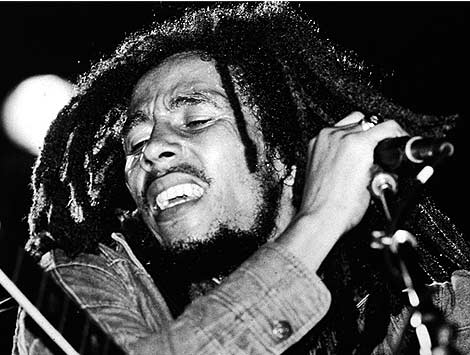 Bob Marley. Photo Getty Images/Express Newspapers.
 |
War, Bob Marley & The Wailers
(Rastaman Vibration, 1976)
If any musician has ever been treated as a deity, it must be Bob Marley. Jamaica’s favourite son was regarded as a prophet and philosopher in his home country. He was the Rastafarian version of Bob Dylan, a master songwriter who held the worries of the poor and lumpen close to his chest.
Marley knew his power, and used it to promote the agenda of Prime Minister Michael Manley. This sat poorly with Manley’s opponents; in 1976, Marley survived a gunshot wound in an assassination attempt. He decamped from Jamaica to London, but returned two years later to perform at the One Love Peace Concert. There, he orchestrated a landmark, symbolic handshake between Manley and Edward Seaga, bitter rivals for rule of Jamaica.
War was Marley and the Wailers’ parsing of a rousing speech by Haile Selassie I, the Egyptian king whom Rastafarians worship as their god. “That until there are no longer first-class / And second-class citizens of any nation / Until the colour of a man’s skin / Is of no more significance / Than the colour of his eyes / Me say war.”
Marley collapsed while jogging in New York’s Central Park in 1980; on May 11, 1981, he died of cancer that had spread to his brain, lungs and liver. He was 36.
Copyright © 2005 Canadian Broadcasting Corporation - All Rights Reserved

More from this Author
Matthew McKinnon
- The Smackdown
- This week: Is U2 over?
- Can't Stop, Won't Stop
- The unretirement of Jay-Z
- Twos of a Kind
- François Brunelle’s look-alike portraits
- Behind the Music, Y'all
- Kevin Federline's Playing with Fire: the liner notes
- See No Ego
- A doc reveals the amazing story of the blind mountaineers of Tibet