Wally Gretzky (Tom McCamus), after recovering from his debilitating brain aneurism.
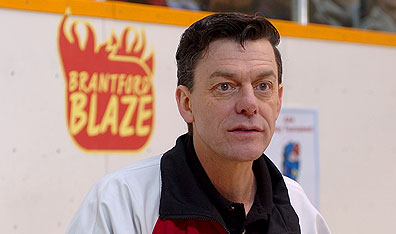
Waking Up Wally will no doubt be enjoyed by the million or so viewers who settle into their TV rooms Sunday night in search of stirring family entertainment. The story of Walter Gretzky, our most famous hockey dad, is one for the ages. And the CBC production, which features a commanding performance by actor Tom McCamus as a man who recovers from a debilitating stroke, heroically reinventing himself with the support of a sturdy family, is as warm and inviting as a crackling fire from a winter hearth.
Still, the inevitable success of the Gretzky biopic can’t be considered altogether good news. After the recent TV movie version of Terry Fox’s valiant struggle against cancer (Terry, CTV), and now Walter Gretzky’s courageous return from a stroke, not to mention the upcoming story of Canadian Football Leaguer, Terry Evanshen’s brave comeback from a coma (The Man Who Lost Himself, CTV, Nov. 15), it’s evident that the issue-oriented Canadian TV docudrama is in danger.
A genre once dedicated to telling stories as challenging as Riel, The Boys of St. Vincent and Net Worth, seems to have become the domain of broadcasters determined to turn the category into that most American of all TV film types: the inspirational weepie.
Which is not to say there shouldn’t be a TV place for Waking Up Wally, a Canadian fairy tale unlike any other. Walter Gretzky was a talented, too small hockey player who flunked a tryout with the fabled Toronto Marlboros and so became a lineman for Bell Canada. He later married and raised a family in Brantford, Ont., where he created a magical backyard rink, shaving the grass down to a hobo’s stubble then laying down a smooth, unwrinkled belt of ice with lawn sprinklers.
Walter taught his sons, Wayne and Brent, everything he knew about hockey on that rink. Wayne of course went on to become hockey’s most famous performer. A professed worrywart, Walter followed his celebrated protégé around North America, and could be found during intermissions pacing arena lobbies, glumly pulling on a cigarette. I once saw him in the ’80s at Toronto’s Maple Leaf Gardens with Wayne’s team, the Edmonton Oilers, up a pile of goals. Still, Gretzky Sr. had about him the air of a defendant sweating out a jury verdict.
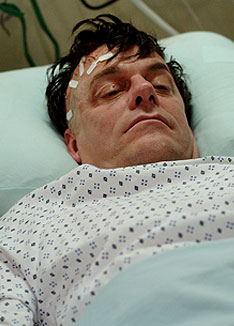 Walter Gretzky (Tom McCamus) in a coma after suffering a brain aneurism. |
Perhaps because Waking Up Wally was filmed with the participation of the Gretzkys, the film feels like an authorized, condensed version of Walter’s best-selling memoir, Walter Gretzky: On Family, Hockey and Healing. Occasionally, characters speak in portentous, cartoon balloon sentences meant to hurry the story forward. And everyone other than poor Walter seems a little too good to be true.
When Wayne and siblings gather at Walter’s hospital bedside, daughter Kim complains, “It’s not fair. He finally retired. Now this.”
“I don’t think it’s his time,” is Wayne’s wise response. Alas, even during reenactments of what must have been exceedingly raw and emotional scenes, Wayne (Kris Holden-Reid) remains the implacable P.R. smoothie we know from Hockey Night in Canada interviews.
The caution and restraint writer Carol Hay (The Sheldon Kennedy Story) and filmmaker Dean Bennett (Distant Drumming) exhibit in telling the Gretzky family story does, however, effectively underscore what is one of the most remarkable performances of the television year. A Stratford theatre legend, Tom McCamus has offered several memorable film performances (I Love a Man in Uniform, The Sweet Hereafter). Here he contributes to a swelling body of accomplished work, offering an eloquent, harrowing portrait of a middle-aged man who suddenly has no idea who he is or how even to button a shirt.
To make matters worse, Walter has no short-term memory. Learning the simplest task requires endless repetition. He re-loses his mind a hundred times daily and even after being released from hospital, remains in bed, hiding from the spilled jigsaw-puzzle world around him.
McCamus constructs his performance with exquisite care, nervously repeating a hopeful mantra (“sounds good to me”), but dealing with most enquiries with an empty stare that builds to a bewildered agitation when challenged with unmanageable tasks. Only in the film’s big scenes, in particular a sequence where he confuses a hockey tote bag for his mother’s coffin, does he raise the intensity of his performance, giving voice to the barely sublimated rage that threatens his fragile sanity.
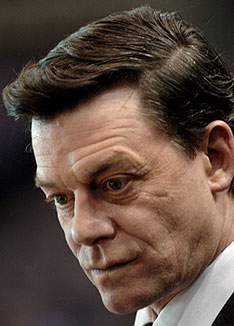 Wally (Tom McCamus) contemplates his son's future. |
That Waking Up Wally turns into such a crowd pleaser is a wonderful thing. Canadian television needs rousing populist fare. And speaking as a country music fan I have no problem in theory with the nation’s network celebrating Shania Twain’s Timmins-rags-to-Nashville-riches story this coming Monday night (although it might have been nice to document Maritime folk legends Stompin’ Tom Connors or Hank Snow first).
But we should remember what the Canadian TV docudrama tradition has meant — challenging works that allow our best filmmakers to test their ambition in interpreting stories of surpassing interest.
Walter Gretzky’s life story is perhaps Canadian hockey’s greatest comeback story. And it’s good to have it on the air. That said, it would be nice if we might have an occasional return to the ambitious, searching docudramas of yesteryear — efforts like Donald Brittain’s ’80s mini-series on Mackenzie King, or the searing 1994 film, The Boys of St. Vincent. We have enough comfort food on television. Docudramas, a Canadian tradition that goes back to the CBC radio plays of the ’40s, were meant to educate and amaze us.
Stephen Cole writes about television for CBC.ca.Copyright © 2005 Canadian Broadcasting Corporation - All Rights Reserved
More from this Author
Stephen Cole
- Guy Talk
- The hit comedy Entourage shows Hollywood some love
- Tuned Out
- Panic in American TV land
- End of Term
- The series finale of The West Wing
- Heeeeeeelp!
- The disaster picture, then and now
- Canadian Idols
- Randy Bachman and Burton Cummings take care of business


