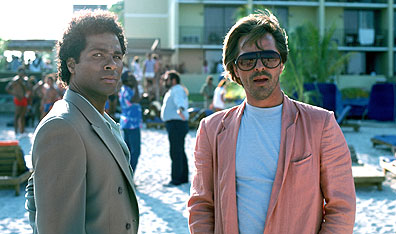
Smooth operators: Don Johnson, right, as Sonny Crockett and Philip Michael Thomas as Rico Tubbs in Miami Vice. AP Photo. Courtesy Universal Studios.
People who know me well know that I have a thing for Miami Vice. I’ve always been a bit sheepish about this fixation, for fear of being seen as shamelessly nostalgic or worse, deluded. But with the first season of Miami Vice having just been released on DVD, and (some) critics speaking wistfully of its cultural impact, I feel strong enough to talk about it.
During its five-season run (1984-89), Miami Vice changed the network crime drama forever, bringing a visual vibrancy to a genre that had become drab. (Much of it had to do with the location.) The quintessentially ’80s show about a pair of undercover cops – who were also, let’s face it, proto-metrosexuals – inspired any number of fleeting affectations: two-day stubble; wearing a white T-shirt under a pastel suit; adopting a hostile attitude toward socks. I grant that these elements added a cool sheen to the show’s look. But it was the music that drew me.
As a pre-teen obsessed with Top 40 radio, my entry point was producer Michael Mann’s aggressive use of au courant pop hits. (His recent film Collateral reaffirms that he’s scrupulous in his choice of tunes.) With an alleged budget of $50,000 US per episode for prerecorded music (an unprecedented figure at the time), the series showcased everyone from Peter Gabriel to the Pointer Sisters to Tina Turner to Glenn Frey. Neither the artists nor their songs have aged particularly well, but looking back on the show, there are scenes – amplified by music – that are indelible. Take the series pilot: having reconciled their initial differences, Sonny Crockett (Don Johnson) and Rico Tubbs (Philip Michael Thomas) unite to ambush Calderon, a Columbian gangster. As they cruise through Miami in Crockett’s jet-black Ferrari, Mann removes all ambient noise, leaving only the opening pulse of Phil Collins’s In the Air Tonight. Johnson is now slouching towards retirement and Collins has sold his soul to Disney, but 21 years later, the montage remains spine-tingling. I have vivid memories of a later episode, in which Godley & Creme’s eerie Cry is the soundtrack to a hostage swap gone horribly awry. It haunts me still.
But Mann didn’t stop there; he knew he needed a singular score to help define the show’s flashy esthetic. A drama about dodgy drug smugglers, pitiless gunrunners and grimy pimps begged for something brasher than the standard Mike Post treatment. (Quick primer: composer Mike Post was ubiquitous during the ’80s, penning blandly catchy themes to, among others, Hill Street Blues, The Greatest American Hero, The A-Team and Hardcastle & McCormick.) For an arresting aural signature, Michael Mann turned to Czech-born composer Jan Hammer, whose CV included session work with jazz greats like Sarah Vaughan and Elvin Jones and a seminal stint in the fusion group Mahavishnu Orchestra.
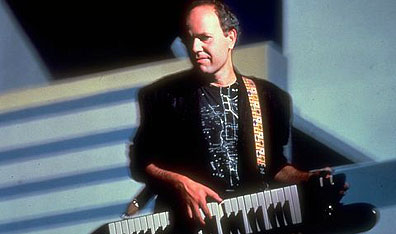
"Keytar" hero Jan Hammer. Photo by Chris Callis. Courtesy Elliott Sears.
People sometimes refer to scores as “incidental music,” but to me, Hammer’s music was anything but incidental. After all, the Miami Vice Theme is the only show theme to ever hit No. 1 on the Billboard singles chart. The rest of Hammer’s score was equally bracing and exotic: rippling marimbas to accompany swaying palm trees; stampeding percussion to underscore the requisite chases; wailing guitars to accent all those botched drug deals. To me, a single fizzy synth motif crystallized the perils of Crockett and Tubbs’s world: the chronic heat, the seedy allure of the firearms trade, the inherent risk of undercover detective work and the emotional toll it exacted. Am I overstating the effect? No doubt. But at the time, I found the whole milieu terribly thrilling, and tuned in every week to immerse myself in a seamy, perilous world.
Naturally, I bought all three Miami Vice soundtrack compilations, and listened to them compulsively. Once the series ended, they became precious companions. The songs were mnemonics that enabled me to replay episodes in my head (syndication was a long way off). While my fellow high-schoolers were discovering the joys of hip-hop, I was still obsessing about the background music to a show that had not only ceased to be cool, but had ceased to be.
When I got my driver’s licence in 1991, it became a fixture in my car stereo. The songs enabled me to maintain the fantasy that I was tear-assing around Miami in a Ferrari, even if I was merely coasting through a dreary Toronto suburb in my parents’ Ford Tempo. Most newly minted drivers would slow down at red lights pumping de rigueur dance hits like Black Box’s Strike It Up or Snap’s Rhythm Is a Dancer; I would sidle up blaring Crockett’s Theme.
Hammer’s music was so evocative that it inspired me to want to become a film scorer myself. After buying my first synthesizer in 1990 (a Korg Wavestation, a keyboard Jan was rumoured to have used), I wrote a slew of jazzified electro “themes” to a non-existent show with a similarly dark tone. (The premise, however, was totally different. It concerned an intrepid detective hunting down mobsters, usually by means of an extremely fast automobile. Like I said, totally different.)
As a matter of course, I sought out Hammer’s early jazz work; while it was enjoyable, I found few hints of the rousing atmospherics that had captivated me (although the Mahavishnu albums are pretty devastating). What set Hammer apart from his ivory-tinkling contemporaries was that he had a guitarist’s ear for soloing, and would simulate blistering guitar solos using his sampling keyboard. Years later, I felt a quiver of vindication when I read that bona fide guitar-shredder Jeff Beck once extolled Hammer as his favourite guitarist.
Mention Hammer’s name now, though, and you’ll incite a laugh-riot. That’s because he has such a strong ’80s association, one that isn’t helped by the fact that during his Miami Vice prime, Hammer was often seen with a keyboard slung around his neck. This was the dubious “keytar,” the portable keyboard-guitar hybrid whose appeal, like Philip Michael Thomas’s, seems limited to the ’80s.
After Miami Vice left the air in 1989, I bought Hammer’s subsequent solo albums in the hopes of extending the proverbial honeymoon, only to discover that I was listening to a guy who was trying to do the same thing. You couldn’t blame him; the best gig of his life had passed. My fervour for Miami Vice petered out around 1994, when I finally realized that the ’80s had ended, and that indie rock better articulated my teen angst. Even so, I’ll always be thankful to Michael, and Jan, for teaching me to dream in stereophonic sound.
Andre Mayer writes about the arts for CBC.ca.More from this Author
Andre Mayer
- The Smackdown
- This week: Is U2 over?
- Mad About Mad World
- One song's curious route to popularity
- On Golden Bond
- Casino Royale unleashes a meaner, more exciting James Bond
- For Your Ears Only
- The best and worst James Bond themes
- Everything He Wants
- A new greatest-hits package reveals George Michael's conflicted soul


