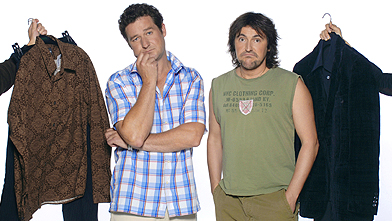
Agents provocateur: Guy Lepage (right) and Dany Turcotte, hosts of the popular current affairs program Tout le monde en parle. (Radio-Canada)
At 8 p.m. on a recent Sunday, more than 3.5 million Quebecers — about half the population — were watching domestically made television. These numbers aren’t unusual in La Belle Province; TV viewers here have been setting audience records since the 1950s. Television watching is a communal ritual that reinforces Quebec’s collective identity like no other. And the fall season marks the start of the tradition’s high holidays.
Throughout September and into October, Quebec broadcasters embark on an aggressive, star-infused media campaign to seduce audiences. The new shows are reviewed and their ratings obsessively monitored to see which will be the one everyone watches.
In contrast to the United States and English Canada, where Thursday night is king, the hottest evening for TV in Quebec is Sunday. Historically, the big draws have been téléromans (literally translated as tele-novels), a homegrown dramatic form of which Quebecers are famously fond. But in the past few years, what this province watches has changed dramatically: most of the post-millennial ratings record-breakers are superficial talk and reality shows, concepts that didn’t even originate here.
“In the days of yore, when you had few television channels, the television was national. The same drama would reach out across the land. It had to be cross-generational and appeal to many members of the same family,” says Roger de la Garde, a professor of communications at Laval University in Quebec City. “It may be sacrilegious to say this, but the shows that continue this tradition these days are reality shows and programs such as Toute le monde en parle.”
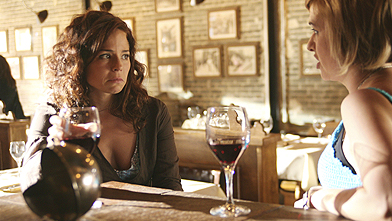
The CBC’s French-language network, Radio-Canada, invested $60 million in 11 new dramas this year, six of which will run in the new year. The five that debuted in the fall haven’t really connected with viewers. About a half-million people — an abysmal score here — tuned in for Tout sur moi (All about Me), a clever sitcom-cum-reality show starring actress Macha Limonchik and her two neurotic, fellow thespian buddies; the hour-long dramatic comedy Les hauts et les bas de Sophie Paquin (The Ups and Downs of Sophie Paquin) hasn’t caught on, either. Meanwhile, Radio-Canada’s flagship big-budget téléroman, the 13-episode boxing story Le 7e round (The Seventh Round), hasn’t been the knockout success the public broadcaster had hoped. The only new show making any headway is C.A., which stands for “Conseil d’administration,” or “board of directors” in English. It follows the erotic adventures of four yuppies whose approach to intimacy rivals the characters from Seinfeld.
Sophie's choice: Suzanne Clement (left) and Élise Guilbault (Estelle Poliquin) star in Les hauts et les bas de Sophie Paquin. (Radio-Canada)
So what are Quebecers watching? The major TV happening this season is the Sunday-night ratings showdown between two Quebec adaptations of programs that originated in France: Radio-Canada’s glitzy talk fest Tout le monde en parle (TMOP) — where guests sit around a horseshoe-shaped table and gab about current events — and Loft Story, a Big Brother-style reality show on the cable network TQS.
Between 1.5 million to two million people are flipping to TMOP every week, hosted by star Quebec comic Guy A. Lepage. His sardonic interview style and penchant for selecting controversial and entertaining guests has made the show a top program for three straight years. TMOP is now a must stop for anyone who wants to communicate with Quebecers: guests have included Quebec Premier Jean Charest, federal NDP Leader Jack Layton and Liberal leadership candidate Michael Ignatieff. It was on a recent episode of TMOP that Guy Fournier, then chairman of the board for the CBC, attempted to apologize for a column he wrote about bestiality in Lebanon. The sneaky Lepage blindsided the 75-year-old TV writer by digging up an interview with an obscure radio station, in which Fournier discussed the pleasures of defecating. That week, Fournier resigned his CBC post.
Quebecers who aren’t watching TMOP on Sunday night are likely checking out the creepy reality show Loft Story, where microphones and cameras track 15 people sequestered in a palatial Montreal loft. Every week, a member of one gender votes out two from the other; the public decides which of the latter two will actually have to leave the loft. The results are revealed on Sunday night, when about 1.2 million viewers tune in.
TVA, Quebec’s largest and most popular network, didn’t program a Sunday-night contender this fall — only around 700,000 are watching its new variety show, On n’as pas toute la soirée. But the so-called “people’s network” also programs a reality show, Occupation Double, which is vying for top spot with TMOP. Occupation Double’s ultimate goal is to help two lucky Quebecers find love. At the outset, 10 men move into a suburban Montreal home and seven women into the house next door. Every Thursday night, one gender gets together and votes out a member of the other gender that they deem undesirable. The pair that’s left is awarded $500,000 in prizes.
While the widespread popularity of reality programs isn’t unique to Quebec, the implications here are perhaps more serious, given the historic importance of television to Quebec culture. Since La famille Plouffe — the province’s original téléroman — was first broadcast, TV drama has evolved into a respected and meaningful popular art form (known as télévision d’auteur). Some of this province’s most imaginative minds — playwrights, novelists, even politicians — have used television as their preferred form of creative expression, producing more than 800 original works since the 1950s. They have found an exceedingly dedicated audience. In the mid-’90s, La petite vie, a ruthless satire of the modern Quebec family, attracted four million francophone viewers weekly, breaking a world record for per capita television watching. Shows such as Les filles de Caleb, Lance et Compte, Scoop, Blanche and Shehaweh regularly pulled in three million or more viewers a week.
He ain't heavy: Marc-Andre Fortin is hoisted in the air after winning last season's Star Academie competition. (David Boily/Canadian Press)
Some culture watchers blame broadcasters for the declining appetite for drama. In a La Press article entitled “Adieu téléroman! Adieu télévision!” (“Goodbye téléroman, good-bye television!”), award-winning novelist and TV writer Victor Lévy Beaulieu lamented that “television isn’t what it once was.” According to Beaulieu, for many years, Quebec television writers equaled the great feuilletonnistes (French serial novelists) of the 19th century — people like Honoré de Balzac, Eugène Sue, Alexandre Dumas and Victor Hugo. Television dramas, Beaulieu wrote, helped to create a national popular culture in Quebec. To him, shows like TMOP demonstrate that broadcasters no longer care about culture, only ratings and entertainment.
Another high-profile Quebecer, former PQ minister and téléroman writer Lise Payette, is also fed up with what’s on Quebec TV these days. In a column in the Quebec tabloid Le Journal de Montreal last week, Payette said she just didn’t get her province’s love affair with “deathly boring” reality shows such as Occupation Double and Loft Story.
Laval University’s de la Garde says Quebecers are still watching dramas, it’s just that their viewing habits have changed. “Individually, each drama reaches a smaller audience,” he says, “but the total of the separate audiences is still quite large.” Audiences may be fragmenting because there are more dramas to choose from, both in English and French. Many Quebecers are also turned off by the Montreal-centric nature of the newest crop of TV dramas; for the past few years, rural and suburban Quebecers have complained that the only characters they see on television are hip, 30-something Montrealers living in the trendy Plateau neighborhood. To a large extent, they are right. Which is where reality shows such as Occupation Double, Loft Story and Star Academie — the Quebec version of American Idol —come in. While they appear to be unoriginal ideas, these shows are redressing Quebec’s rural-urban divide.
Last season, 12 of Star Academie’s 14 contestants were from communities outside of Montreal. Throughout the course of the talent contest, viewers revisited their hometowns. While the themes of Loft Story and Occupation Double are more adult-oriented, most of the contestants are also from rural and suburban Quebec, a very appealing fact for disgruntled regional audiences. As with Star Academie, extended families and communities are an integral part of the buzz surrounding these shows.
De la Garde says that by appealing to Quebecers of all ages from across the province, these shows are serving the same purpose as the epic téléromans once did -- with one central difference. “There’s a good deal of creativity that goes into these reality shows, but it’s less artistic,” he says. “It’s more about marketing.”
Patricia Bailey is a writer and broadcaster based in Montreal.
 CBC
does not endorse and is not responsible
for the content of external sites
- links will open in new window.
CBC
does not endorse and is not responsible
for the content of external sites
- links will open in new window.
Copyright © 2005 Canadian Broadcasting Corporation - All Rights Reserved
More from this Author
Patricia Bailey
- Night Watch
- What has happened to Quebec's television-viewing habits?
- Big in Japan
- The story behind Tora-san, the longest-running film series in history
- Taking the Plunge
- The documentary Touched by Water explores our universal love of bathing
- Wicked and Weird
- The kooky charms of the Gimli Film Festival
- Guys Like Us
- Quebec television outgrows its male stereotypes


