»
5. Boreal forests
What is it?
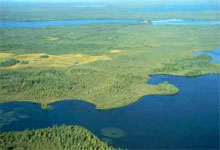
Alberta's boreal region is a mixture of forests, bogs, wetlands, rivers and lakes. (Alberta Heritage Community Foundation)
Alberta's boreal forest is part of the larger, connected network
of boreal forests across the centre of the country
from Newfoundland to the Yukon, and one of the largest in the
world. It is home to many First Nations communities including
Cree, Métis, Dene, and Athabascan, and threatened species
like the woodland caribou and wolverines. The wood bison, whooping
crane, snowshoe hare, great gray owl as well as many species
of songbirds all call the boreal forest home. Also in the boreal,
two major rivers, the Peace and the Athabasca, drain into one
of the world's largest fresh water deltas: the Peace-Athabasca
Delta.
How much is being disturbed?
About five hundred square kilometres of boreal forest
were cleared or mined by the end of 2007, transforming the landscape
in northeastern Alberta. In total, more than 3,000 square kilometres
of boreal forest have been leased for mine development, equivalent
to a city four times the size of Edmonton, representing about
one per cent of Canada's total boreal forest cover.
What's the implication?
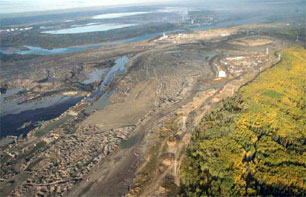
The boreal forest is removed to allow for surface extraction of oilsands in open-pit mines. (David Dodge/Canadian Parks and Wilderness Society)
Because Canada's boreal forest houses a quarter of all ancient forests on the planet, it is a large storehouse of carbon. Once the soil is disturbed and trees are harvested, it releases large amounts of carbon.This disturbance also alters the landscape for species that inhabit the forest's complex ecosystem, especially its wetlands that take decades to develop. This further threatens species like the woodland caribou, whose numbers have been in decline since the advent of oilsands development 45 years ago.
Can it be put back after mining?
Read the full report
According to the Pembina Institute, reclamation is troublesome because environmental organizations, industry and government haven't agreed on what reclamation means. Conservation groups want to see the land "restored" to the same ecological composition prior to mining, while the government requires industry to return the land to a "natural state" of "equivalent land capability."
Putting back massive amounts of soil, vegetation and returning wetlands and bogs to their original state and replanting native species has never happened on a tailings pond and the industry has only limited amounts experience in reclaiming mine sites. However, Syncrude has reclaimed part of its mined areas and small trees are growing. It is still unproven that the boreal forest can truly be returned to its original state after the mining is finished.
Is reclamation certified?
Only one area, Syncrude Energy's 104-hectare Gateway Hill site, was certified reclaimed by the province in March, 2008. But critics argue it was not an oilsands mine (it was just a holding area for what's known overburden soil) and it wasn't returned to its original condition. The Pembina Institute points out in its report, that Gateway Hill is now "a forested hill with public walking trails. Pre-disturbance, this area was a low-lying wetland. Clearly, equivalent land capability is a subjective term that needs some boundaries and parameters."
Gateway Hill amounts to 0.2 per cent of the total land disturbed by mining and, according to the Canadian Association of Petroleum Producers, industry considers another 13 per cent of land reclaimed, but not certified by the province. This includes a buffalo ranch, Bill's pond, and a quarter of Syncrude's Mildred Lake mine site.
Although the Gateway Hill reclamation is "a very small percentage," says
CAPP spokesperson Travis Davis, it is "meaningful only in that
it proves it is possible."

Audio & Video

- WatchDefending the oilsands
- Feb. 25, 2009 | Prentice responds to a National Geographic feature (2:50)
- ListenTerry Tamminen
- Feb. 19, 2009 | Obama energy advisor talks about 'dirty' oil (25:30)
- ListenThe Current Pt. 1
- Feb. 18, 2009 | The Current explores the oilsands' challenges (26:00)
- ListenThe Current Pt. 2
- Feb. 18, 2009 | More on the oilsands and Alberta's finance minister (26:00)
- ListenBishop's letter
- Jan. 27, 2009 | Bishop calls oilsands development immoral (6:55)
- ListenTailings pond solutions
- Dec. 11, 2008 | CBC Radio's Erik Denison reports on the tailings waste and industry's solutions to clean it up (21:39)
- ListenToxic tailings leaking
- Dec. 9, 2008 | Ponds leaking 11 million litres of tailings daily: report (4:50)
- ListenTailings conference
- Dec. 8, 2008 | Conference on tailings ponds comes to Edmonton. Erik Denison reports (4:29)
- ListenCarbon capture limitations
- Nov. 25, 2008 | Limitations revealed in government documents (4:14)
- ListenCarbon capture
- Nov. 24, 2008 | Minister's sectret briefing down on carbon capture (6:29)
- ListenOilsands plan B
- Nov. 21, 2008 | Selling Alberta's oilsands to Asia is facing stiff opposition (6:51)
- ListenCBC oilsands forum
- Nov. 20, 2008 | 3 panelists debate if the oilsands are 'dirty' (51:09)
- ListenUpgrader pollution
- Nov. 19, 2008 | U.S. town doesn't want oilsands upgrading (5:53)
- ListenU.S. reservations
- Nov. 19, 2008 | California introduces low-carbon standards (6:05)
- ListenOilsands jobs
- Nov. 18, 2008 | Nfld.'s dependence on oilsands jobs (5:10)
- ListenEthical investing
- Nov. 18, 2008 | CBC Radio's Adrienne Lamb reports (6:41)
- Listen'Dirty oil' label
- Nov. 17, 2008 | CBC Radio's Erik Denison explains the label (7:42)
- Listen 'Comprehensive' health study launched
- May 22, 2008 | CBC Radio's Erik Denison reports (5:50)
- ListenOil-covered ducks
- May 2, 2008 | A hunter discovered an oil-coated duck in Wood Buffalo Park (2:39)
- Watch500 ducks die
- Apr. 29, 2008 | Ducks land in a Syncrude Energy tailings pond (1:48)
- WatchA town's toxic questions
- Dec. 2007 | Fort Chipewyan is living in fear (20:23)
- WatchCrude Awakening - Pt. 1
- Dec. 2007 | CBC-TV's feature about the oilsands' environmental costs (16:01)
- WatchCrude Awakening - Pt. 2
- Dec. 2007 | Part 2 of Darrow MacIntyre's feature (16:45)