Why it's called 'dirty oil'
1. Tailings ponds
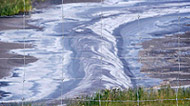
Called the largest project on earth, Alberta's oilsands produce over 1.3 million barrels of crude oil daily. But it has become more famous for the toxic wastewater it generates than its oil — 1.8 billion litres daily. The wastewater known as tailings, are stored in ponds are so large they can be seen by the naked eye from space. More »
2. Greenhouse gas emissions
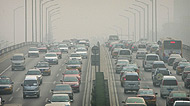
The oilsands are Canada's fastest growing source of carbon dioxide, emitting five per cent of Canada greenhouse gases. Large amounts of energy are used to extract and covert the oilsands to crude oil, producing three times more greenhouse gases than a conventional barrel of oil. More »
3. Water pollution
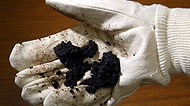
Alberta's oilsands need water for mining and processing, using enough water for two cities the size of Calgary annually. The toxic wastewater that cannot be recycled is stored in large open-air tailings ponds. Fears of tailings seeping into ground water and nearby rivers is a growing problem in northeastern Alberta. More »
4. Air pollution
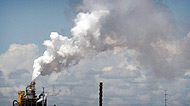
Oilsands upgraders in the Fort McMurray area consistently rank among the top 10 most polluting facilities in Canada. But the story doesn't end there. The oilsands industry needs a tremendous amount of energy and in Alberta, a lot of that energy comes from coal-fired plants — some of the worst polluters in the country. More »
5. Boreal forests
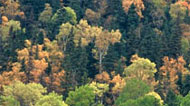
About five hundred square kilometres of boreal forest were cleared or mined by the end of 2007, transforming the landscape in northeastern Alberta. Industry promises to return the forest after extracting the oilsands, but it has never been proven that the forests' complex ecosystem can be reclaimed. Meanwhile, threatened species like the woodland caribou continue to dwindle. More »

Audio & Video

- WatchDefending the oilsands
- Feb. 25, 2009 | Prentice responds to a National Geographic feature (2:50)
- ListenTerry Tamminen
- Feb. 19, 2009 | Obama energy advisor talks about 'dirty' oil (25:30)
- ListenThe Current Pt. 1
- Feb. 18, 2009 | The Current explores the oilsands' challenges (26:00)
- ListenThe Current Pt. 2
- Feb. 18, 2009 | More on the oilsands and Alberta's finance minister (26:00)
- ListenBishop's letter
- Jan. 27, 2009 | Bishop calls oilsands development immoral (6:55)
- ListenTailings pond solutions
- Dec. 11, 2008 | CBC Radio's Erik Denison reports on the tailings waste and industry's solutions to clean it up (21:39)
- ListenToxic tailings leaking
- Dec. 9, 2008 | Ponds leaking 11 million litres of tailings daily: report (4:50)
- ListenTailings conference
- Dec. 8, 2008 | Conference on tailings ponds comes to Edmonton. Erik Denison reports (4:29)
- ListenCarbon capture limitations
- Nov. 25, 2008 | Limitations revealed in government documents (4:14)
- ListenCarbon capture
- Nov. 24, 2008 | Minister's sectret briefing down on carbon capture (6:29)
- ListenOilsands plan B
- Nov. 21, 2008 | Selling Alberta's oilsands to Asia is facing stiff opposition (6:51)
- ListenCBC oilsands forum
- Nov. 20, 2008 | 3 panelists debate if the oilsands are 'dirty' (51:09)
- ListenUpgrader pollution
- Nov. 19, 2008 | U.S. town doesn't want oilsands upgrading (5:53)
- ListenU.S. reservations
- Nov. 19, 2008 | California introduces low-carbon standards (6:05)
- ListenOilsands jobs
- Nov. 18, 2008 | Nfld.'s dependence on oilsands jobs (5:10)
- ListenEthical investing
- Nov. 18, 2008 | CBC Radio's Adrienne Lamb reports (6:41)
- Listen'Dirty oil' label
- Nov. 17, 2008 | CBC Radio's Erik Denison explains the label (7:42)
- Listen 'Comprehensive' health study launched
- May 22, 2008 | CBC Radio's Erik Denison reports (5:50)
- ListenOil-covered ducks
- May 2, 2008 | A hunter discovered an oil-coated duck in Wood Buffalo Park (2:39)
- Watch500 ducks die
- Apr. 29, 2008 | Ducks land in a Syncrude Energy tailings pond (1:48)
- WatchA town's toxic questions
- Dec. 2007 | Fort Chipewyan is living in fear (20:23)
- WatchCrude Awakening - Pt. 1
- Dec. 2007 | CBC-TV's feature about the oilsands' environmental costs (16:01)
- WatchCrude Awakening - Pt. 2
- Dec. 2007 | Part 2 of Darrow MacIntyre's feature (16:45)