»
1. Tailings ponds
What are tailings?
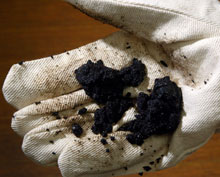
Bitumen, the thickest and heaviest form of oil, must be washed with water and further processed before it becomes crude oil. (CP)
Tailings are the non-recyclable wastewater left after bitumen — a thick, tar-like substance that is turned into oil — is separated from the sand it is buried under.
Surface-mined bitumen needs water, solvents and lighter hydrocarbons to become conventional crude oil, which is further refined to make gasoline for cars, asphalt for paving roads, and even detergents, fertilizers and plastics.
Stored for decades in open-air lakes, tailings are made of water and toxic slurry consisting of naphthenic acids (NAs), polycyclic aromatic hydrocarbons (PAHs), arsenic, sand, mercury, residual bitumen, salt and clay. However, they are mostly comprised of substances that occur naturally in the region, but not at such high concentrations.
How much waste is generated?
Since each cubic metre of bitumen extracted creates three to five cubic metres of tailings that need to be stored, the "ponds" are so large they can be seen by the naked eye from space.
Syncrude's tailings pond, at 540 million cubic metres in volume, is the world's largest dam, second only to China's Three Gorges Dam.
In total, there are 130 square kilometres of tailings, and the ponds are projected to grow to 220 square kilometres — an area five times the size of Alberta's Sylvan Lake. That's because there are 1.8 billion litres of tailings waste produced daily, according to Calgary-based Pembina Institute.
How long will they be there?
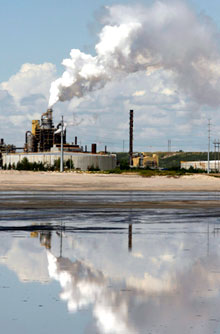 A tailings pond reflects the Syncrude oilsands mine facility near
Fort McMurray, Alta., on July 9, 2008. (Jeff McIntosh/CP)
A tailings pond reflects the Syncrude oilsands mine facility near
Fort McMurray, Alta., on July 9, 2008. (Jeff McIntosh/CP)It's not known for sure. Since oilsands development began in 1967, none of these tailings have ever been emptied or the land reclaimed. The industry has a number of ideas for reclaiming these ponds, which, given their size, might more accurately be described as lakes.
One of the primary plans is to reclaim tailings ponds by burying the toxic sludge into deep pits to settle, adding layers of earth and topping it off with fresh water, called End Pit Lakes (EPL). These plans are only hypothetical , however, and there would be serious ramifications if the two waters ever mixed. The government's Joint Review Panel, in reviewing Imperial Oil's Kearl Lake Mine application, stated: "The Joint Panel notes that the EPL reclamation strategy remains an unproven and unapproved reclamation option." Still, pilot projects are set to begin between 2010 and 2012.
There are at least 25 EPLs planned for the Athabasca Boreal region within the next 60 years, according to Pembina's report. "These EPLs have been approved in the absence of a single demonstrated EPL by any oilsands operator," the report says.
Read the reports
Pembina Institute: Fact or Fiction (PDF)
CAPP: Environmental challenges in progress in Canada's
oil sands (PDF)
Industry is testing new techniques such as tailing thickeners and CO2 reactions to recycle more water and reduce the volume of tailings and the amount of time they need to be stored. Other options include cycloning or centrifugation, which separate the tailings waste in a solid state and recycles the remaining water.
Are tailings government regulated?
The government has never had formal regulations on tailings management, performance, or enforcement mechanisms, and this has become a growing concern for government as the volume of tailings grows.
More background
In June 2008, Alberta's Energy Resources Conservation Board (ERCB) released a draft policy that will require industry to submit its plans and timelines for tailings pond construction, operation and abandonment.
The final policy is expected to be released in late December 2008.
On December 8, 2008, a report released by Environmental Defense says 11 million litres of toxic water leak each day from the giant waste ponds. The environmental lobby group criticizes the province for allowing companies to self-regulate and not requiring public disclosure of water quality reports. The report predicts tailings leaks will grow from 4 fo ur billion litres a year now, to 25 billion litres a year within a decade. This growth in toxic waste and its effects on the landscape and water quality is a major reason the oilsands are getting the 'dirty oil' label.

Audio & Video

- WatchDefending the oilsands
- Feb. 25, 2009 | Prentice responds to a National Geographic feature (2:50)
- ListenTerry Tamminen
- Feb. 19, 2009 | Obama energy advisor talks about 'dirty' oil (25:30)
- ListenThe Current Pt. 1
- Feb. 18, 2009 | The Current explores the oilsands' challenges (26:00)
- ListenThe Current Pt. 2
- Feb. 18, 2009 | More on the oilsands and Alberta's finance minister (26:00)
- ListenBishop's letter
- Jan. 27, 2009 | Bishop calls oilsands development immoral (6:55)
- ListenTailings pond solutions
- Dec. 11, 2008 | CBC Radio's Erik Denison reports on the tailings waste and industry's solutions to clean it up (21:39)
- ListenToxic tailings leaking
- Dec. 9, 2008 | Ponds leaking 11 million litres of tailings daily: report (4:50)
- ListenTailings conference
- Dec. 8, 2008 | Conference on tailings ponds comes to Edmonton. Erik Denison reports (4:29)
- ListenCarbon capture limitations
- Nov. 25, 2008 | Limitations revealed in government documents (4:14)
- ListenCarbon capture
- Nov. 24, 2008 | Minister's sectret briefing down on carbon capture (6:29)
- ListenOilsands plan B
- Nov. 21, 2008 | Selling Alberta's oilsands to Asia is facing stiff opposition (6:51)
- ListenCBC oilsands forum
- Nov. 20, 2008 | 3 panelists debate if the oilsands are 'dirty' (51:09)
- ListenUpgrader pollution
- Nov. 19, 2008 | U.S. town doesn't want oilsands upgrading (5:53)
- ListenU.S. reservations
- Nov. 19, 2008 | California introduces low-carbon standards (6:05)
- ListenOilsands jobs
- Nov. 18, 2008 | Nfld.'s dependence on oilsands jobs (5:10)
- ListenEthical investing
- Nov. 18, 2008 | CBC Radio's Adrienne Lamb reports (6:41)
- Listen'Dirty oil' label
- Nov. 17, 2008 | CBC Radio's Erik Denison explains the label (7:42)
- Listen 'Comprehensive' health study launched
- May 22, 2008 | CBC Radio's Erik Denison reports (5:50)
- ListenOil-covered ducks
- May 2, 2008 | A hunter discovered an oil-coated duck in Wood Buffalo Park (2:39)
- Watch500 ducks die
- Apr. 29, 2008 | Ducks land in a Syncrude Energy tailings pond (1:48)
- WatchA town's toxic questions
- Dec. 2007 | Fort Chipewyan is living in fear (20:23)
- WatchCrude Awakening - Pt. 1
- Dec. 2007 | CBC-TV's feature about the oilsands' environmental costs (16:01)
- WatchCrude Awakening - Pt. 2
- Dec. 2007 | Part 2 of Darrow MacIntyre's feature (16:45)