»
3. Water pollution
How is water used?
Oilsands production is a water-intensive process. The industry uses on average two to three barrels of water to produce one barrel of surface-mined bitumen. The long-established companies such as Suncor and Syncrude have efficient water recycling systems that allow them to recycle each barrel of water up to 18 times. Despite their recycling efforts, up to five barrels of tailings water is left after one barrel of oil is produced, and that water ends up in the massive tailings ponds.
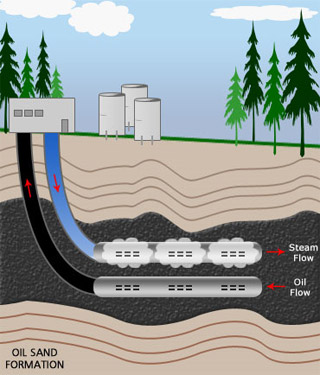 Diagram of In-situ extraction: Two parallel wells are drilled
into the bottom of the reservoir. Steam is injected into the
top well and the heat melts the bitumen, which drains by gravity
into the lower well.
Because the water is mostly recycled, the process takes less than a barrel of
water for every barrel of oil produced. That compares to between
two and 4½ barrels of water needed to produce one barrel of
oil when bitumen is mined.
Diagram of In-situ extraction: Two parallel wells are drilled
into the bottom of the reservoir. Steam is injected into the
top well and the heat melts the bitumen, which drains by gravity
into the lower well.
Because the water is mostly recycled, the process takes less than a barrel of
water for every barrel of oil produced. That compares to between
two and 4½ barrels of water needed to produce one barrel of
oil when bitumen is mined.
Currently, oilsands projects can withdraw 349 million cubic
metres of water annually, 65 per cent of which they get from
the Athabasca River. That's two per cent of the river's annual
flow — enough water for two cities the size of Calgary.
For the 82 per cent of Alberta's oilsands too deep to be surface-mined (i.e.
more than 400 metres deep), in-situ extraction methods are used, usually with
fresh groundwater.
Industry plans to reclaim the land holding the enormous tailings
wastewater by burying them deep into the ground, and creating
a lake above it in End Pit Lakes that become healthy aquatic
ecosystems. However, filling an EPL would require a water depth
65 to 100 metres, mostly drawn from the Athabasca River, further
straining it.
Is the river polluted?
Alberta's government has as strict zero-discharge policy,
but Suncor Energy has admitted that its Tar Island Dyke — the
oilsands' first tailings pond built in the mid-60s — leaks
1,600 cubic metres (1.6-million litres) of toxic tailings into
the Athabasca River, which has also leached into nearby groundwater.
The company has never been fined for the leak and, since 1976,
says it has put in place a collection system to capture the
toxins and pump it back into the pond. Suncor spokesman, Brade
Bellows, admits that the company's modeling suggests "some amount
of seepage may bypass the collection systems," and says Suncor's
testing shows no changes in river water
quality both upstream and downstream. The company plans to decommission
the tailings pond by 2010 by moving the water to another pond.
It then hopes to prove a tailings pond can be reclaimed by reclaiming
that area.
What are the safeguards?
Alberta operates under a regulate-and-monitor system, but environmental organizations have accused the government of "outsourced” monitoring of water pollution, delegating the task to the Regional Aquatics Monitoring Group (RAMP) — an industry-funded and chaired stakeholder group. Some scientists have called RAMP's data so inconsistent from year to year that they cannot compare historical data or make scientifically sound conclusions about water quality.
Industry is testing new techniques such as tailing thickeners and CO2 reactions to recycle more water and reduce the volume of tailings and the amount of time they need to be stored. Other options include cycloning or centrifugation, which separate the tailings waste in a solid state and recycles the remaining water.
What are the health implications?
In depth: Fort Chipewyan
In March 2006, Dr. John O'Connor went public with concerns about elevated rates of cancers among his patients in Fort Chipewyan, a hamlet of 1,200 downstream from the oilsands, 300 kilometres north of Fort McMurray. Fort Chipewyan's residents rely on the local fish and game for food. They've noticed their fish are deformed with crooked tails, bulging eyes, skin tumours and humpbacks. After repeated promises from the province of a comprehensive health study of their food and water, Fort Chipewyan's Nunee Health Board commissioned its own independent study of the Athabasca River Delta sediment.
Read the report
The report by Dr. Kevin Timoney, a well-known ecologist and statistician, found extremely high levels of mercury, arsenic, and double the acceptable levels of polycyclic aromatic hydrocarbons (PAHs) — long known to cause cancer in fish.
If the U.S. Environmental Protection Agency's standards are applied, all walleye (pickerel), all female whitefish, and 90 per cent of male whitefish exceed subsistence fishermen guidelines for mercury consumption. Timoney said the contaminants were not only found in fish, but also in waterfowl, beavers, muskrat, and moose — traditional foods the community lives on. Suncor's own modeling predicted that moose meat could contain up to 453 times the accepted level of arsenic. A study by Alberta Health contradicted Suncor's results, concluding the risk is 17 to 33 times acceptable levels.
NEXT: 4. Air pollution »

Audio & Video

- WatchDefending the oilsands
- Feb. 25, 2009 | Prentice responds to a National Geographic feature (2:50)
- ListenTerry Tamminen
- Feb. 19, 2009 | Obama energy advisor talks about 'dirty' oil (25:30)
- ListenThe Current Pt. 1
- Feb. 18, 2009 | The Current explores the oilsands' challenges (26:00)
- ListenThe Current Pt. 2
- Feb. 18, 2009 | More on the oilsands and Alberta's finance minister (26:00)
- ListenBishop's letter
- Jan. 27, 2009 | Bishop calls oilsands development immoral (6:55)
- ListenTailings pond solutions
- Dec. 11, 2008 | CBC Radio's Erik Denison reports on the tailings waste and industry's solutions to clean it up (21:39)
- ListenToxic tailings leaking
- Dec. 9, 2008 | Ponds leaking 11 million litres of tailings daily: report (4:50)
- ListenTailings conference
- Dec. 8, 2008 | Conference on tailings ponds comes to Edmonton. Erik Denison reports (4:29)
- ListenCarbon capture limitations
- Nov. 25, 2008 | Limitations revealed in government documents (4:14)
- ListenCarbon capture
- Nov. 24, 2008 | Minister's sectret briefing down on carbon capture (6:29)
- ListenOilsands plan B
- Nov. 21, 2008 | Selling Alberta's oilsands to Asia is facing stiff opposition (6:51)
- ListenCBC oilsands forum
- Nov. 20, 2008 | 3 panelists debate if the oilsands are 'dirty' (51:09)
- ListenUpgrader pollution
- Nov. 19, 2008 | U.S. town doesn't want oilsands upgrading (5:53)
- ListenU.S. reservations
- Nov. 19, 2008 | California introduces low-carbon standards (6:05)
- ListenOilsands jobs
- Nov. 18, 2008 | Nfld.'s dependence on oilsands jobs (5:10)
- ListenEthical investing
- Nov. 18, 2008 | CBC Radio's Adrienne Lamb reports (6:41)
- Listen'Dirty oil' label
- Nov. 17, 2008 | CBC Radio's Erik Denison explains the label (7:42)
- Listen 'Comprehensive' health study launched
- May 22, 2008 | CBC Radio's Erik Denison reports (5:50)
- ListenOil-covered ducks
- May 2, 2008 | A hunter discovered an oil-coated duck in Wood Buffalo Park (2:39)
- Watch500 ducks die
- Apr. 29, 2008 | Ducks land in a Syncrude Energy tailings pond (1:48)
- WatchA town's toxic questions
- Dec. 2007 | Fort Chipewyan is living in fear (20:23)
- WatchCrude Awakening - Pt. 1
- Dec. 2007 | CBC-TV's feature about the oilsands' environmental costs (16:01)
- WatchCrude Awakening - Pt. 2
- Dec. 2007 | Part 2 of Darrow MacIntyre's feature (16:45)