»
4. Air pollution
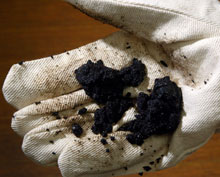
Bitumen, the tickest and heaviest form of oil, must be washed with water to separate it from sand, and processed before it becomes crude oil. (CP)
The oilsands emit a large amount of pollution into the air. For example, Syncrude alone releases 245 tonnes of sulphur dioxide a day. Sulphur dioxide is responsible for acid rain and those living in the neighbouring province of Saskatchewan are concerned for the health of their lakes.
What is causing the pollution?
Oilsands upgraders in the Fort McMurray area consistently rank among the top 10 most polluting facilities in Canada. But the story doesn't end there. The oilsands industry needs a tremendous amount of energy and in Alberta, a lot of that energy comes from coal-fired plants — some of the worst polluters in the country.
Other pollution comes from the giant trucks used to ferry machinery and carry the oily sand from the mines. An Alberta government air-quality study found a list of pollutants was increasing in the Fort McMurray area despite being on the decline everywhere else in Alberta. That included dangerous hydrogen sulphide (known as sour gas) and sulphur dioxide, which can harm human health and acidify lakes and soil — too much for some animals and plants to survive.
Syncrude recently had to pay compensation to people living
in Fort MacKay after a blast of ammonia from its operation floated
toward a school in that community, causing students to throw
up and become ill. Some were taken to hospital but no one was
seriously injured by the accidental release.
What is being done?
The industry says it is working hard to clean up its air pollution. Syncrude, one of the major producers of sulfur dioxide, installed a device on its emission stacks that captures sulphur before it goes into the air. The company's website says, "since 1983, Syncrude has reduced SO2 emissions per barrel by 50%, and total SO2 emissions by 4%. This has occurred while crude oil production has more than doubled."
Suncor was the first to introduce "scrubbers" to its oilsands facility, reducing its sulphur emissions dramatically. The company is also introducing new kinds of trucks in its mines with very limited emissions. The company notes that overall pollution releases are on the decline at its facilities while production has increased significantly.
NEXT: 5. Boreal forests »

Audio & Video

- WatchDefending the oilsands
- Feb. 25, 2009 | Prentice responds to a National Geographic feature (2:50)
- ListenTerry Tamminen
- Feb. 19, 2009 | Obama energy advisor talks about 'dirty' oil (25:30)
- ListenThe Current Pt. 1
- Feb. 18, 2009 | The Current explores the oilsands' challenges (26:00)
- ListenThe Current Pt. 2
- Feb. 18, 2009 | More on the oilsands and Alberta's finance minister (26:00)
- ListenBishop's letter
- Jan. 27, 2009 | Bishop calls oilsands development immoral (6:55)
- ListenTailings pond solutions
- Dec. 11, 2008 | CBC Radio's Erik Denison reports on the tailings waste and industry's solutions to clean it up (21:39)
- ListenToxic tailings leaking
- Dec. 9, 2008 | Ponds leaking 11 million litres of tailings daily: report (4:50)
- ListenTailings conference
- Dec. 8, 2008 | Conference on tailings ponds comes to Edmonton. Erik Denison reports (4:29)
- ListenCarbon capture limitations
- Nov. 25, 2008 | Limitations revealed in government documents (4:14)
- ListenCarbon capture
- Nov. 24, 2008 | Minister's sectret briefing down on carbon capture (6:29)
- ListenOilsands plan B
- Nov. 21, 2008 | Selling Alberta's oilsands to Asia is facing stiff opposition (6:51)
- ListenCBC oilsands forum
- Nov. 20, 2008 | 3 panelists debate if the oilsands are 'dirty' (51:09)
- ListenUpgrader pollution
- Nov. 19, 2008 | U.S. town doesn't want oilsands upgrading (5:53)
- ListenU.S. reservations
- Nov. 19, 2008 | California introduces low-carbon standards (6:05)
- ListenOilsands jobs
- Nov. 18, 2008 | Nfld.'s dependence on oilsands jobs (5:10)
- ListenEthical investing
- Nov. 18, 2008 | CBC Radio's Adrienne Lamb reports (6:41)
- Listen'Dirty oil' label
- Nov. 17, 2008 | CBC Radio's Erik Denison explains the label (7:42)
- Listen 'Comprehensive' health study launched
- May 22, 2008 | CBC Radio's Erik Denison reports (5:50)
- ListenOil-covered ducks
- May 2, 2008 | A hunter discovered an oil-coated duck in Wood Buffalo Park (2:39)
- Watch500 ducks die
- Apr. 29, 2008 | Ducks land in a Syncrude Energy tailings pond (1:48)
- WatchA town's toxic questions
- Dec. 2007 | Fort Chipewyan is living in fear (20:23)
- WatchCrude Awakening - Pt. 1
- Dec. 2007 | CBC-TV's feature about the oilsands' environmental costs (16:01)
- WatchCrude Awakening - Pt. 2
- Dec. 2007 | Part 2 of Darrow MacIntyre's feature (16:45)