Self Portrait, 1962. Photo Larry Clark. Courtesy of the artist and Luhring Augustine, NY.
Larry Clark, known to the art world since the 1970s for his graphic photographs of methamphetamine users in Tulsa, and more widely famed for his explicit depiction of bad behaviour in the 1995 movie Kids, is currently being given his first North American retrospective at the International Center for Photography in Manhattan. On Saturdays, it’s craning room only at ICP.
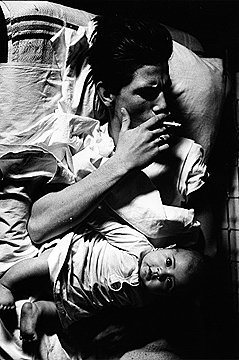 Untitled, 1963. From Tulsa. Photo Larry Clark. Courtesy of the artist and Luhring Augustine, NY. |
The ICP show includes photographs and collages from the past 40 years. In addition to Clark’s Tulsa series — which was shot between 1962 and 1970 — there are images of teens having sex; naked teen hippies in a New Mexico commune; teenage hustlers in Times Square in the 1980s (one particularly disturbing scene features a girl being raped while tripping on acid); and collages combining images of near-naked teenage boys, photos of Matt Dillon and River Phoenix ripped from the pages of Tiger Beat and newspaper clippings about teens who committed violent crimes.
Also included are Clark’s early-’90s teenage skater series and casting Polaroids of the Kids actors (Chloë Sevigny and Rosario Dawson, along with the “real” teenagers featured in the film). There are other fascinating documents from Clark’s life, including a history of drug abuse that he provided to St. Luke’s Roosevelt Hospital in the ’90s in order to get clean, as well as snippets from episodes of Donahue and The Today Show featuring teens who killed their parents or committed other violent crimes. The latter inspired the storylines for his later films Bully (2001) and Ken Park (which is still awaiting wide release).
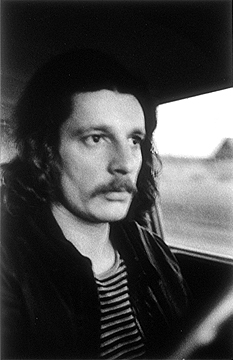 Untitled, 1971. Photo Larry Clark. Courtesy of the artist and Luhring Augustine, NY. |
To be fair, Clark was once the genuine article. When he began shooting his meth-addicted friends in Tulsa in the ’60s, he was also shooting up — daily. Applying the old chestnut “write what you know” to his photography worked. The photographs Clark took of wannabe Natalie Woods and James Deans — like the pregnant, beehived prostitute injecting herself, or the group of duck-tailed boys tying tourniquets in their Southern working-class family room beneath a Jesus painting and a vase of plastic flowers — are both formally beautiful and emotionally trenchant. They influenced Scorsese’s Mean Streets, Coppola’s Rumble Fish, Van Sant’s Drugstore Cowboy and certainly come closest to validating the ICP’s grand claims for Clark’s significance. But the Tulsa series is the first and last set of Clark’s images that complicate the notion of exploitation (because of the short distance between the using artist and his using subjects) and reach towards richer, more nuanced meaning.
Long before he picked up a camera, exploitation was a comfortable mode for Clark. In the introduction to Teenage Lust, his self-published book, Clark writes of his longing to use a camera to turn back the clock to his glory days as a boy “f---ing in the backseat... the fat girl next door who gave me blow jobs after school. I treated her mean and told all my pals. We kept count up to about 300 times we f---ed her in the 8th grade. Once when I f---ed her after Bobby Hood (ol' horse dick) I was f---ing hair and air. A little rape.” Clark may have been an amoral asshole as a teenager, but at a certain age, this excuse stops being valid, or interesting.
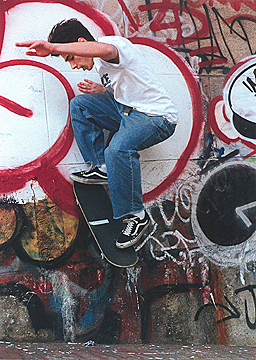 Untitled, 1992-95. Photo Larry Clark. Courtesy of the artist and Luhring Augustine, NY. |
Clark’s position as cultural renegade is undermined by the predictable lechery of his films and photographs. This is an artist who shares with John Updike that most conservative, widely accepted of western, middlebrow axioms: that eros, delivered in the most obvious form — underage flesh — provides redemption. In an interview in Pataphysics magazine, Clark rhapsodized about the final group sex scene in Ken Park: “Normally I think in this film you would just show how broken all the kids were, but in Ken Park I had this idea that I wanted to have a scene that showed some kind of temporary redemption — maybe some kind of temporary salvation, maybe something uplifting… my idea was to say, well, I’m going to do this by the kids coming together and having sex.”
This is, of course, a sex scene with young, good-looking actors, engineered by him for adult viewers. Why is Michael Jackson vilified for creating his Neverland, and Clark isn’t? Clark’s work isn’t saying anything “real” about teenage life; it’s a narcissistic reflection of his own perpetual impasse. And although his visual sense is quite good, now that the style he helped invent has been co-opted for American Apparel ad campaigns, it’s become irrelevant as art.
The Larry Clark retrospective at the International Center for Photography in Manhattan ends June 5.
Miranda Purves is a Canadian writer living in New York City.Copyright © 2005 Canadian Broadcasting Corporation - All Rights Reserved
More from this Author
Miranda Purves
- The Trouble with Larry
- Larry Clark's dubious legacy
- Gated Community
- Inside Central Park for the launch of The Gates


