Pectoral evidence: These covers of Physique Illustrated magazine provide examples of photographer Alan B. Stone's pioneering work. Courtesy Quebec Gay Archives.
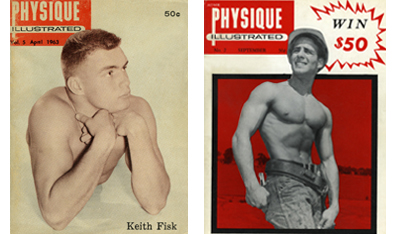
Shot in the ’50s and ’60s, the photography of Alan B. Stone captures men out in nature, showing off their ample muscles and wearing as little as possible. In 2006, it’s obviously intended for a gay audience. But at the time the photos were taken, they were accepted as physique and fitness photography. As a new documentary reveals, these beefcake shots of yesteryear were part of an elaborate code that allowed gay men to communicate with each other at a time when their desire dared not speak its name.
Philip Lewis and Jean-Francois Monette’s Eye on the Guy: Alan B. Stone & the Age of Beefcake traces the life of the male physique photographer, who lived and worked in Montreal until his death in 1992. Stone has gained most of his fame since passing on. The story of how he first got noticed dates back more than two decades.
In the mid-’80s, Thomas Waugh, a film studies professor at Concordia University, began researching the history of gay male erotic photography. He learned that Montreal had a legacy, with artists such as Jimmy Caruso creating and selling a large number of physique photographs. Like Stone’s work, these photos pictured muscular, scantily clad men posing, often in the wilderness. The athletic motifs in the photos enabled them to fly under the radar of censorious police and government authorities, and created a place where gay men could gather around their objects of desire in relative safety.
“I was struck by how ingenious much of Stone’s photography was,” recalls Waugh. “[It] created this sanitized yet prurient image of the male body. The pouches the men were wearing, the coy nods to [homosexuality] — it was all very clever, and was a product of the repression of that time.”
In his research, Waugh found that none of the photos had Stone’s name on them, but rather his company name, Mark One Studio. “That led to a post office box number in upstate New York,” says Waugh, who managed to get the postmaster there to give him Stone’s phone number. “I called up Stone, and we began talking. I told him I was doing research into physique photography, and he agreed to meet.”
The man behind the camera: Alan B. Stone. Courtesy Quebec Gay Archives.
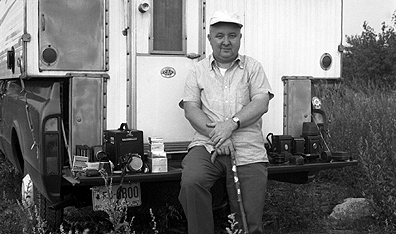
Waugh spoke with Stone a number of times before the photographer’s death. When Stone passed on, his sister arranged for his extensive collection of photography — more than 50,000 negatives — to be donated to the Quebec Gay Archives.
It was here that Montreal filmmaker Philip Lewis, then doing volunteer work for the archives, came across Stone’s images. Says Lewis: “As I looked at more of his work, I became astonished at his range, not to mention how prolific he was with his camera. He had also taken quite a bit of 8-mm film footage of some of his photo shoots. His story was begging for documentary treatment.” Lewis contacted Jean-Francois Monette, a Montreal director with some documentary experience (Anatomy of Desire) and the two began delving into Stones’s life and legacy.
Co-written by Quebec Gay Archives co-founder Ross Higgins, Eye on the Guy details the covert life of a man who, through his work, provided a visual outlet for gay men, the vast majority of whom must have been closeted.
“When looking through all of these shots, I came to respect Stone a great deal,” says Lewis. “He did all of this from the basement of his suburban, Montreal West Island home. His work speaks volumes about cultural history and gay history, but it also stands as exquisite art.”
In Stone’s heyday, he was part of an international photography underground, in which photographers communicated with a growing gay consumer base through physique photography. Stone would recruit models, shoot them in a natural setting — the beach, the woods, tall grass — and then sell the pictures via mail-order ads in magazines. This system allowed Stone’s customers to remain completely anonymous. After receiving their money, Stone would send out his wares in brown, unmarked envelopes.
“There’s a real tendency to think that all contemporary gay culture began with Stonewall,” Lewis says, referring to the 1969 New York City riots in which gay men and lesbians fought back against police harassment. Many people cite them as the launch of contemporary gay liberation. “But the kind of photography that Stone mastered paved the way for gay liberation. With this photography came a market and with that an identity. Our generation doesn’t even think about it, we take it for granted. Many see the ’60s as the time when things began to shift, but things actually began earlier, and Stone’s photos from the ’50s are evidence of that.”
Part of Lewis and Monette’s research meant tracking down a number of Stone’s original models. “That was just incredible,” says Lewis. “We found five of them, and all were willing to be interviewed for the film. Most of these men are straight, married, with children. Some of them even said they had no idea the photos were about reaching a gay readership, though some said they knew and didn’t really care.” The documentary cuts between original Stone shots of the models and contemporary photo shoots of the same men taken specifically for the film.
Close friends hint at Stone’s own double life, but say that he was a very secretive man who never discussed his homosexuality. “I think one of the things that evolved for me was my sense of how Stone must have lived his life,” says Lewis. “I thought he must have been very sad, that he must have been stranded somehow as a gay man in a very straight world. But while he did struggle with arthritis, I think Stone did all right. He managed to communicate through his work, while doing it under the radar. I think he was very triumphant in managing to do all of this.”
Eye on the Guy: Alan B. Stone & the Age of Beefcake screens May 3 as part of the Hot Docs Canadian International Documentary Film Festival.
Matthew Hays is a Montreal writer.
 CBC
does not endorse and is not responsible
for the content of external sites
- links will open in new window.
CBC
does not endorse and is not responsible
for the content of external sites
- links will open in new window.
Copyright © 2005 Canadian Broadcasting Corporation - All Rights Reserved
More from this Author
Matthew Hays
- Sick Puppies
- The Omen and film's fascination with demonic children
- Flesh for Fantasy
- A new doc chronicles the life of beefcake photographer Alan B. Stone
- Rocket Launcher
- Roy Dupuis on his astonishing turn as Maurice Richard
- Three's Company
- These Girls, a thinking filmgoer's teen comedy
- The Don of Canfilm
- Film pioneer Don Owen the subject of a new book


