Roy Dupuis hits the ice as Maurice Richard in The Rocket. Courtesy Alliance Atlantis.
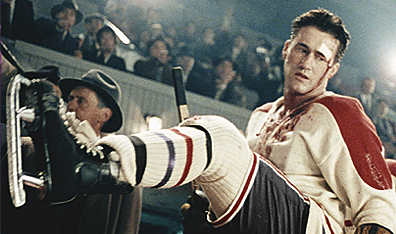
In Charles Binamé’s biopic The Rocket – which opens this week across Canada after already proving a box-office success in its native Quebec – thespian heartthrob Roy Dupuis pulls off an astonishing performance as late hockey legend Maurice Richard. The actor, who lost 20 pounds so that he could play Richard, had done his homework. He has played the hockey legend twice before, first for a TV series and then for a Canadian Heritage Minute. Dupuis actually met the man, and they became friends.
It’s difficult to convey just how significant this casting decision was for Quebec audiences. Richard resonates as a wildly popular athletic folk hero in la belle province. It was here that the Habs star player fought back against anti-French sentiment, proving his incredible prowess on the ice, demanding respect from the rest of the country. In 1955, when Richard was banned from playing by the hockey commissioner, a riot broke out in Montreal outside the Forum; this is still regarded by many as a turning point in Quebec society and the beginning of the Quiet Revolution. Dupuis has also become a symbol of Quebec pride, because of his immense star power and exalted position in the province’s booming film business. He has appeared in everything from Being at Home with Claude to the Oscar-winning Barbarian Invasions.
CBC Arts Online sat down with Dupuis in Montreal to talk about playing a legend.
A: Oh yeah. I’m from a region about 500 kilometres north of Montreal, and that was about all we had to do in the winter – and the summer, come to think of it. I was skating when I was three. I stopped playing hockey when I was about 15.
A: We watched a lot of the old games, watched footage and then tried to be as close to it as possible. We did that for about two weeks prior to shooting. It was historical footage, so we wanted to capture the choreography of the matches as closely as we could. Actually, we did it very well.
A: It’s funny, there’s not much that struck me. He was a very simple guy. When we drove over there to meet him, the first time I ever played him in a TV series, the producer told me that Maurice didn’t talk a lot. But something clicked, and then we talked for two hours, non-stop. After that shoot we became friends. When you have to portray someone, and you have access to them, and this person opens up to you, there’s an intimacy that happens. It was a special bond between me and Maurice.
A: Never. The main thing for me was to figure out how to grasp the energy of this man. I never wanted to do an imitation of him. I thought that the best way to be true to someone is to start from inside. I grasped him pretty quickly. In some respects, he was a simple, straightforward guy. He reminded me a lot of my father, actually. My father played a lot of hockey, and he was poor. He had to stop playing hockey because his father wanted him to go play in the mines. There was something of Maurice that I understood because he was like my father.
A: Very important. You can’t really tell the story of Maurice Richard without discussing what he meant to French Canadians, and what he became. It’s what makes this character worth being on the big screen for me. We make movies about athletes, but when you have a chance to make a film that has a social meaning, it brings a lot more depth to the story.
A: I don’t know. (Laughs) What we’ve heard is that the response has been terrific. The reason why they are doing such a huge release and put the push on distribution, is because they had test screenings throughout the rest of Canada and it scored incredibly well – as good or better than most Hollywood films. On average people were giving it a nine out of 10. So that’s why there’s such a push for the film now. So the reception has already been very good. What I think is interesting about this film is that because of the social and political end of it, it becomes a historical film. It’s as much an English-Canadian historical movie as it is a French-Canadian historical movie. It’s as much about your story as it is about mine. And that’s the way people are seeing it, at least that’s what people have told me. Some have said it’s the best Canadian movie they’ve ever seen.
A: People say they don’t recognize me in the movie. They say they just see Maurice. And I’m talking about Quebecers, who know me pretty well. And his children said the same thing. They said to me that they saw their father. It was touching. I was close to this man, and when someone you know well dies, they become close to you in a certain way. They’re no longer there, they’re just inside of you. I wanted this movie to give him justice, to be true to him. That was very important.
A: Yes, but I like it. I come from the woods – a very small community. What surprised me when I first arrived in Montreal was how anonymous you could be. It’s not like that in a small town. Everyone knows who you are and your business. You know everyone. You can’t just say or do what you want. In a big city you have a certain freedom. You can say what you want to the person next to you, and you may never see them again. I lost that freedom. That’s one thing I lost with the fame. It feels good when I travel and can go somewhere where I don’t feel like I’m being watched at all times. That tends to make me feel like I’m onstage at all times.
A: Pride. Pride and knowledge of where it is we came from.
The Rocket opens across Canada April 21.
Matthew Hays is a Montreal writer.
 CBC
does not endorse and is not responsible
for the content of external sites
- links will open in new window.
CBC
does not endorse and is not responsible
for the content of external sites
- links will open in new window.
Copyright © 2005 Canadian Broadcasting Corporation - All Rights Reserved
Related
More from this Author
Matthew Hays
- Sick Puppies
- The Omen and film's fascination with demonic children
- Flesh for Fantasy
- A new doc chronicles the life of beefcake photographer Alan B. Stone
- Rocket Launcher
- Roy Dupuis on his astonishing turn as Maurice Richard
- Three's Company
- These Girls, a thinking filmgoer's teen comedy
- The Don of Canfilm
- Film pioneer Don Owen the subject of a new book


