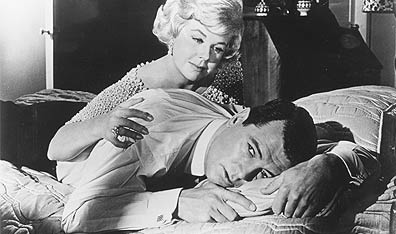
You're hiding something: Doris Day tries to figure out Rock Hudson in the 1961 film Lover Come Back. Photo Evening Standard/Getty Images.
When Ang Lee’s latest film, Brokeback Mountain, did the festival circuit in the fall, it was greeted with warm critical and audience responses, won the top prize at Venice and was declared a cinematic breakthrough. The film — which opens Dec. 16 — involves two cowboys, played by rising stars Jake Gyllenhaal and Heath Ledger, who meet and fall in love in the 1960s. Despite their passionate romance, one that continues clandestinely over decades, they are never able to live together as a gay couple might do today. The social taboo surrounding homosexuality, the film tells us, is all that stands between them and their honest and innocent pursuit of happiness.
Brokeback Mountain is a testimony to the huge advances gays have made in terms of their representation on the big screen. It is a beautifully shot, studio-backed film featuring two bankable stars, directed by an Oscar-winning director, with a same-sex romance as its central focus. But these changes have not come easily.
In 1981, New York film critic Vito Russo penned the first edition of The Celluloid Closet, a diatribe in which he argued that the powers-that-be in Tinseltown had long supported anti-gay attitudes by infusing American movies with injurious stereotypes about the lives of gays and lesbians. Gays were too often sidekicks and the brunt of bad jokes, Russo argued, chastising closeted Hollywood gays for not pushing the issue further. Most striking was the book’s concluding section, “Necrology,” in which Russo tallied a list of movies in which gay and lesbian characters met their untimely ends via suicide, mutilation, skewering or gunfire.
“Hollywood is too busy making old formulas hit the jackpot again to see the future,” Russo stated in his final sentences of the book. “Hollywood is yesterday, forever catching up tomorrow with what’s happening today. This will change only when it becomes financially profitable, and reality will never be profitable until society overcomes its fear and hatred of difference and begins to see that we’re all in this together.”
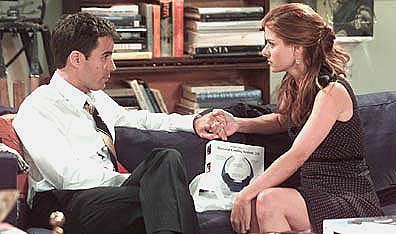
Many of Russo’s dreams have been realized since his death in 1990. With a general demystification of homosexuality in Western culture has come a shift in Hollywood casting calls. Now, heterosexual actors are no longer afraid to take on gay roles for fear of being identified as gay themselves. This has brought major star power to gay characters and issues that affect them. In Philadelphia (1994), Tom Hanks played a corporate banker who loses his job when his employers learn he has AIDS. He won an Oscar for his role, seen as doubly courageous given the character’s sexual orientation and illness. In 2003, Charlize Theron won the Oscar courage sweepstakes for her role in Monster, portraying a homely, serial-killing lesbian prostitute. It seems a fait accompli that Philip Seymour Hoffman will get an Oscar nomination for his portrayal of gay scribe Truman Capote. On television, meanwhile, Eric McCormack has won an Emmy for his ongoing role in the long-running sitcom Will & Grace.
I am not a homosexual, but I play one on TV: Eric McCormack as Will Truman and Debra Messing as Grace Adler on TV's Will and Grace. Photo Chris Haston. Courtesy Global Television.
These roles, considered breakthroughs in their own way, have something in common: the characters are all played by heterosexual actors. All of these portrayals have been accompanied by media fanfare and publicity. In interviews, the actors were always careful to emphasize that they are heterosexual. Indeed, it could be argued that their ability to muster widespread audience sympathy and empathy seems to be predicated on the fact that they’re only playing gay. Despite this so-called progress, when an actor plays a serial killer, they are never asked about their reluctance to take on the role. When an actor plays gay, the possible-reluctance question is obligatory.
If dramatic gay and lesbian representations have shifted radically in the past two decades, the change for gay actors is starkly unmoved by comparison. Various thespians have come out, but the idea of a leading actor — male or female — being openly gay remains out of the question. A number of British actors have come forward, notably Sir Ian McKellen and Rupert Everett, and Nathan Lane and Harvey Fierstein have given a number of supporting-role performances in Hollywood features. Ellen DeGeneres and Rosie O’Donnell have famously come out, but are now thought of primarily as talk-show hosts.
But little has shifted for the A-list acting club since Rock Hudson succumbed to AIDS 20 years ago. The damage such widespread knowledge could do to an actor was reinforced in 2001, when Tom Cruise sued a French tabloid for $10 million US over a fallacious story about the actor’s affair with a French porn star. Cruise’s lawyer, Bert Fields, pointed out in his legal brief that the mere perception that Cruise might be gay — and he is not, Fields repeated — could seriously damage Cruise’s ability to command multi-million-dollar film roles. In fact, much of the damage, Fields inferred, had already been done. “It’s something that will be there forever,” he said. The tabloid printed a full retraction and an apology.
The issue of closeted actors is something San Francisco-based author and screenwriter Armistead Maupin has dealt with in his own work. The author of the hugely popular newspaper serial-cum-book series Tales of the City, Maupin is a hero within the gay community for championing sexual honesty above all else. In 1995, when filmmakers chose to make a feature-length documentary version of Russo’s book The Celluloid Closet, they hired Maupin to write the narration. When the film was released, however, Maupin distanced himself from the project, slighting the film’s narrator, Lily Tomlin, for not being more forthcoming about her lesbianism. (Tomlin has since come out of the closet.)
“If Vito could see this now,” Maupin said at the time, “he’d be very upset. Having a closeted person involved with this project runs counter to everything Vito Russo stood for: openness and honesty, and an end to the celluloid closet he wrote about so passionately.”
In speeches and articles, Maupin frequently refers to the massive successes of the gay and lesbian liberation movement, a phrase that now seems almost quaint. But for all the discussion of evolving attitudes, he acknowledges little has changed for a new generation of A-list actors.
“Unfortunately, that closet hasn’t really vanished at all,” Maupin told me recently. “It’s simply more sophisticated than it was in the past. Rock Hudson could rely on the fact that the local press wouldn’t run with a story about him being seen with another man. Now, gay superstars are required to get married, have children or adopt them and be very discreet about that trainer who travels with them.”
At a time when black actors fought for better roles, the point was often made that Hollywood is about green, not black and white. According to Maupin, the question for gay actors boils down to the same thing: economics.
“It’s about money and the continuing perception that actors will lose money for their agents if they come out. And that may be true, but it won’t change until there’s honesty. I have more admiration than ever for people like Ian McKellan and Rupert Everett, who’ve come forward, been honest and are still pursuing their careers.”
That’s two British actors who’ve come out. Where’s the American leading man?
Maupin sighs. “You’re right: there isn’t one.”
Matthew Hays is a writer based in Montreal.Copyright © 2005 Canadian Broadcasting Corporation - All Rights Reserved
More from this Author
Matthew Hays
- Sick Puppies
- The Omen and film's fascination with demonic children
- Flesh for Fantasy
- A new doc chronicles the life of beefcake photographer Alan B. Stone
- Rocket Launcher
- Roy Dupuis on his astonishing turn as Maurice Richard
- Three's Company
- These Girls, a thinking filmgoer's teen comedy
- The Don of Canfilm
- Film pioneer Don Owen the subject of a new book


