Documentary filmmaker Albert Maysles. Photo Kendall Messick. Courtesy Maysles Films Inc.
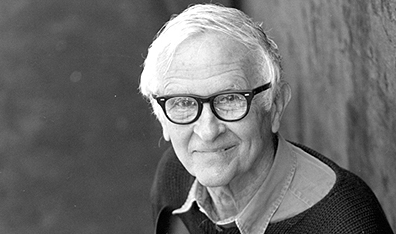
Forty-five years ago, a young Albert Maysles scored one of his first film gigs as a cameraman. Using 16-mm camera equipment, Maysles followed around John F. Kennedy as the charismatic young politician ran successfully for the U.S. presidency. The film, Primary, directed by Robert Drew, would become a landmark documentary, capturing what appeared to be unrehearsed moments in the campaign and allowing the audience a unique sense of intimacy with JFK and his wife, Jacqueline.
Albert and his brother David would go on to become one of the most accomplished filmmaking teams in history, true pioneers of “direct cinema” — the ’60s documentary movement that rejected authoritative narrative voiceovers and interviewer questions.
The Maysles Brothers’ body of work is staggering; they profiled the famous actor in Meet Marlon Brando (1966), chatted up the author in A Visit with Truman Capote (1966) and chronicled the Fab Four’s taking of America in What’s Happening! The Beatles in the U.S.A. (1964).
But their greatest achievements came in a triptych of films that offer a surreal glimpse into the lives of their respective subjects. In 1969, they released Salesman, a bruising documentary about the desperate lives of a group of salesmen who sell bibles door to door. In 1970, the Maysles delivered Gimme Shelter, their unblinking look at the Rolling Stones concert at Altamont, at which a young man was stabbed to death by Hells Angels bikers. And in 1975, the filmmakers found two relatives of Jacqueline Onassis, a mother and daughter who lived in a dilapidated mansion called Grey Gardens in the East Hamptons. Grey Gardens captured the tortured relationship this octogenarian mother shared with her schizophrenic daughter. The film has since become a lightning rod for critics who charge it represents the very essence of documentary exploitation.
David Maysles died in 1987, but Albert has continued to create documentaries, following the projects of the artist Christo in a series of films (he just finished editing a feature on the Gates in Central Park), and is now putting the final touches on The Jew on Trial, his film about the infamous trial of Mendel Beilis, a man accused of blood libel in Kiev and acquitted in 1913. This weekend, Maysles will be venturing to Montreal to hold a master class at the city’s Jewish Film Festival. He spoke with me from his New York office.
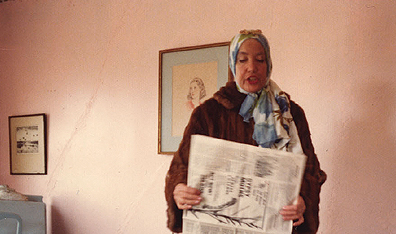
A scene from the documentary film Grey Gardens. Courtesy The Criterion Collection.
Q: Do you ever look back on a film and wish that some of what you’d left on the cutting room floor had made it into the final cut?
A: It’s funny, because just the other day I was looking at some of the outs from Grey Gardens. I came across a 10-minute piece of Edie talking about schizophrenia, and it’s just amazing. She had such a clear understanding of how it was that she wasn’t schizophrenic. It just didn’t work for the film. The film was so well edited that I can’t really fault it. I’m going to put a piece of that in the DVD scrapbook that we’re making for that film.
A: I guess it’s just if there’s something going on in their life. With Grey Gardens, there was definitely something going on in their lives (laughs). With Salesman, as it turns out with so many works of art, you find out before or after, that there was something about yourself that the project illuminates — that there was something about yourself in it. With Salesman, my brother and I both sold stuff door to door. There was a great deal of anti-Semitism back then. When we were kids, hardly a day would go by when an Irish kid wouldn’t come up to us and say, “I’ll meet you outside.” This meant a fight. I got to be pretty good with my fists! But I really wanted to be friends. This was a way of finally getting to know some Irish guys. Paul, the central figure in the film, really had a lot in common with our father. My father could have been a musician, and Paul could have been something much more fulfilling than a door-to-door bible salesman.
A: No. Whatever intimacy we had with the women in Grey Gardens only helped to create a rapport. We wouldn’t have gotten the access we did without that. If Fred Wiseman had that idea then he never would have gone as far as we did with those women.
A: My first thought is that they identify with people who are also outsiders. These women are total outsiders, and they’ve chosen to be, but with this weird kind of paradox. But they also became these ultimate insiders because they got to be in the film. So how did they do that? Outsiders often want desperately to be insiders. The women in Grey Gardens got both. I suppose that’s true of homosexuals: they would like to be accepted for who they are, but maintain their individuality.
A: It’s sort of a yes and no answer. The first film my brother and I ever made was called Showman. It’s about a man called Joseph Levine, who was a film distributor, and during the course of filming he became a film producer as well. He was brought up at an earlier time in Boston, when there was even more anti-Semitism there. When people in Hollywood saw the film, they thought that he was such a stereotypical Jew that they thought the film was anti-Semitic. He heard this from so many people that it really left an impression. But he really didn’t know if he should have done the film. There’s this weird thing, Freud would call it identification with the aggressor. On an unconscious level at least, you begin to think the charges against you as a Jew are true. I think this was the case with Joseph, I think he felt like he was a businessman, a fat little Jew, he talked with his hands. The anti-Semitism really got worked into him. He could never make up his mind about the film we did on him. He liked us very much. Several years after the film he showed us a painting someone had done of him, and he felt that the painter had made him look bad because he was Jewish. Andrew Wyeth was the painter. Joseph was quite disturbed by it. But I don’t think that was the case, Joseph was just nervous that way.
A: I’ve actually been a big critic of his, and even before seeing his work, which really isn’t fair. Then I saw Fahrenheit 9/11, and I thought it was rather good. There are a couple of things in it that are characteristic of his excesses. I thought it was unfair to watch Bush as he heard of the attacks on 9/11, as if to say that he wasn’t responding, but who knows what was going on in his mind? But I thought as a piece of propaganda it worked. I thought it did more good than harm.
A: That I disapprove of entirely. He has made the statement that he doesn’t have to go out and get people, that they’ll do it to themselves. Well, what an attitude to take to the people you’re filming. I wouldn’t go with that at all. He’s unfair. He’s not looking to discover what’s going on, he’s only looking for those things that will prove his point.
Q: There’s such a debate about finding an essential truth to a subject. Do you think documentary filmmakers can really capture a truth with their work?
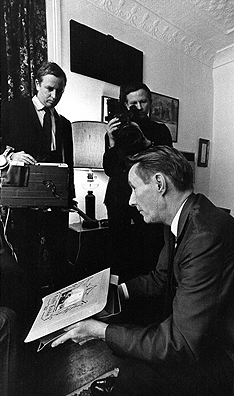
Documentary filmmakers David and Albert Maysles with bible seller Paul Brennan in Salesman. Courtesy Maysles Films Inc.
A: My films are over 30 years old, and I think they hold up as true. What makes it confusing is that two very good filmmakers in exactly the same place at exactly the same time will come up with a somewhat different film, or a very different film. And that would seem to suggest that there’s no essential truth. But each one of those films can be an essential part of the truth. I don’t think anyone can claim that they’re telling the whole truth. That’s too big a job. What you do put forth in the context that you provide for it, can be truthful. If I thought otherwise, I wouldn’t be doing what I’m doing. What’s great about a really great documentary is that it gives us some essential knowledge.
A: I watched one episode of The Osbournes. That was enough for me. Too much swearing and not enough of what I think makes a good documentary. A lot of what the media focuses on today is so negative: miserable relationships and that sort of thing. There’s not even a language to describe anything positive. It seems that we can say how things went badly, but we can’t say that they went goodly [laughs].
A: Compare them with the neighbours. They were outstanding for having stayed together, there was a tremendous love there. These people stuck it out. We’re having a lot of fun putting together this scrapbook of the film.
The Montreal Jewish Film Festival screens May 10-19.
Albert Maysles presents his Master Class at Montreal’s NFB Cinema at 3:30 p.m. Sunday, May 15. Info: www.mjff.qc.ca
 CBC
does not endorse and is not responsible
for the content of external sites
- links will open in new window.
CBC
does not endorse and is not responsible
for the content of external sites
- links will open in new window.
Copyright © 2005 Canadian Broadcasting Corporation - All Rights Reserved
More from this Author
Matthew Hays
- Sick Puppies
- The Omen and film's fascination with demonic children
- Flesh for Fantasy
- A new doc chronicles the life of beefcake photographer Alan B. Stone
- Rocket Launcher
- Roy Dupuis on his astonishing turn as Maurice Richard
- Three's Company
- These Girls, a thinking filmgoer's teen comedy
- The Don of Canfilm
- Film pioneer Don Owen the subject of a new book


