PHOTO ESSAY
Bring the Noise
The evolution of portable audio
By Matthew McKinnon


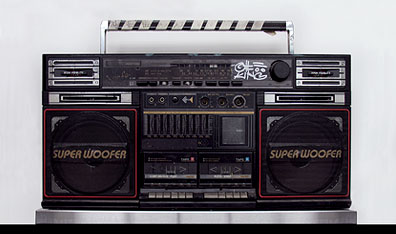 Photo by open.inc |
The boombox, 1976-1980
“Because the streets are alive with the sound of boom! Bap! / Can I hear it once again? / Boom bap tell a neighbour tell a friend / Every box got a right to be boomin’” — Michael Franti and Spearhead, Stay Human (All the Freaky People)
Hip-hop is born in the Bronx in the mid-’70s, a culture built on the four pillars of DJing (mixing records), MCing (rapping), tagging (writing graffiti) and b-boying (breakdancing). Around the same time, Panasonic, Sony, Marantz and GE introduce “personal stereos” — i.e. boomboxes. The machines offer cassette decks, AM/FM tuners, loud speakers, stereo sound and, in ideal cases, input and output jacks for connecting microphones and turntables. They function as mobile public-address systems, converting any park, corner or kitchen to instant dance floor.
The boombox, carried above the shoulder, blaring Afrika Bambaataa, Blondie, Grandmaster Flash and the Furious Five, is the soulsonic force that spreads hip-hop’s message to every inner city. Detractors rechristen it the ghetto blaster, a name intended to degrade the device and its devotees; most of the latter shrug, push the volume to 11, and keep the party popping.

More from this Author
Matthew McKinnon
- The Smackdown
- This week: Is U2 over?
- Can't Stop, Won't Stop
- The unretirement of Jay-Z
- Twos of a Kind
- François Brunelle’s look-alike portraits
- Behind the Music, Y'all
- Kevin Federline's Playing with Fire: the liner notes
- See No Ego
- A doc reveals the amazing story of the blind mountaineers of Tibet